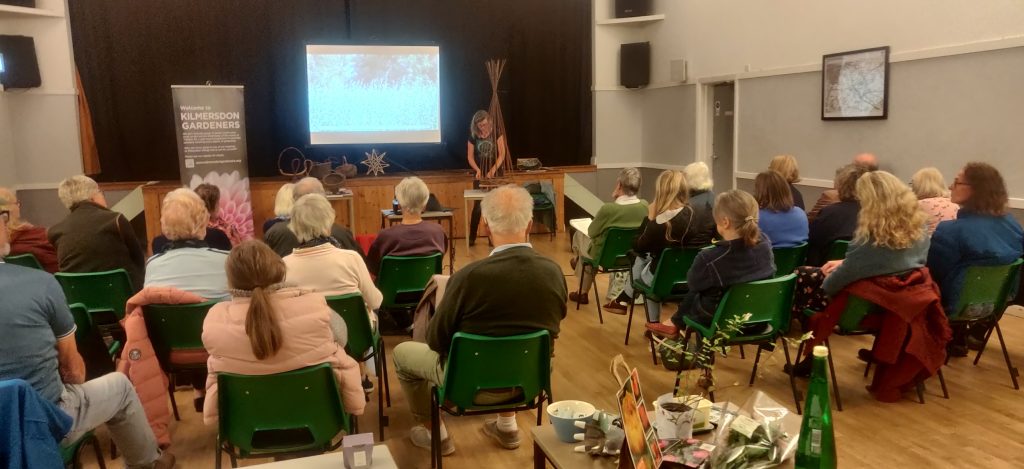
 From the willow beds of Somerset to sculptures, living structures and natural burials, one craftswoman reveals the extraordinary versatility of a plant that has served humanity for thousands of years. A summary of a talk at the Village Hall, Kilmersdon on Wednesday 14th October 2026
There are some subjects which, at first glance, seem rather ordinary, but which reveal an unexpected richness when explored by someone who genuinely loves them. Willow is one such subject. To most of us it is a familiar tree growing beside rivers and streams, perhaps associated with basket-making or the graceful branches of a weeping willow. Yet, as willow artist and craftswoman Mary Cross demonstrated in a fascinating and wide-ranging presentation, this remarkable plant has a history and versatility that few of us fully appreciate.
Mary began with a quotation from the naturalist David Bellamy, taken from the foreword to Willow, a book by Somerset artist Kate Lynch. It contained a wonderful collection of traditional willow-working expressions, including terms such as mooring out, slewing a hurdle and three-rod wale. These were the words of generations of craftsmen, passed down through the willow-growing communities of the Somerset Levels.
Many such expressions have disappeared from everyday speech, but Mary was delighted to point out that she still uses most of them in her own work. There is, she believes, something of a willow revival taking place, and with it an opportunity to preserve both the skills and the language of an ancient rural industry.
A Plant of Remarkable Qualities
Willow belongs to the botanical genus Salix, which includes more than 400 species. For basket-making, particular varieties have been cultivated for their flexibility, strength, colour and growth characteristics. Some produce long, vigorous rods suitable for structural work, while others grow more slowly and yield the finer, tougher material required for delicate baskets.
Mary spoke affectionately of the different varieties, almost as though they were old acquaintances. Some were reliable workhorses, while others could be decidedly temperamental. As she observed, willow is an organic material, and sometimes it behaves beautifully, while at other times it refuses to cooperate.
One of its greatest virtues is its ability to regenerate. Willow grows readily from cuttings, and established plants can be harvested year after year without being destroyed. Under suitable conditions, a willow stool may remain productive for several decades.
Mary has established her own willow bed at Midford, just south of Bath, planting around 600 cuttings of six different varieties. Her enthusiasm was evident as she described their progress, although the first year brought an unexpected setback.
Deer discovered the young plants and promptly helped themselves. A camera revealed that one visiting mother had even brought her two youngsters along to enjoy the feast. Mary subsequently installed higher fencing, and the plants have recovered remarkably well. She suspects that their initial lack of growth above ground may actually have encouraged the development of stronger roots.
Willow is planted closely together so that the rods compete for light, growing upwards rather than producing numerous side branches. Each winter the new growth is cut back, ready for another season.
The colours of freshly grown willow are particularly striking. Reds, greens, yellows and browns occur naturally, often with a brilliance that fades as the wood ages. It is another reminder that nature frequently produces effects which no artificial colouring could improve upon.
Somerset and the Willow Industry
The Somerset Levels have long been an important centre of commercial willow production. The damp, peaty soil provides ideal growing conditions, and several of the country’s leading growers operate within a relatively small area.
Mary mentioned Musgrove Willows, Coates English Willow and Somerset Willow Growers, all of which contribute to maintaining this traditional industry.
Although modern machinery is used for harvesting, much of the subsequent work still depends upon human skill and judgement. Willow rods must be dried carefully, sorted according to length and prepared for their eventual purpose.
Too much drying makes them brittle; too little encourages mould. Timing is everything.
Mary explained the differences between green willow, brown willow, semi-dry willow, buff willow, white willow and steamed willow. Each has its own characteristics and uses.
Buff willow, familiar from traditional wicker baskets, acquires its warm honey colour when the rods are boiled with their bark still attached, allowing natural tannins to penetrate the wood. White willow is produced by removing the bark while the rods are still alive and the sap is rising, a labour-intensive process which must be completed quickly.
Mary described the urgency of this seasonal operation, traditionally known as doing the whites. Workers must strip and dry the rods within a narrow window of opportunity, often taking advantage of a sunny, windy day.
It was fascinating to discover how much knowledge and practical experience lies behind something as apparently simple as a basket.
From Ancient Medicine to Aspirin
Willow has also played a significant part in the history of medicine.
For centuries, preparations made from willow bark and leaves were used to relieve pain and fever. References to their medicinal properties can be found in ancient cultures, including Greece and the Middle East.
The connection arises from compounds in willow associated with salicylic acid, which eventually contributed to the development of modern aspirin. The familiar medicine was marketed by Bayer at the end of the nineteenth century.
Mary also mentioned willow’s place among the Bach flower remedies, where it is traditionally associated with feelings of bitterness and resentment.
Another intriguing possibility is the use of willow bark preparations to encourage rooting in plant cuttings. Mary described the traditional practice of steeping chopped willow in water and using the resulting liquid as a rooting aid. She also mentioned claims that it may help protect young seedlings against certain diseases, although she readily admitted that she had not yet tested these ideas herself.
It was one of several moments when her curiosity was as evident as her knowledge.
Willow Through the Ages
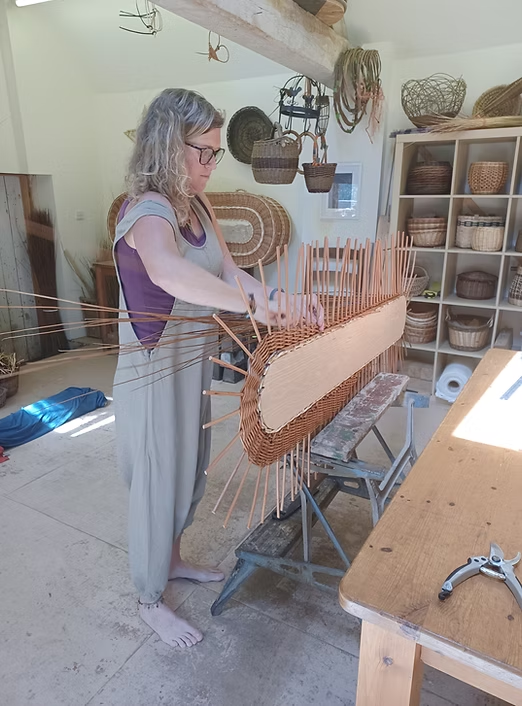 The historical uses of willow are almost endless.
Its flexibility and toughness made it valuable for fishing traps, coracles, agricultural equipment and countless household objects. Mary showed examples of traditional fishing structures from the Severn Estuary and explained how their construction closely resembled techniques still used for garden supports today.
During the First World War, willow became an important material for military equipment. Baskets were used to transport ammunition and other supplies, while specially constructed containers carried messenger pigeons.
The material’s ability to absorb shocks without breaking made it particularly useful. Willow workers were considered so important to the war effort that some were exempted from military service.
Mary had discovered much of this history through Kate Lynch’s book while preparing a workshop for schoolchildren commemorating the end of the war.
Other uses include cricket bats, artists’ charcoal and the production of biomass fuel. Willow’s rapid growth makes it attractive as a renewable resource, while living willow can be woven into riverbank structures to help prevent erosion and provide habitats for wildlife.
It is difficult to think of many other plants that have contributed so widely to human activity.
When Willow Becomes Art
The second half of Mary’s presentation became increasingly personal as she described the projects which have shaped her career.
Her first ambitious sculpture was a giraffe. Having been asked to produce a life-sized example, she sensibly decided to attend a course and experiment before undertaking the commission. The result, which she described as a full-sized baby giraffe, was sufficiently successful to encourage further work.
Other commissions followed, including large animal sculptures, decorative installations, garden structures and school projects.
One particularly memorable experience involved creating a willow horse for a Druid camp. The sculpture developed the elongated shape associated with Britain’s ancient white horses and was intended to be burned ceremonially at the end of the gathering.
Participants placed written messages inside the horse before it was lifted onto a funeral pyre. After some discussion about who should light it, the landowner fired a flaming arrow into the structure.
Mary recalled the extraordinary atmosphere of the occasion. Some people wondered how she could bear to see so much work destroyed, but for her the sculpture had been created with that very purpose in mind. Its destruction was part of its meaning.
It was a striking example of how willow can become more than a practical material. It can also provide a focus for symbolism, ceremony and shared experience.
Working with Children and Communities
Mary’s work with schools has been equally varied.
For a production of Into the Woods, she helped children create enormous willow letters which became part of the stage scenery. Another project involved making 200 poppies to commemorate the First World War.
In that instance, she paired older children with younger ones so that each poppy became a joint creation. The arrangement proved so successful that she has continued using the approach in subsequent workshops.
She also described a particularly touching commission at Will’s Woodland in Devon, a charitable retreat established by a father in memory of his young son, who had died from a brain tumour.
The retreat offers families with children undergoing cancer treatment a peaceful place to spend time together. Mary was invited to create a living willow structure consisting of a temple-like space and a connecting tunnel.
She remembered the pleasure of watching young children running through the newly completed tunnel. For her, it was a reminder that even a relatively simple structure can bring considerable happiness.
Living willow has the added advantage of continuing to grow, gradually becoming part of the surrounding landscape. It does, however, require regular maintenance, as Mary discovered when she returned after a couple of years and found that nature had been rather enthusiastically reclaiming her handiwork.
Mary also runs workshops from her premises in Nunney, where small groups can learn to make baskets, plant supports, bird feeders, decorative stars and other objects.
She admitted, with refreshing candour, that she is not particularly good at promoting herself and has little enthusiasm for social media. Instead, she prefers people to approach her directly and arrange workshops according to their interests.
A New Direction – Willow and the End of Life
Perhaps the most moving part of the evening came when Mary described the direction in which her work has increasingly developed.
Over time, she had received requests to make willow objects connected with death and remembrance. One involved creating a simple cradle for a friend’s husband, who was approaching the end of his life.
The man’s wife and son came to work with Mary on the project. They spent the day weaving, talking, laughing, crying and sharing memories.
What might otherwise have been a practical task became something much more profound.
Mary realised how valuable it could be for families to participate in making something for a loved one’s final journey. The physical act of weaving provided an opportunity to remember, reflect and express feelings which might otherwise have remained unspoken.
A later request to make a baby’s coffin was particularly difficult emotionally, but Mary regarded it as an honour to be trusted with such a sensitive commission.
She subsequently undertook specialist training in coffin-making and has increasingly concentrated on producing natural willow coffins, often using the beautiful variations of colour found in untreated willow.
Families can participate in the weaving if they wish, making the coffin a deeply personal creation rather than simply an item purchased from a funeral supplier.
This work has now led to another development: Mary’s involvement in establishing a natural burial meadow at a local site. The project had been operating for about a year at the time of her talk, and she explained that interest was gradually increasing as more people became aware of natural burial as an alternative to conventional funeral arrangements.
There was something especially appropriate about this progression. Willow, a plant which renews itself year after year, had become part of a practice concerned with death, remembrance and returning to the natural world.
An Unexpected Full Circle
Mary ended with a delightful story about the book which had helped inspire her presentation.
Years earlier, a friend had given her Willow by Kate Lynch, and it had proved invaluable when she was researching the history of willow during the First World War.
Some time later, at a local acoustic café in Nunney, she was introduced to a woman who turned out to be Kate Lynch herself.
The two got on extremely well, and during the COVID period Kate contacted Mary about another book, Somerset Portraits and Voices. She wanted to include Mary and her willow work.
Kate visited her workshop, painted her portrait and recorded their conversation. Mary was delighted when she learned that her picture would appear on a postcard, but even more astonished when Kate subsequently decided to put her on the cover of the book.
Thus the artist whose earlier work had helped Mary discover so much about willow had eventually made Mary herself part of the continuing story of Somerset craftsmanship.
It was a particularly satisfying conclusion to the evening.
More Than Basket-Making
What made this presentation so enjoyable was not simply the amount of information it contained, but the affection Mary clearly feels for her material and the people she works with.
Her account moved effortlessly between botany, local history, traditional crafts, personal adventures, schoolchildren, ceremonial sculpture and the deeply human business of preparing for death.
Willow emerged as a material of extraordinary adaptability, capable of becoming something as modest as a bird feeder or as meaningful as a coffin made by grieving relatives.
There was also an important lesson about traditional skills. They need not remain museum exhibits or nostalgic reminders of a vanished rural past. In the hands of imaginative and committed people, they can continue to evolve and find entirely new purposes.
Mary’s journey demonstrates that a craft can begin as an interest, develop into a livelihood and eventually become a way of serving others at some of the most important moments of their lives.
And perhaps that is the most remarkable quality of willow: not simply that it bends without breaking, or that it grows again after being cut, but that it continues to connect people with nature, with history and with one another.
Contact details for Mary – www.organic-matters.co.uk She lives in Nunney, Somerset.
To arrange a visit please contact Mary Cross, Burial Meadow Manager 07899 065364 or 07917 582572 for Organic matters
Burial@thoulstonepark.com or Mary@organic-matters.co.uk
She conducts workshops including making bespoke willow coffins
