I am beginning to crank up the gears on my latest project, and I notice a considerable change in my attitude since my involvement with Chard. On that occasion, I was concerned about how people would respond to my efforts. This time, I am much less concerned. My responsibility is simply to do the best I can. I regard myself rather like an artist, painting a picture not with oils or watercolours, but with words. People will either respond to the finished work or they will not.
Already, at this early stage, I have encountered varying degrees of scepticism, mistrust and an apparent inability to connect with what I am trying to achieve. I have to remind myself that I have been a free agent all my life. I became self-employed at the age of 23, and here I am, nearly sixty years later, still rocking and rolling much as I did in my twenties.
I sometimes sense that the people I approach are looking over their shoulders, as though some invisible authority might be monitoring their responses. There seems to be a reluctance to express themselves freely, even when the subject is something as innocent as improving community life.
This has led me to reflect upon what seems to be a growing atmosphere of fear and distrust in society. Neither is particularly attractive on its own, but when the two combine, the result can be deeply corrosive to human relationships. Fear encourages suspicion, while suspicion reinforces fear. Eventually, even a perfectly genuine offer of assistance may be regarded as something requiring investigation.
Of course, caution is understandable. We live in an age of scams, misleading information, institutional failures and endless warnings about possible dangers. People have good reasons to be careful. But there is an important distinction between exercising sensible judgement and approaching every unfamiliar situation with suspicion.
The Three Fears That Hold People Back
I suspect there are three particular fears at work: the fear of being wrong, the fear of taking responsibility and the fear of disapproval.
The fear of being wrong can make people reluctant to express an opinion or support an unfamiliar idea. It is safer to say nothing than to risk making a judgement that might later prove mistaken. Yet how can anything new develop if we are unwilling to make occasional mistakes? Every worthwhile enterprise involves a degree of uncertainty.
Then there is the fear of taking responsibility. To become involved in something is to risk being asked to do more, to make decisions or perhaps to account for an outcome. For someone already burdened by everyday obligations, this may be an unattractive prospect. It is much easier to remain an observer than to become a participant.
Perhaps most powerful of all is the fear of disapproval. What will other people think? Will colleagues, friends or those in positions of authority approve? Might I be criticised for supporting something that has not received an official blessing?
I sometimes wonder whether this explains the impression I get of people looking over their shoulders. They may not be opposed to an idea at all. They may simply be uncertain whether they are permitted to welcome it.
Having worked independently for so many years, I find this mentality difficult to understand. If I believe something is worthwhile, my natural inclination is to get on with it. I do not feel the need to seek permission merely to have an idea or express enthusiasm for it.
Nevertheless, I must remember that not everyone has enjoyed the freedom of being self-employed for nearly sixty years. Many people have spent their working lives within organisations where decisions are made by others and initiative is not always encouraged.
The Joy of a Spontaneous Response
Fortunately, there are exceptions, and occasionally I receive a response that makes the whole enterprise worthwhile. One correspondent, having read about my new scheme, replied:
“Wow. It was definitely good advice to be sitting down to read your email! What you are aiming to do is amazing for the local community and such a useful tool. I wish you so much success with your venture.”
What a delight to receive such a heartfelt and spontaneous reaction! It gave me genuine joy and renewed my faith in the human condition.
By contrast, yesterday I spoke to someone who, when I explained my idea, scarcely moved a muscle. There was no visible enthusiasm, curiosity or even surprise.
I realised that, having spent most of my life involved in community activities, I tend to assume that everyone instinctively understands their value. Clearly this is not so. For some people, the idea of community life beyond the immediate demands of earning a living and surviving from day to day may seem almost alien.
I must therefore make a conscious effort to be more patient. This is not intended as a criticism of anyone. We all come from different backgrounds, with different experiences and expectations. What seems perfectly natural to one person may be unfamiliar territory to another.
Nor should I assume that every hesitant response is necessarily caused by fear. People may simply be tired, preoccupied, overcommitted or uninterested. Silence does not always signify disapproval.
Why Trust Matters to Community Life
What concerns me most about the combination of fear and distrust is its effect upon community life.
A healthy community depends upon people being willing to take modest risks with one another. Someone must introduce themselves to a stranger, offer assistance, join an unfamiliar group or support an initiative whose outcome cannot be guaranteed.
If everyone waits for absolute certainty, official approval or reassurance from others, very little of consequence will happen.
Fear narrows our horizons, while distrust closes doors that might otherwise lead to friendship, cooperation and discovery.
I sometimes wonder whether we have become so preoccupied with protecting ourselves from disappointment, criticism or exploitation that we are losing some of our capacity for spontaneous human connection.
This is one reason why I am enthusiastic about my new community directory. It is not merely a collection of names, addresses and meeting times. Its wider purpose is to help people discover opportunities for friendship, companionship, voluntary work and participation in local life.
There must be many people who would welcome greater social contact but hesitate to take the first step. They may be newly arrived in the area, recently bereaved, retired or simply uncertain about how to meet others. A friendly, accessible source of information could help remove some of those barriers.
The Freedom to Create
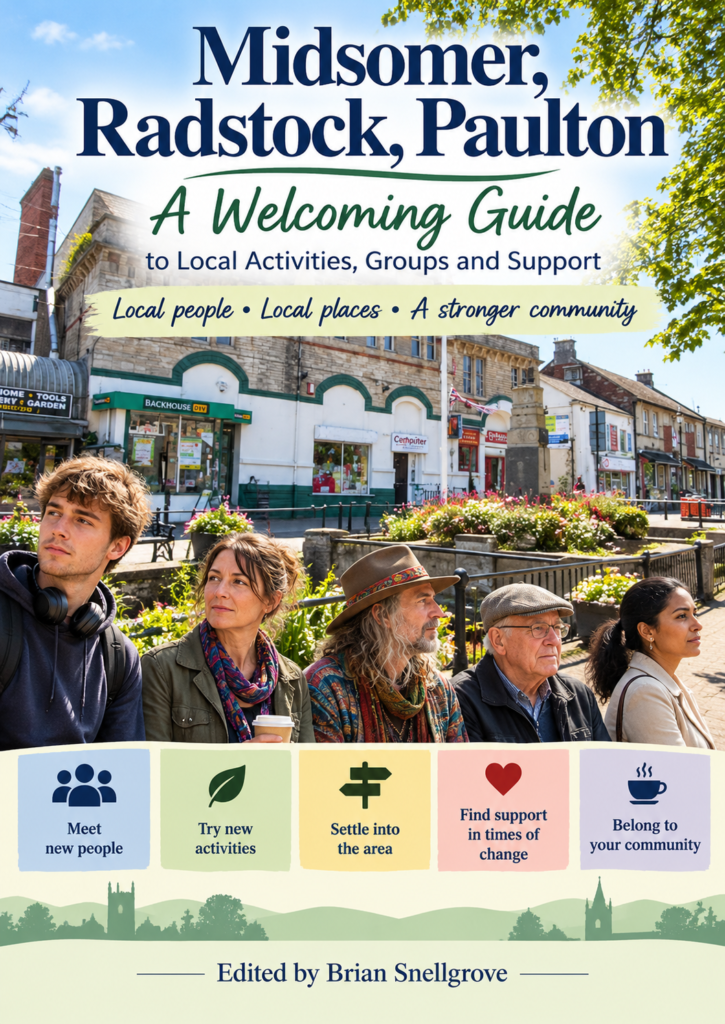
When introducing the project, I usually show people the illustration below, together with copies of my books about Somerset villages and the town of Chard. These provide tangible evidence that I am not simply talking about ideas but have a record of turning them into reality.
My first village book was produced only last year, so I certainly cannot be accused of working at a leisurely pace.
I have always tended to operate at full speed or not at all. Either I travel a hundred miles or I stay at home. I see little attraction in doing things half-heartedly.
What gives me particular satisfaction is that I am not being paid for this undertaking. I am under no obligation to anyone except myself, and I am free to proceed according to my own judgement.
In that sense, the conventional notions of success and failure scarcely apply. I am simply making an effort to contribute something useful to the world around me.
I also recognise that every person I encounter will respond differently. There are as many reactions as there are human beings, and no two people are quite alike. That, of course, is part of what makes the whole exercise so fascinating.
Perhaps the real challenge in an increasingly cautious society is not to eliminate fear, which would be impossible, but to prevent it from governing our relationships.
A society cannot flourish on suspicion alone. Somewhere, someone has to make the first gesture of trust.
An Evening of Conversations
This evening I intend to visit Bath Community Kitchen, which provides a free community meal at the Connections Day Centre in Writhlington.
I shall take the opportunity to talk to as many people as possible, discover what they think about local community life, what they feel is missing, and what forms of social support or activity they would most welcome.
I suspect the conversations will be varied, unpredictable and thoroughly enjoyable.
And, naturally, I shall write about them afterwards.

0 Comments