I had read recently in the Mendip Times that a soup lunch was being held at the Old School House Community Centre in Pensford, and so we thought, why not give it a try? It was advertised as taking place between twelve and two, and it was fortunate that we arrived shortly after twelve, for the room was already almost full.
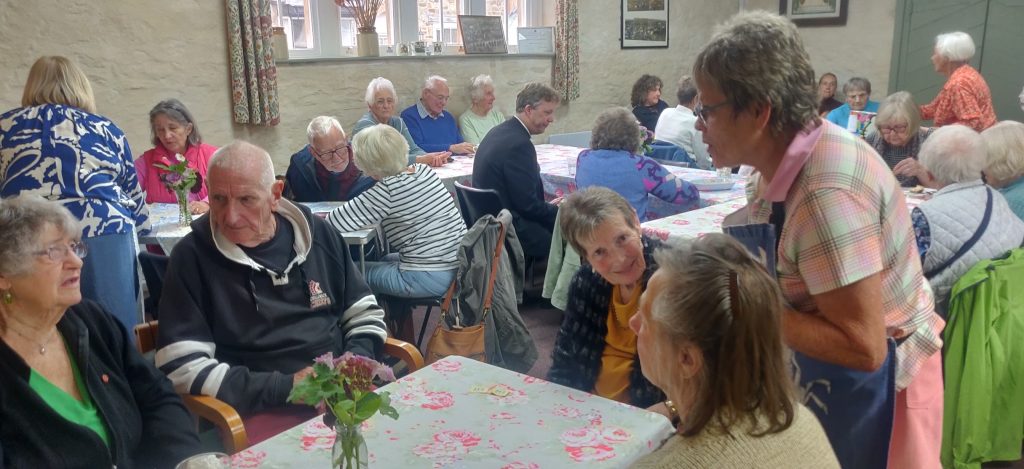
A number of tables and chairs had been arranged for lunch, and we found places at a table where, among our companions, was a Church of England vicar. I discovered him to be the Reverend Richard Greatrex, who told us that he was shortly to take responsibility for five additional churches.
I remarked that my brother, during his time as a priest in Wales, had once had six churches under his care. Richard replied that each of his parishes expected at least two services a month, so a considerable amount of juggling would be required. I replied that I thought things would work out.
Françoise sat beside me and, on her other side, was an elderly lady whose head inclined permanently to one side and who was being attentively cared for by her husband. Opposite me sat a remarkably bright and lively lady of ninety-four, who seemed to possess all the animation of someone many years younger. I joked that I at 82 was a youngster compared with her.
The atmosphere was wonderfully cheerful. Four ladies were busy serving, and there was a choice of three soups: mushroom, tomato, and ham and pea. These came with bread and was followed by tea or coffee. Afterwards there was a raffle, with tickets costing £1 and some eight prizes, all donated by local people. For some reason I was given two jars of instant coffee because the person who donated a tub of coffee gave ‘too much’.
We stayed for about an hour, although we could very easily have remained longer. During the winter months these lunches take place fortnightly, and it struck me as precisely the sort of simple community gathering of which we could do with more. It provides companionship for those who live alone, a welcoming place for people with mental or physical difficulties, and, indeed, for pretty much anyone who feels inclined to come along. There was no sense of exclusivity or ceremony; one simply arrived, sat down, ate, talked and became, for an hour or two, part of the company.
Afterwards we wandered through the adjoining churchyard, enjoying the scenery, before deciding to continue to Stanton Drew to see the ancient stone circles.
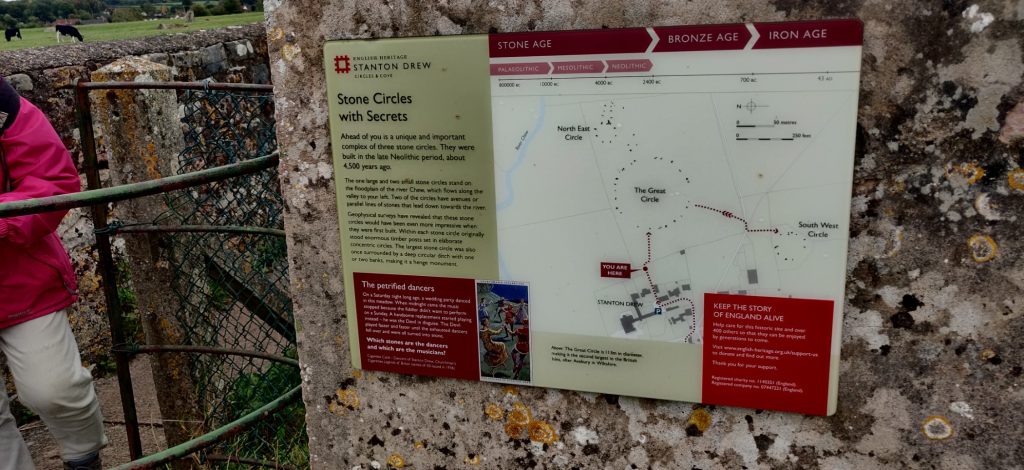
When we arrived, however, we found cattle in the field. I spoke to a woman who was just leaving and asked whether she thought it wise to walk through them to reach the stones. She advised against it. There were calves among the herd, she explained, and the cows might become protective, even aggressive, if they imagined us to be a threat.
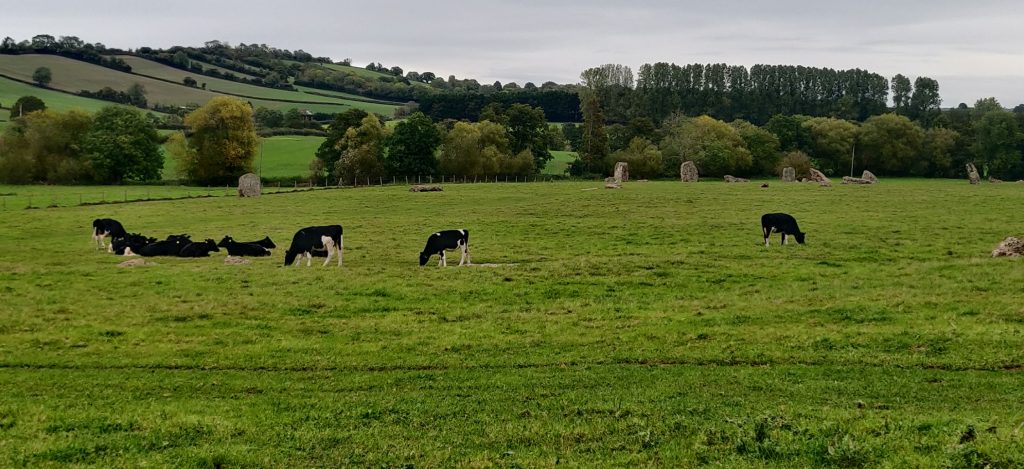
Ancient stones though they were, they were not worth an argument with a field full of protective mothers. We therefore took the prudent course and walked around the field instead. We were joined by a motor cyclist from Derbyshire who wandered nearer the cattle unlike our rather cowardly selves. In the skies to our west the flightpath of planes from Bristol airport made their presence known. The feel at this Bronze Age site was a wonderful combination of wind, sun, moving air, nature
