Chichester – a city of history, art and hospitality
One of the tours included in the price of the JustGo holiday was a visit to a very lively Chichester on market day, a Wednesday, and was immediately struck by the vitality of the city. There is something particularly attractive about an English cathedral city where the activities of everyday life take place against a backdrop of centuries of history. The market traders, the shoppers, the cafés and the ancient buildings all seem to belong together.
Chichester has its origins in Roman Britain, when it was known as Noviomagus Reginorum. The influence of the Romans can still be seen in the layout of the city, with its four principal streets meeting at the magnificent Market Cross, built around 1501. Much of the circuit of the old city walls survives. One of the pleasures of Chichester is its relatively compact size, which enables the visitor to explore much of its history on foot without feeling overwhelmed.
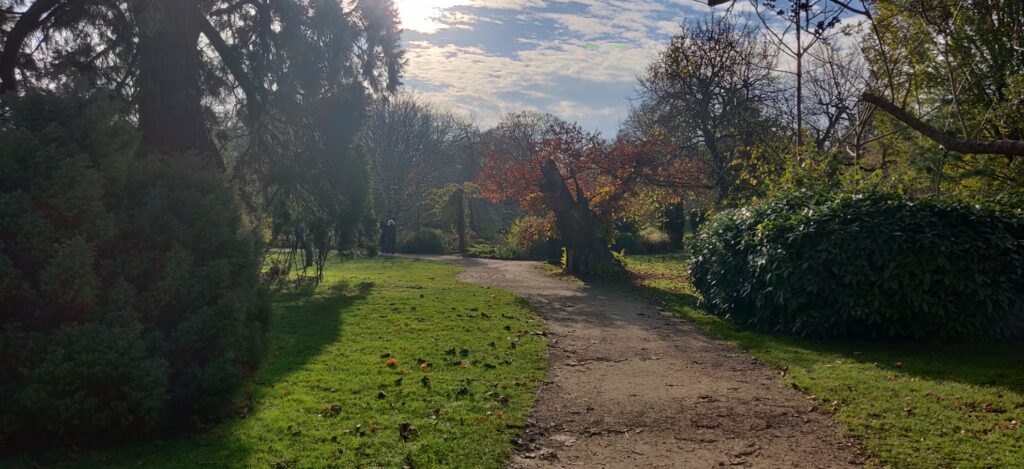
The Bishop’s Garden
The Cathedral and its turbulent history
The cathedral itself captivated me. Its origins go back to AD 681, when St Wilfrid founded a monastery at Selsey. Following the Norman Conquest, the bishopric was transferred to Chichester, and construction of the present cathedral began in 1075. It was consecrated in 1108. Two devastating fires during the following century necessitated considerable rebuilding, which explains the interesting mixture of Norman and Gothic architecture that we see today.
One of the most significant personalities in the Cathedral’s history was St Richard of Chichester, who served as bishop from 1245 until his death in 1253. Renowned for his piety and concern for the poor, he was subsequently canonised, and his shrine became a popular destination for pilgrims. Sadly, it was destroyed in 1538 during the Reformation under Henry VIII.
Chichester Cathedral was extensively vandalised in December 1642, during the English Civil War, by Parliamentary soldiers under the command of Sir William Waller. Following the surrender of the Royalist defenders, the troops plundered and desecrated the Cathedral. Much of the destruction was associated with Puritan opposition to religious imagery and elaborate decoration. Although such acts are popularly attributed to Oliver Cromwell, it was Waller’s troops who were responsible at Chichester.
Another dramatic event occurred in 1861 when the central tower and spire collapsed. Remarkably, nobody was killed or injured. The distinguished Victorian architect Sir George Gilbert Scott supervised the rebuilding, and the cathedral fully reopened in 1866. Another unusual architectural feature is its detached mediaeval bell tower, a rarity among English cathedrals.
A living cathedral – not a museum
I was extremely impressed by the warmth of the welcome and particularly by the fact that the Dean himself was on duty, available to answer whatever questions members of the public cared to ask. There is something very encouraging about meeting a senior member of the clergy who is approachable and prepared to engage with ordinary people. It sends out a much more powerful message of welcome than any number of notices or mission statements.
The Cathedral has produced a very helpful 21-point guide which directs visitors towards its numerous paintings, sculptures, tapestries, stained-glass windows and architectural features. What distinguishes Chichester from many other cathedrals is its willingness to embrace contemporary art alongside its mediaeval treasures.
 Much of the credit must go to Walter Hussey, Dean of Chichester from 1955 to 1977, who believed that the creative talents of contemporary artists should be employed in the service of Christianity.
One of the outstanding examples is the beautifully coloured stained-glass window designed by the Russian-born French Jewish artist Marc Chagall (1887–1985). Installed in 1978, it takes its inspiration from Psalm 150, traditionally associated with the Psalms of David.
The underlying theme is that of praising God through music, artistic expression and the sheer joy of being alive. The concluding words of the psalm are particularly appropriate:
Let everything that hath breath praise the Lord.
I find it particularly encouraging that a Jewish artist should have been invited to contribute something of such spiritual significance to a Christian cathedral. Surely artistic inspiration and the recognition of the divine need not be confined within denominational boundaries.
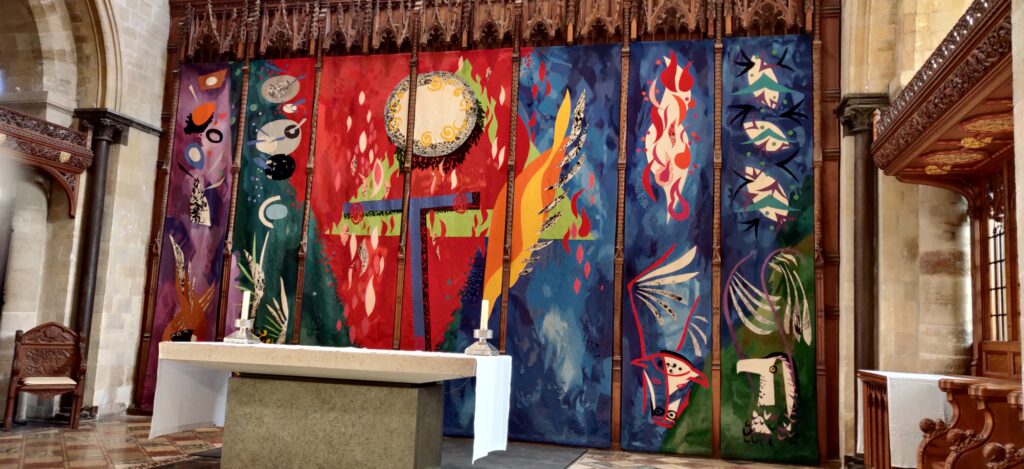
The magnificent tapestry behind the High Altar was created by the British artist John Piper and installed in 1966. Comprising seven panels, each five metres high, it depicts the Holy Trinity through colour and symbolism. Its abstract nature was considered rather controversial at the time, and not everyone welcomed such a departure from traditional religious imagery. Sixty years later, it has become one of the cathedral’s most celebrated features.
There is an interesting lesson here. Everything that we now regard as traditional was once contemporary. Had previous generations been unwilling to experiment or embrace new forms of expression, our cathedrals would be considerably less interesting places.
Back to the life of the city
Françoise encountered a very animated French cheese seller in the market. We also visited a Wetherspoons establishment which was full to bursting, to the extent that we had to wait for a seat. Whatever people may say about the decline of the British high street, there was little evidence of it in Chichester on this particular Wednesday. The city had a reassuring sense of vitality, with people meeting, shopping, eating and generally enjoying themselves.
Chichester also has a considerable cultural reputation, not least through its Festival Theatre, which opened in 1962, and the Pallant House Gallery, with its important collection of modern British art. For a relatively small city, it has an impressive cultural life.
The Bishop’s Palace Gardens
Our visit to the Bishop’s Palace Gardens demonstrated how it can take centuries to create a truly mature garden. The adjoining Bishop’s Palace contains a mediaeval chapel dating from the twelfth century, which has remained in use for some eight hundred years.
Chichester Cathedral
What a refuge of peace and quiet the gardens were, particularly in contrast to the bustling streets only a short distance away. Mature trees have a presence that cannot be reproduced by even the most ambitious modern landscaping scheme. There is something humbling about standing beneath a tree planted by someone who knew that they would never live to see it reach its full maturity.
How much we owe to previous generations who were prepared to create things for the benefit of people they would never meet.
I came away from Chichester with a very positive impression. Here is a city where commerce, culture, spirituality, history and everyday human activity seem to coexist quite comfortably. I was particularly encouraged by a cathedral that appears to understand that its purpose is not merely to preserve the past but to engage with the present.
A cathedral should surely be more than a magnificent building or a repository of religious history. It should be a place where people feel welcome, where they can ask questions without embarrassment, where the creative spirit is encouraged and where, however briefly, they can find refuge from the pressures of the world.
Chichester Cathedral seems to be doing a great deal right.
Editorial note: I have corrected the spelling of Marc Chagall, identified John Piper’s work as the High Altar tapestry, and supplemented your personal observations with historical information from the Cathedral’s own website. I have also added some philosophical reflections in keeping with your diary style.
