It is some ninety years since the origins of this Warner holiday establishment, one of two on Hayling Island, when a relatively unremarkable stretch of coastline was developed into a holiday destination. Hayling Island, situated not far from Portsmouth, has a long association with the British seaside holiday, and there is something rather reassuring about the survival and evolution of this particular form of recreation.
Our journey by car took two hours and thirty-five minutes from door to door. Had we chosen the coach option, I suspect we would have been travelling for something approaching six hours, allowing for the various pick-up points. Eighty-seven miles is not a particularly formidable distance, especially when a proportion of the journey is on the motorway. There is also something to be said for having one’s own transport available during a holiday, particularly if, like me, you enjoy exploring the surrounding countryside and visiting places of historical and cultural interest.
The accommodation follows the traditional holiday village model, consisting largely of single-storey chalets, with occasional two-storey buildings. This means that the establishment occupies a considerable acreage. Unlike a conventional hotel, where everything is contained within one building, here you have something approaching a small village, with pathways connecting the various residential and recreational facilities.
I rather like this arrangement because it encourages people to get outside. There is a psychological difference between walking along an enclosed hotel corridor and stepping out into the fresh air to make your way to breakfast. Even in November, when the weather is not necessarily at its most accommodating, I found this aspect of the holiday particularly enjoyable.
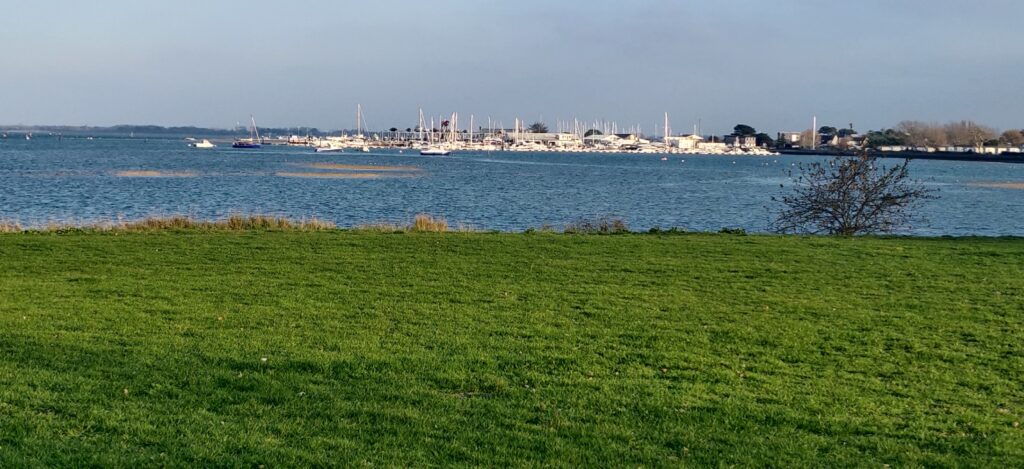
A view from the edge of the property over the bay to a neighbouring island. Your could hear barking dogs from about a mile away.
The dining arrangements
The main reception and entertainment complex incorporates a remarkably large dining area, capable of accommodating a considerable number of guests at one sitting. There are two secondary areas, which help to distribute the traffic and prevent excessive congestion. Members of staff bring the starters and desserts, while guests generally help themselves to the main course.
I particularly enjoy this buffet style of eating because there is plenty of coming and going, which suits my temperament perfectly. I have never been entirely comfortable with the rather formal atmosphere of certain restaurants, where everyone sits in their appointed place and conversations are conducted in carefully moderated tones. Here there is movement, spontaneity and plenty of opportunity for casual encounters.
We were assigned a table at the beginning of our holiday, which remained ours for the duration of our stay. This is a surprisingly important feature from the social point of view. You gradually become acquainted with those sitting at neighbouring tables, and what begins as a polite acknowledgement on the first evening can develop into a considerable amount of conversation and amusement by the time you leave.
 There is something to be learned from this arrangement. Friendships and acquaintanceships often develop not through elaborate introductions but through repeated encounters in relatively relaxed circumstances. Familiarity gradually removes the barriers that people instinctively erect when meeting strangers.
I met a chap called Alisdair and photographed him and turned him into a dwizzard (thank you, Dola) just for fun. He asked me how I did it, and I just said, ‘Oh, it is just something I do.’
By the second or third day, you find yourself greeting people as though you have known them for considerably longer than you actually have. It is a pleasant reminder that human relationships need not be as complicated as we sometimes make them.
The importance of breakfast
The most important thing for me in the morning is that the coffee machine should be in good working order, as indeed it was. There are few things more disappointing than arriving for breakfast in a hotel and discovering that the coffee is barely drinkable. Fortunately, there were no such difficulties here.
My main breakfast consisted of a lovely creamy porridge, to which I could add fruit, dates or whatever else appealed to me. There was yoghurt and a considerable selection of other items. For those with a more substantial appetite, the traditional English fried breakfast was available in all its glory.
These days I am particularly sensitive to certain fats and rich foods. I made the mistake of indulging in one of my favourite breakfast items, fried bread, which unfortunately repeated on me. I wondered whether the cooking oil was entirely fresh, although it may simply have been my increasing sensitivity to fried food. There comes a point in life when one has to acknowledge that the digestive system is no longer prepared to cooperate with every enthusiasm of the mind.
The breakfasts were sufficiently substantial that we did not bother with lunch. Indeed, we felt no particular need for it. This suited us very well because it gave us an uninterrupted period during the day in which to go out exploring or enjoy the facilities without having to return at an appointed hour for yet another meal.
We started our evening meal at six o’clock, which pleased me greatly, as I cannot comfortably eat late at night. One of the advantages of a holiday establishment catering predominantly for older people is that the arrangements tend to be reasonably sympathetic to the habits and requirements of that age group.
The social character of the guests
I would say that the vast majority of the clientele were in their sixties and upwards, with retired people featuring prominently. These were, for the most part, jolly people who were delighted to get away from their domestic environment and have someone else undertake the cooking, washing up and general responsibilities of everyday living.
There is a particular pleasure in being temporarily relieved of one’s domestic obligations. It is not necessarily that these duties are onerous in themselves, but that their cumulative effect can make life somewhat repetitive. A few days away from home, with meals provided and entertainment laid on, can introduce a welcome change of rhythm.
We made friends with several of those sitting near us, including a gentleman called Alistair. I took a photograph of him and subsequently enhanced it with the assistance of artificial intelligence. He was most pleased with the result. It is interesting how modern technology, which is so often accused of separating people from one another, can also provide an occasion for amusement and social interaction.
We also met a couple called Simon and Joyce. Joyce was a rather reserved person who did not readily enter into conversation. One never knows what experiences another human being has had, and I have learned that it is unwise to make too many assumptions about the reasons for someone’s reserve. Simon, by contrast, was full of the joys of spring and an absolute delight to talk to. His professional background was in technical aspects of catering, and he struck me as a natural communicator.
There were quite a number of people from the Midlands, including Birmingham, whose particular brand of humour I greatly enjoyed. There is a directness about the Birmingham sense of humour which some people might initially find disconcerting, but which I find refreshing. There is often considerable warmth behind the apparent bluntness.
The general atmosphere was one of openness and good humour. People seemed quite happy to make jokes at their own expense, and there was little evidence of anyone taking themselves too seriously.
The art of talking to strangers
One of the things that particularly struck me about the Warner experience was the ease with which conversations could be initiated. It was almost as if we were all members of the same club. There was an unspoken understanding that we had something in common simply by virtue of being there.
I had no difficulty talking to anyone and everyone, even if it was merely to tell a joke, pass the time of day or make an observation about the food. Not every conversation needs to be profound or lead to a lasting friendship. Sometimes a brief exchange between two human beings is valuable in its own right.
In our ordinary lives, particularly in towns and cities, we tend to be rather guarded. We are unsure whether our approaches will be welcomed, and so we often refrain from speaking altogether. The result is that two people who might have enjoyed one another’s company can spend considerable periods in close proximity without exchanging a single word.
I noticed one or two people, particularly women, sitting on their own who appeared somewhat separate from the general atmosphere of sociability. I wondered whether some might have recently lost their husbands and were undertaking their first holiday alone. Of course, I had no way of knowing their circumstances, and some people are perfectly content with their own company.
Nevertheless, I was reminded of the courage it can take to enter an unfamiliar social environment following the loss of a partner. The practical difficulties of bereavement are considerable, but perhaps the greater challenge is learning how to occupy a different place in the social world.
This has particular relevance to my Somer Valley Diary project. Providing information about activities is only part of the task. We also need to create environments in which people feel sufficiently comfortable to take that first step and join in. Warner has, whether consciously or otherwise, created a setting in which much of this happens naturally.
Entertainment from morning until night
Warner certainly understands the entertainment business. Activities were available from about ten o’clock in the morning until eleven at night, with musical performances, quizzes, competitions, pantomimes and various other diversions.
The main dining area was also used for evening entertainment, while the drinks lounge provided a setting for smaller gatherings, quizzes and performances by solo artists.
The advantage of such an extensive programme is that you can participate as much or as little as you wish. There is no obligation to be entertained, but neither is there any necessity to sit in your room wondering what to do with yourself.
For someone travelling alone, this must be particularly valuable. There is a considerable difference between booking a room in an ordinary hotel, where you are largely responsible for organising your own time, and staying somewhere where opportunities for recreation and companionship are constantly available.
The price of drinks was in keeping with normal hotel prices and therefore a considerable distance removed from the bargain prices of Wetherspoons. To my great surprise, however, on the first evening we were offered unlimited drinks until midnight. This was certainly a generous gesture and contributed to the festive atmosphere at the beginning of the holiday.
What I appreciate about this style of entertainment is that it makes no great intellectual demands upon the participants. There are occasions in life when one does not particularly want to be educated, challenged or improved. Sometimes it is quite sufficient to laugh, listen to music and enjoy the company of other people.
The recreation centre and a lesson in dehydration
There was also a substantial recreation centre with a swimming pool of a size that surprised me. Among the facilities was a steam room, which I decided to investigate.
I spent approximately fifteen minutes in the steam room and emerged dripping with perspiration. There is something rather pleasurable about the sensation of being thoroughly warmed through, particularly at this time of year.
However, I made the elementary mistake of forgetting to drink sufficient water afterwards.
I paid for this at approximately two o’clock the following morning when I discovered, much to my astonishment, that I appeared to have been transformed into a very old man. I found myself unable to get out of bed without assistance, which was both alarming and somewhat humiliating.
It was only subsequently that I connected my weakness with the considerable amount of fluid I had lost in the steam room and my failure to replenish it. Dehydration seemed a possible explanation, although I cannot be certain that it was the sole cause.
I amused the staff by recounting the incident and explaining how foolish I had been. It is extraordinary that one can reach an advanced age, accumulate a considerable amount of experience and still overlook something as elementary as drinking water.
Perhaps one of the dangers of feeling reasonably youthful is that one occasionally forgets that the body has its own timetable and its own requirements, irrespective of one’s mental attitude.
Autumn and the pleasures of walking
Autumn was in full swing, and I delighted in walking around the grounds, enjoying the wind, the trees and the abundance of brown leaves.
I have never entirely subscribed to the idea that a holiday must be accompanied by sunshine and warm weather. Every season has its own particular qualities, and there is something invigorating about being outside on a blustery autumn day, particularly when one knows that a warm and comfortable room awaits one’s return.
The spread-out nature of the accommodation encouraged walking, even if it was merely from our chalet to the restaurant. These little journeys gave me opportunities to observe the surroundings, encounter other guests and enjoy the changing light.
There is much to be said for holidays outside the main summer season. The world is quieter, the roads are generally less congested, and one is not competing with quite so many people for the enjoyment of the same facilities.
The accommodation and length of stay
Our room was a delight. It contained modern equipment, a very comfortable mattress, a radiator that belted out heat with considerable enthusiasm and a deep bath in which one could almost totally immerse oneself.
I have a particular appreciation of a good bath. Showers may be more economical and efficient, but efficiency is not necessarily the principal objective when one is on holiday. There is something wonderfully indulgent about lying in a deep bath without having to be anywhere at a particular time.
I could not reasonably have asked for more from the accommodation.
Personally, I do not like going away on holiday for fewer than five days. When I arrive somewhere, I like the prospect of four nights stretching ahead of me. It takes a certain amount of time to adjust to a new environment, discover how everything works and establish a comfortable routine.
On the first day you are still mentally attached to home. By the second day you are beginning to relax. By the third day you have become sufficiently familiar with your surroundings to feel that you belong there, and it is at this point that the real benefits of a holiday begin to make themselves apparent.
A word about the staff
The staff were bright and breezy and looked after us well. I have considerable respect for people working in the hospitality industry, particularly in establishments where they are required to maintain a cheerful disposition in the face of an almost continuous succession of new arrivals.
Warner operates a pattern of three-night weekend breaks and four-night weekday breaks. This means that staff are constantly saying goodbye to one group of people and welcoming another.
What is a special occasion for us is an ordinary working day for them. Yet they are expected to convey enthusiasm, patience and friendliness to each new group as though they were the first visitors of the season.
I imagine that, were I working in such an environment, I would enjoy the constant variety of human beings passing through. No two groups of guests are quite the same, and there must be a considerable amount of entertainment to be derived from observing the different personalities and their various requirements.
Value for money and final impressions
We paid £678 for the two of us for our four-night stay, which works out at £339 per person, or just under £85 per person per night. Considering that this included accommodation, breakfast, evening meals, entertainment and access to recreational facilities, I regard it as good value for money.
I would not necessarily expect to obtain the same price during the summer months, but for a November break it represented a very reasonable proposition.
Oh, and one other thing. They do not normally accommodate children or pet dogs.
Hooray!
This is not to suggest that I have anything against either children or dogs, but there are times when one appreciates an environment designed specifically around the requirements of adults. There is a different atmosphere when people are not continually attending to the needs of children or negotiating their way around other people’s pets.
My overall impression is that Warner has understood something quite important about the requirements of older people. It is not simply a matter of providing comfortable accommodation, plentiful food and entertainment. It is also about creating an environment in which people can relax socially, rediscover their sense of humour and enjoy companionship without feeling under any particular obligation.
As we grow older, opportunities for spontaneous social interaction can diminish. Retirement, bereavement, changes in mobility and the dispersal of families can all contribute to a gradual narrowing of one’s social world.
A few days in an environment where people are approachable, where conversations occur naturally and where laughter is never far away can do a great deal to reverse that tendency, even if only temporarily.
Perhaps the greatest compliment I can pay Warner is that I felt entirely comfortable being myself. I could talk to strangers, make jokes, wander around the grounds, enjoy my breakfast, disappear for several hours or participate in whatever entertainment appealed to me.
There was no pressure to conform to anything other than the reasonable requirements of communal living.
And that, surely, is what a good holiday should be about.
