A Professional Who Knows His Windows
Our first visitor today was a gentleman who came to give us an estimate for replacing some of our double glazing. The windows have been in place since the bungalow was built in the mid-1980s, so they have certainly earned their keep. However, technology has moved on considerably in forty years, and modern glass can perform tricks that would have been quite remarkable when our original windows were installed.
The principle, as he explained it, is that specially treated glass can help reduce heat loss by reflecting warmth from inside the house back into the rooms while also improving insulation against the cold outside. It is not simply a matter of putting two sheets of glass together with a gap between them. There are now sophisticated coatings, different types of gas between the panes and improvements in the frames themselves. All of this should make a noticeable difference to comfort and, hopefully, our heating bills.
We asked him to provide quotations for five areas: the living room, bathroom, bedroom, kitchen and the intermediate door leading outside. The latter is not a priority, but it will be useful to know the cost so that we can make an informed decision.
I was impressed by the man, Mak Rogers, himself. He has been in the business for 35 years, and there is something reassuring about dealing with somebody who knows his subject thoroughly and does not need to impress you with a lot of salesmanship. He was a true professional.
He had recently bought a new van, which I admired, although perhaps not for the reasons he expected. It was a rather unexciting grey colour, with no company name or advertising plastered all over it. I congratulated him on resisting the temptation to turn it into a mobile billboard. For goodness’ sake, I said, keep it that way! The moment you advertise that you are carrying valuable tools and equipment, you are practically inviting somebody to break in.
I sometimes wonder why tradesmen spend money advertising the contents of their vans to people who may have no intention of employing them but every intention of helping themselves to the tools.
Designing a Website That Actually Works
Later in the day I sat down with my web developer before he had started work, and we went through the principal features of the Somer Valley Diary website.
My philosophy is that if I am going to do something, I might as well do it properly. There is no point in creating yet another website that looks attractive but is awkward to use. I want something that is ahead of comparable local websites in both functionality and simplicity. The two are not mutually exclusive. In fact, the more sophisticated the underlying system, the easier it should be for the ordinary visitor.
I have always believed in looking for the weak points before they become problems. Rather than waiting until something goes wrong and then trying to repair it, why not anticipate the difficulties at the design stage?
For example, suppose an organiser enters an event onto the website. What is to stop somebody else from interfering with it, changing the details or deleting it altogether? How will the system know who made the original entry? Should the organiser be able to edit only their own material, and what happens if they leave the organisation and somebody else takes over?
These may sound like small technical details, but they are fundamental to making the system trustworthy. If people are going to take responsibility for entering their own events, they need to know that the information will remain secure and accurate.
The second major question concerns membership. Which parts of the website should be available to everybody, and which should be restricted to registered local participants?
By default, most websites are designed for the whole wide world. Anybody, anywhere, can look at them, and often anybody can contribute. I want to do something rather different. The Somer Valley Diary will be publicly readable, but active participation will be focused on people living within our local area, principally the BA2, BA3 and BS39 postcode districts.
I am not interested in creating another version of Facebook, where local matters become mixed up with comments from people living fifty miles away or even in another country. There is a place for worldwide communication, but there is also a place for a genuinely local conversation.
My intention is to concentrate on the approximately 45,000 inhabitants of the area I am covering. People will be able to submit events, make comments, suggest improvements and propose entirely new activities or groups where they feel there is an unmet need.
This last feature particularly interests me. Suppose somebody would like to join a particular type of group but cannot find one locally. Why shouldn’t they be able to say so? Others may have exactly the same interest, and before long something new could come into existence. The website could become not merely a record of what is already happening but a means of encouraging new things to happen.
Of course, this means I shall have to exercise some judgement over who is allowed to contribute and what they are permitted to publish. I want to do this sensitively, without creating an atmosphere of bureaucracy or suspicion. Having spent years working with thousands of people who came to London wanting to build a social life, I feel reasonably confident about handling the human side of the operation.
Rather amusingly, we held our meeting in what must be the only café in Peasedown St John without a usable signal. Here we were, discussing a modern internet-based community system, and we could not even access the internet! I had to send my developer a couple of items afterwards. There is a certain irony in that.
All I need initially is a working model. At our organisers’ meeting on 16 February, I want people to be able to try the system for themselves, enter sample events and tell us what works and what needs improving. That will give us an opportunity to iron out the problems before the book and website are announced to the wider public.
One of the great advantages of publishing through Kindle Direct Publishing is that corrections can be made to the book after publication, with updated files becoming available for future printed copies once approved. This removes some of the anxiety about getting every last detail perfect on the first attempt.
I am increasingly excited about the possibilities. What began as a simple community guide is gradually turning into something much more useful.
My 69th Eye Injection at the Royal United Hospital
The next part of the day took me to the Royal United Hospital in Bath for my 69th injection for wet age-related macular degeneration. I have been receiving these injections since 2016, so this is now my tenth year of treatment. I suppose I should regard myself as something of a veteran.
I have long since decided that if I have to visit a hospital regularly, I might as well make the experience as entertaining as possible. There is no particular virtue in sitting around looking miserable, especially when the staff are doing their best under considerable pressure.
As usual, I arrived in good time and decided to have lunch before going up to the eye department. I always enjoy this part of the visit. Hospitals are fascinating places for observing human behaviour, and the restaurant provides an excellent opportunity to watch the world go by.
I have recently acquired a piece of software called Dola, which can transform ordinary photographs into rather interesting artistic images. It can take a photograph and produce something resembling a pencil drawing, often giving the original a completely different character.
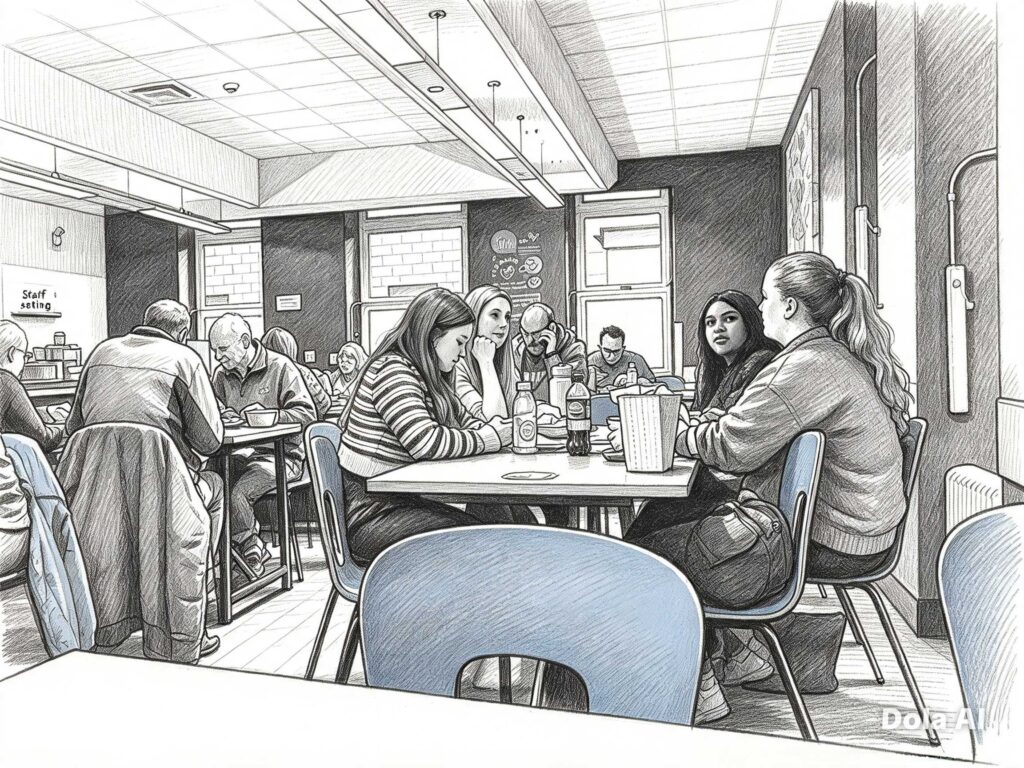
This was in the eating area / restaurant of the RUH. I sometimes think that this type of imagery is more interesting than colour; that does all the work for you
There were four young women sitting together, chatting happily, and I took a photograph of them and asked the software to produce a pencil sketch. The result was rather attractive, so, being me, I decided to show it to them.
I was conscious that they might consider this intrusive. After all, a complete stranger approaching a table of young women with an unsolicited picture is not necessarily going to receive an enthusiastic welcome.
However, I need not have worried. They were absolutely delighted. There was much laughter and appreciation, and one of the women was so taken with the picture that she approached me as I was about to leave and asked whether she could photograph the image herself.
I was pleased that something so simple had given them pleasure. It cost nothing, took only a few moments and produced a cheerful little encounter that none of us had anticipated.
The Friends of the Hospital – Quietly Making a Difference
While enjoying my lunch, I reflected on the valuable contribution made by the Friends of the Royal United Hospital. These organisations are sometimes taken for granted, but they provide much more than refreshments and a convenient place to buy a newspaper or sandwich.
The Friends operate a café and shop, with profits helping to finance equipment, facilities and services for patients. Their volunteers also contribute an enormous amount of time and goodwill to the running of the hospital.
I was particularly interested to discover the scale of their fundraising. The Friends contributed £100,548 towards the hospital’s robotic surgery programme, part of the much larger £2.3 million project funded through the hospital charity RUHX.
The equipment involved is the Da Vinci surgical robot, introduced in 2023. Despite the name, the robot does not perform operations independently. It is controlled by a surgeon, who uses sophisticated instruments and highly magnified three-dimensional images to carry out complex procedures with exceptional precision.
The system is used for operations involving colorectal, prostate and gynaecological cancers. Smaller incisions can mean less trauma, fewer complications and a quicker recovery for patients.
The Friends have supported numerous other improvements, including intensive care equipment, breast care facilities and better waiting areas for patients experiencing mental health difficulties. Their reported donations for 2025/26 amounted to £381,300.
I find this impressive. The next time somebody buys a coffee or a sandwich at the Friends’ café, they might like to remember that the proceeds are helping to improve the lives of patients throughout the hospital.
There is something rather satisfying about the idea that an ordinary cup of coffee can contribute, however modestly, towards equipment costing hundreds of thousands of pounds.
Announcing My Official Arrival
Before lunch I had already visited the eye department reception to make sure I had the correct appointment time. The receptionist asked whether I intended to wait or come back later, and I explained that I would return after eating.
I also informed her that I had not yet officially arrived.
Half an hour later I returned and announced, with a certain amount of theatrical ceremony, that I was now making my official arrival.
It was a completely unnecessary performance, of course, but it amused me and, I hope, the receptionist. I have always felt that there is room for a little theatre in everyday life. We spend far too much time behaving as though everything must be conducted with solemn efficiency.
A smile costs nothing, and hospital staff probably encounter enough anxiety and irritation during the day without needing any more from me.
A Difficult Scene in the Children’s Unit
While passing through a corridor near the Children’s Unit, I witnessed a rather unpleasant confrontation.
A young person was extremely agitated, shouting and swearing at members of staff and demanding to be allowed out. I did not hear the beginning of the incident and therefore had no idea what had caused the disagreement, but it was clearly a difficult situation.
What impressed me was the behaviour of the staff. They remained remarkably calm, repeating their questions or instructions without becoming drawn into an argument. They did not raise their voices or attempt to match the young person’s aggression.
From what I could observe, they were trying to allow the emotional storm to subside rather than adding fuel to it. Eventually the situation did calm down.
I suppose people arrive at hospitals carrying all sorts of burdens that are not immediately visible. They may be frightened, in pain, confused, exhausted or overwhelmed by circumstances that most of us would find difficult to imagine. Occasionally the pressure becomes too much and the fuse blows.
It is easy for an observer to criticise somebody who is behaving badly, but without knowing the background we cannot really judge what has brought them to that point.
Full credit to the staff for maintaining their composure. It must require considerable patience and training to remain calm when somebody is directing a stream of abuse at you.
Meeting the Doctor Who Started It All
 One of the most rewarding encounters of the day came when I recognised the doctor who had first seen me for my wet macular degeneration back in 2016.
I remember her very clearly. She was a slim lady whom I took to be of Egyptian appearance, named Mrs Misha Badial. At that first appointment she explained that I might need six injections, or perhaps sixty-six. Nobody could predict how the condition would develop or how long treatment might continue.
Well, here I was, ten years later, approaching injection number 69.
I introduced myself and reminded her of our original meeting. I wanted to thank her for the help and reassurance she had given me at the beginning of what has turned out to be a very long course of treatment.
She told me that some patients actually blamed her for their condition, which I found rather extraordinary. A doctor does not cause somebody’s illness by diagnosing it, yet I suppose when people are frightened or distressed they sometimes direct their frustration towards the person who has to deliver the unwelcome news.
What particularly impressed me was the attention she gave me. She was under no obligation to stop and talk, yet she looked me directly in the eye, asked my name, listened to what I had to say and enquired about my general wellbeing.
At the end of our conversation she shook my hand and said it had been a great pleasure to meet me.
I found this genuinely touching. In a busy hospital, where clinicians are under constant pressure to see the next patient, it is very easy for the individual to become little more than a name on a screen or a number on an appointment list.
Here was somebody who had taken a few moments to acknowledge me as a person. I appreciated that enormously.
I have always believed that the quality of human contact is just as important as technical competence. We need both. A doctor may possess all the medical knowledge in the world, but a little warmth and genuine interest can make an enormous difference to the person receiving treatment.
The Cheerful Waiting Corridor
The waiting area outside the injection rooms is usually a surprisingly cheerful place. Most of us know what is coming, and there is a certain camaraderie among people who are undergoing the same procedure.
Today there was a woman from Thailand who spoke very little English. The receptionist arranged for an interpreter on the telephone so that the necessary questions could be asked and answered. I thought this was an excellent example of the practical difficulties hospital staff have to overcome every day.
I always keep an eye out for people who are attending for their first injection. Understandably, they are often nervous. The thought of somebody putting a needle into your eye is not exactly appealing, and the imagination can produce horrors far worse than the reality.
I usually offer a few words of encouragement and tell them that it is not nearly as bad as they think. I can speak with some authority on the subject after nearly seventy injections.
The Procedure – With a Little Mischief
By now I know the routine almost as well as the staff. I lie back on the couch, make myself comfortable and wait while they carry out the various sterilising procedures.
For me, the most unpleasant part is not the injection itself but the preparation. A sticky sterile covering is placed over the area around the eye, and an opening is arranged so that the doctor can work safely. An instrument is then used to keep the eyelids apart. It is not particularly comfortable, although mercifully it does not last long.
I have noticed that the injection seems to be given in slightly different positions on different occasions. I imagine there is a clinical reason for this, perhaps to avoid repeatedly using exactly the same site, although I have never asked.
The staff invariably ask how I intend to get home, because driving immediately after the procedure is not advisable.
Sometimes I tell them I am going by bus. On other occasions I announce that I have arranged a horse-drawn carriage. I am not entirely sure whether everybody appreciates the humour, but I enjoy introducing a little variety into what must otherwise be a rather repetitive working day.
At the end of the procedure they hold up some fingers and ask me how many I can see. This is a straightforward check that I can still perceive what is in front of me.
Being naughty, I sometimes short-circuit the exercise by holding up two fingers of my own and announcing the answer.
I suspect they have encountered worse patients.
A Quieter Journey Home
On the return journey I noticed that the buses serving the Odd Down Park and Ride appeared to be fully electric. There was none of the familiar engine noise or vibration associated with diesel buses, and the ride seemed noticeably smoother.
It is a rather different travelling experience. Instead of the constant rumble of an engine, there is a much quieter movement, which makes the journey feel more relaxed. I must admit that I rather like it.
By the time I arrived home, the sun was setting and the day was drawing to a close.
Looking back, I had covered an extraordinary variety of subjects. I had discussed the thermal properties of modern glass, considered the security and membership arrangements of a new community website, learnt more about charitable fundraising for robotic surgery, watched hospital staff handle a difficult confrontation, thanked a doctor who had helped me ten years earlier and entertained a group of young women with an unexpected pencil sketch.
Not bad for one day.
What struck me most, however, was the number of small human encounters. None of them was particularly dramatic, and most lasted only a few minutes, but each had its own value.
I have always believed that we influence one another far more than we realise. A kind word, a joke, a moment of appreciation or simply taking the trouble to listen can change the atmosphere around another person.
We cannot know what burdens somebody may be carrying when we meet them. The person serving our lunch, answering the telephone or sitting beside us in a waiting room may be having a difficult day. Equally, they may be perfectly happy and simply enjoy an unexpected conversation.
Either way, there is usually an opportunity to contribute something positive.
I arrived home with the feeling that I might have cheered up half a dozen people during the course of the day. Perhaps I did, perhaps I didn’t. But I certainly enjoyed trying.
We tend to measure the success of a day by what we have accomplished. I sometimes think it is equally important to ask how many people are a little happier because we happened to cross their path.
And on that basis, I would call today a success.
