Being Listened To – The Courage to Speak
and the Wisdom to Remain Silent
One of the things I value most in human relationships is the experience of being genuinely listened to. I do not spend my entire life talking to people, although I enjoy conversation and the exchange of ideas, but when I have something that I consider worthwhile to say, I appreciate the courtesy of another person’s attention. I do not expect everyone to agree with me, nor would I particularly want them to. A world in which everybody agreed with everybody else would be a remarkably dull place, and there would be little opportunity for intellectual or spiritual growth. What I do hope for is some indication that my words have been received, considered and perhaps allowed to challenge an existing assumption.
During the past few weeks I have encountered several people who have nodded politely, smiled at appropriate moments and given every outward appearance of listening, yet I have come away wondering whether anything I said actually registered. It is a curious and sometimes rather discouraging experience. One makes an effort to communicate something that matters, perhaps an observation drawn from many years of experience, and yet there is no discernible response beyond a few conventional expressions of agreement. I sometimes feel that my words have been left to wither on the vine, although I am beginning to question whether this is an entirely fair judgement.
Perhaps the problem lies partly in my expectations. Having reached a certain stage of life, I naturally feel that the experiences I have accumulated ought to be of some value to others. I have made mistakes, encountered unusual people, witnessed changes in society and developed opinions that have been tested against the realities of everyday life. Surely there must be some purpose in acquiring such experience beyond keeping it to oneself. Yet there is a subtle danger here, because the desire to share what one has learnt can gradually become an expectation that others should recognise its importance.
Nobody is under any obligation to accept my interpretation of life, and it would be presumptuous to imagine that age automatically confers wisdom. I have met younger people whose insight has impressed me greatly and older people who appear to have learnt remarkably little from their experiences. The question is therefore not simply whether I have something worth saying, but whether I am sufficiently detached from my own contribution to allow another person the freedom to receive it, question it or even disregard it.
I was reminded of the familiar biblical expression about casting bread upon the waters. Like many quotations from Scripture, it is frequently repeated without much consideration of its context or deeper implications. The words come from Ecclesiastes, chapter 11, verse 1: “Cast your bread upon the waters, for you will find it after many days.” It is an extraordinary image because bread thrown onto water would appear, at first sight, to be lost. It would float away, become soaked and eventually disappear from view.
Yet the writer is encouraging a willingness to act without demanding an immediate or predictable return. The passage has been interpreted in various ways, including as an encouragement to undertake ventures whose rewards may be delayed or uncertain, but I find its application to human relationships particularly attractive. We do not always know what becomes of something we release into the world, and this is especially true of words. We may offer an observation to another person and receive no response whatsoever, yet months or even years later that person may remember what was said at precisely the moment when it becomes relevant. We may never know that our contribution has had any effect, and perhaps it is better that way.
When I examine my own life, I can recall people who influenced me profoundly without making any obvious attempt to do so. They were not delivering lectures, promoting elaborate philosophies or trying to convert me to their particular understanding of reality. They were simply being themselves. Something in their manner, their integrity, their humour or their approach to difficulties communicated far more than they probably realised. Sometimes it was a casual remark that remained in my memory for decades. On other occasions it was an example of personal courage or kindness that demonstrated, without the need for explanation, that another way of behaving was possible.
The influence was not necessarily contained in the words themselves but in the quality of the person from whom they came. This leads me to wonder whether we underestimate the extent to which our very presence communicates something to others. We are constantly transmitting information through our attitudes, expressions, reactions and choices, even when we are not consciously attempting to influence anyone. A person who remains calm during a difficult situation may communicate more about self-discipline than someone who delivers an hour-long lecture on the subject.
There is something comforting in this recognition because it releases me from the need to measure the success of every conversation. I find myself chiding my own tendency to look for evidence that my remarks have been useful. Why should I require confirmation that somebody has benefited from what I have said? Is there perhaps a little vanity concealed beneath my desire to be helpful? I suspect that there is, and acknowledging it is probably healthier than pretending otherwise.
Communication is not a commercial transaction in which I deliver a parcel of wisdom and expect a receipt. Nor is it an examination in which the listener must demonstrate that the lesson has been understood. Sometimes the most constructive thing we can do is plant a seed and walk away, allowing it to develop according to conditions over which we have little control. A seed cannot be made to germinate by repeatedly digging it up to see whether anything is happening, and an idea cannot always be encouraged to mature by continually reminding somebody that we have introduced it.
The philosopher Alan Watts expressed a related principle in the observation that muddy water is best cleared by leaving it alone. This is a remarkably simple statement, yet it contains considerable wisdom when applied to human relationships. If we stir muddy water in an attempt to make it clear, we merely keep the sediment in suspension. If we leave it undisturbed, the particles gradually settle and clarity returns. Human disagreements often behave in much the same way. Suppose we have had a difference of opinion with a friend.
We may feel an overwhelming urge to explain ourselves, correct a misunderstanding or demonstrate why our position is reasonable. We rehearse our arguments, sometimes during the night when we ought to be sleeping, and imagine the satisfaction of finally convincing the other person. Yet every additional explanation may simply stir up more mud. There are occasions when the most constructive action is to do nothing, not because we have abandoned our principles, but because we recognise that people need time to process information, particularly when it challenges something they have believed for many years.
This raises the important question of timing. I have noticed that some people become defensive almost before a sentence has been completed. They are not necessarily responding to what has actually been said but to what they imagine is about to be said. Once that defensive mechanism has been activated, meaningful communication becomes extremely difficult. The listener is no longer considering the argument but preparing to protect an established position. Under such circumstances, even the most carefully chosen words may be interpreted as hostile.
We therefore need to become more sensitive to the conditions in which a conversation takes place. Is the person tired, anxious or preoccupied? Have they recently suffered a disappointment? Are they feeling threatened or insecure? A perfectly reasonable observation made at the wrong moment can produce a completely unreasonable reaction, whereas the same observation offered a week later over a cup of tea may be received with gratitude. The wisdom of a statement cannot be separated entirely from the circumstances in which it is delivered.
This brings me to another aspect of communication which concerns me considerably, namely the apparent reluctance of many people to express what they genuinely think. There seems to be an increasing tendency to examine every statement for the possibility that someone, somewhere, might take offence. Naturally, consideration for other people is desirable, and nobody should deliberately humiliate or insult another human being. Nevertheless, there is a considerable difference between being considerate and being frightened. I have watched the development of what is commonly described as political correctness and, more recently, the attitudes associated with the term “woke”.
These expressions have become so politically charged that they are sometimes used more as weapons than as useful descriptions. My concern is not with the legitimate desire to protect people from discrimination or unnecessary suffering, but with the possibility that fear of being misunderstood, labelled or publicly condemned can discourage people from engaging in genuine discussion. When individuals begin to calculate the possible social consequences of every unconventional observation, the quality of public conversation inevitably suffers.
Some commentators have attempted to trace aspects of modern political and cultural thinking to the Frankfurt School, the intellectual movement associated with the Institute for Social Research established in Germany in 1923. Its members examined society, culture, ideology and the ways in which established systems of power influence human thought. Critics have sometimes portrayed the movement as part of a deliberate attempt to undermine Western civilisation from within, although such sweeping interpretations go considerably beyond what can be established from the historical record.
The important question for me is not whether one particular school of thought can be blamed for the present situation, but whether our society is becoming less willing to tolerate disagreement. There is a danger of confusing disagreement with hostility, as though questioning someone’s opinion were equivalent to attacking their personal worth. In reality, challenging an idea may be a sign that we take the person expressing it seriously enough to engage with them. There is something rather patronising about agreeing with everyone merely to avoid discomfort, because it suggests that we do not regard them as capable of defending their own position.
I would much rather have an honest disagreement with somebody who respects me than receive a succession of agreeable remarks from someone who has no intention of engaging with what I am saying. David Icke has spoken about the fear of other people’s opinions being one of the greatest prisons in which human beings can live. Whatever one’s views about his wider beliefs, I think there is something worth examining in that observation. How much of our behaviour is governed by the imagined judgement of others?
We choose our words carefully, hesitate before expressing an unconventional opinion and look around to see how other people are reacting before deciding whether to continue. In some circumstances this is ordinary social intelligence, but there comes a point where sensitivity becomes self-censorship. If we are constantly adjusting our beliefs to suit the company we keep, what remains of our individuality? The greatest obstacle to personal freedom may sometimes be not an external authority but the voice inside our own heads telling us that we must not risk disapproval.
There is a familiar saying that we are born originals but die copies. It is a melancholy thought, and one which becomes increasingly relevant when we consider the pressures exerted upon us throughout life. We arrive in this world with our own temperament, curiosity and potential, but gradually we are exposed to the expectations of parents, teachers, employers, religious institutions, political movements and society generally. Many of these influences are valuable and necessary, since without them we would have no common language, shared customs or workable social relationships.
Nevertheless, there is a danger that we become so thoroughly conditioned by other people’s expectations that we forget to examine whether they are true. We can spend a lifetime learning how to fit in without ever discovering who we really are. Surely we were not placed on this earth merely for decoration. I believe that we have a responsibility to contribute something of our own understanding, however imperfect it may be, and to develop sufficient self-respect to say, when appropriate, that we see a matter differently and are prepared to explain why.
This does not mean becoming argumentative for the sake of it, nor does it mean assuming that every unconventional thought is automatically profound. I regard speaking the truth as I understand it as part of my duty, although I am increasingly aware that the phrase “as I understand it” is essential. None of us possesses the whole truth. We see through the filters of our experience, education, temperament and beliefs, and something that appears obvious to me may look quite different to another person whose life has followed a different course. For this reason I prefer an observational approach to an aggressive one.
There is a difference between telling someone that they are wrong and suggesting that we have noticed something which appears to point in another direction. The first invites resistance, while the second invites consideration. One closes a door and the other leaves it open. I am not suggesting that we should become so gentle that our words lose all force, because there are occasions when a firm statement is necessary. Nevertheless, forcefulness need not involve aggression, and a person who is genuinely confident in what they believe does not have to shout.
I have also learned that questions can sometimes be more effective than declarations. A carefully chosen question may encourage somebody to examine an assumption without feeling personally attacked. Instead of declaring that a person’s opinion is inconsistent, we might ask how they reconcile two apparently contradictory positions. They may then discover the inconsistency for themselves, which is usually more valuable than having it pointed out to them. Equally importantly, they may explain something that we have overlooked.
This is the advantage of genuine dialogue, because both parties have the opportunity to learn. If I enter every conversation assuming that my purpose is to correct the other person, I have already restricted what the encounter might achieve. I may have something valuable to contribute, but I may also be about to receive information that changes my own understanding. The willingness to be corrected is therefore just as important as the courage to challenge.
There are, however, situations in which challenging a person may be unwise, particularly when the belief being questioned forms a substantial part of their identity. Someone may have built their friendships, social standing, religious convictions and sense of personal worth around a particular understanding of life. To question that belief is not merely to challenge an intellectual proposition; it may feel as though their entire existence is being threatened. Under those circumstances, direct confrontation may achieve precisely the opposite of what we intend. The person may retreat more deeply into their existing position, not because the evidence is convincing but because abandoning it would be emotionally unbearable. This is where compassion and discernment become essential.
Before speaking, I need to ask myself what I am trying to achieve. Am I genuinely attempting to help another person see something more clearly, or am I simply enjoying the satisfaction of demonstrating that I am right? If my purpose is to win an argument, I may succeed in making the other person feel foolish while achieving nothing constructive. If my purpose is to help, I must take account of their capacity to receive what I am saying.
Jesus gave practical advice about dealing with someone who has done wrong. In Matthew chapter 18, he recommends approaching the person privately in the first instance, and there is great wisdom in this. A private conversation allows somebody to reconsider their behaviour without the humiliation of being corrected before an audience. Public embarrassment can turn a relatively minor disagreement into a permanent grievance, and I suspect that many relationships have been damaged unnecessarily because someone felt compelled to make their point in the presence of others.
There is a distinction between correcting behaviour and diminishing a person, and it is important not to confuse the two. We should be able to express disapproval of an action while continuing to recognise the dignity of the individual concerned. Sometimes the most courageous thing we can do is resist the temptation to demonstrate our cleverness, particularly when we know that we have an audience who would enjoy seeing someone else put in their place.
On the other hand, there are occasions when endless patience becomes counterproductive. The apostle Paul, writing in Romans chapter 16, verses 17 and 18, warns against those who create divisions and obstacles contrary to the teaching the community has received. He advises believers to keep away from such people, particularly those who use flattering language to deceive others while serving their own appetites. This may sound severe, but I think there is an important principle involved. A healthy community depends upon a minimum level of trust and integrity.
People can disagree vigorously while still sharing a commitment to the common good, and indeed disagreement can strengthen a community when it encourages honest examination and prevents complacency. But what happens when someone is interested only in advancing their own position, manipulating others or creating division for personal advantage? At that point the normal rules of constructive discussion begin to break down. If one person approaches a conversation in good faith while the other regards it merely as an opportunity for manipulation, there is no genuine meeting of minds.
I have come to believe that integrity is the foundation upon which worthwhile communication rests. Without it, words become instruments rather than expressions of truth. This does not mean that we should casually dismiss people with whom we disagree, because we must be very careful not to label someone dishonest merely because they challenge our cherished beliefs. Nevertheless, when a pattern of deliberate deception or destructive behaviour becomes clear, we may have to establish boundaries. There is no virtue in allowing ourselves or others to be repeatedly exploited. Sometimes withdrawing from a relationship is not an act of hostility but a necessary acknowledgement that meaningful communication is no longer possible. This is particularly important within a community, where the behaviour of one individual can affect the confidence and wellbeing of many others. The purpose of drawing a boundary should not be punishment or revenge but the protection of relationships based upon mutual respect.
This leads me to what may be the central question behind all these reflections: are my words bringing people together or driving them further apart? I do not mean that every conversation should end in cheerful agreement, which would be unrealistic and rather boring. There are times when a necessary truth creates temporary discomfort. A warning, correction or unwelcome observation may initially disturb a relationship while ultimately making it healthier. A doctor who tells a patient that something is seriously wrong is not being unkind merely because the news is unwelcome. Similarly, a friend who draws attention to a destructive pattern of behaviour may be offering a far greater service than someone who remains silent in order to preserve a pleasant atmosphere. But the intention matters. Am I speaking because I care about the other person and the wider community, or because I want to assert my superiority? The distinction may not always be obvious, even to myself. I have sometimes felt compelled to challenge a statement because remaining silent would seem like an endorsement, while on other occasions I have recognised that my intervention would serve no useful purpose. Perhaps wisdom consists partly in learning the difference.
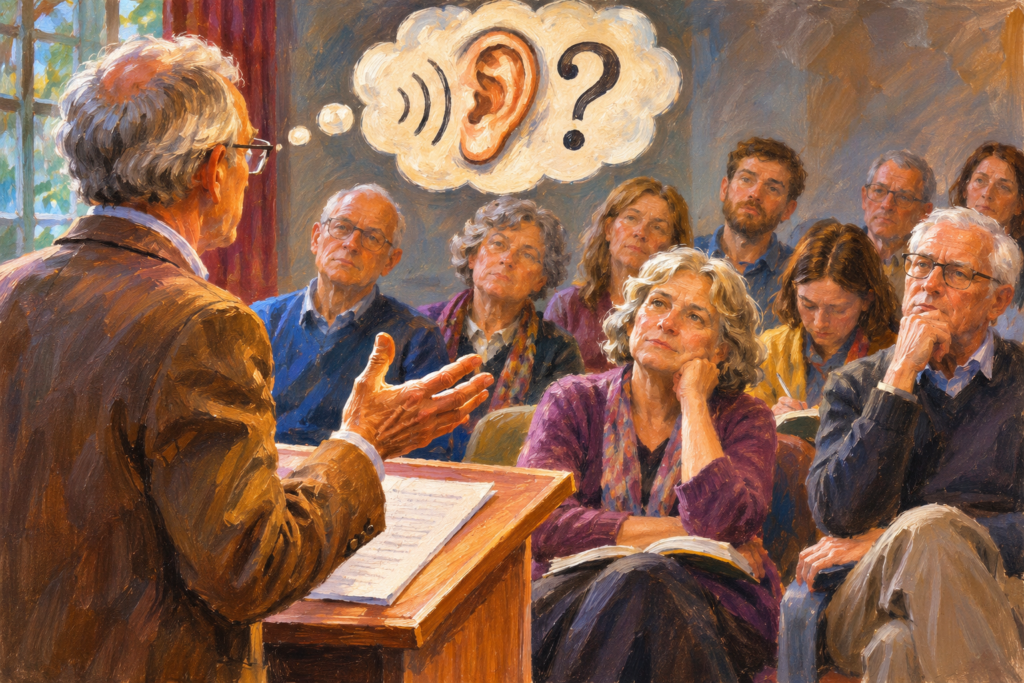
Having spent so much time reflecting upon the importance of being listened to, I must now turn the spotlight upon myself. How good am I at listening? It is easy to complain that other people do not absorb what we say, but rather less comfortable to consider whether we sometimes behave in exactly the same way. Do I listen with genuine curiosity, or am I preparing my reply while the other person is still speaking? Do I allow people to finish their thoughts, particularly when I think I already know what they are going to say? Do I listen differently to someone whose opinions I respect and someone whose views I regard as misguided? These are uncomfortable questions, but necessary ones.
True listening requires a degree of humility because we must be prepared to discover that another person knows something we do not. We must also be willing to tolerate pauses, uncertainty and incomplete explanations. Not everybody can express themselves fluently, and some people need time to find the right words. Others may have valuable insights concealed beneath an awkward manner of speaking. If we judge the value of someone’s contribution solely by their confidence or eloquence, we may overlook a great deal.
There is also the question of emotional listening, which is not quite the same as intellectual engagement. Sometimes people are not asking for advice at all; they simply want to know that their experience has been acknowledged. I suspect that I have occasionally offered solutions when what was really required was sympathetic attention. It is tempting, especially for someone who enjoys analysing situations, to regard every problem as something that must be solved. But human beings are not mechanical devices awaiting repair.
A person who has suffered a bereavement, disappointment or humiliation may not need an explanation of why the event occurred or a list of practical steps for overcoming it. They may simply need another human being to remain present long enough for them to express what they are feeling. In such circumstances, the quality of our attention may be far more valuable than the originality of anything we might say. Listening can itself become an act of generosity because we are offering something that cannot be manufactured or purchased: our time, our patience and our willingness to enter another person’s experience.
I am increasingly convinced that the decline of genuine listening contributes to the fragmentation of modern society. We have more methods of communication than at any previous time in human history, yet it is questionable whether we understand one another any better. Electronic messages can be exchanged instantly, opinions can be broadcast to thousands of people and disagreements can develop into public controversies within minutes. Yet the speed of communication does not necessarily improve its quality. Indeed, it may encourage us to respond before we have properly considered what another person is saying. Social media often rewards certainty, indignation and dramatic statements rather than patient reflection.
People can become more interested in demonstrating their allegiance to a particular group than in discovering whether an opposing argument contains any truth. Under these conditions, conversation risks becoming a performance in which each participant is addressing an invisible audience rather than the person immediately before them.
This has particular significance for the health of local communities. A community is not simply a collection of people living within a particular geographical area. It is a network of relationships, obligations, shared experiences and opportunities for mutual assistance. Such relationships cannot flourish without trust, and trust cannot develop unless people feel that their contributions are taken seriously. Someone who repeatedly feels ignored may gradually withdraw from participation, not necessarily because they have lost interest but because they no longer believe that their presence makes any difference.
This is particularly relevant to older people, newcomers and those who have experienced bereavement or separation. They may have much to contribute, but they need opportunities to be recognised as individuals rather than treated merely as recipients of services. A welcoming community is therefore not simply one that invites people to attend activities. It is one that makes room for their voices and allows them to influence what happens.
I return once more to the image of bread cast upon the waters, because perhaps the greatest mistake is to assume that the value of a conversation can be measured by the immediate response. A person may appear indifferent while inwardly considering every word. They may reject an idea today and return to it in six months. They may never adopt our particular viewpoint but nevertheless become more thoughtful because we challenged them. Equally, something we say casually may have a far greater effect than a carefully prepared argument.
A passing remark can encourage someone who is feeling discouraged, an unexpected compliment can restore confidence, and a question can open a door that has remained closed for years. Unfortunately, the opposite is also true. A careless criticism can remain in someone’s memory long after the speaker has forgotten it. We are constantly influencing one another, often without being aware of it, and this introduces both responsibility and mystery into ordinary human relationships.
The recognition that our influence is largely beyond our control should not make us passive. On the contrary, it should encourage us to take greater care over the quality of our contribution while becoming less attached to immediate results. We cannot control every interpretation of our words, and attempting to do so would make spontaneous conversation impossible. But we can cultivate an intention to communicate with honesty, kindness and courage. We can develop the habit of asking ourselves whether our words are necessary, whether they are likely to be helpful and whether the circumstances are appropriate.
We can learn to distinguish between a person who genuinely wants to understand and one who is merely waiting for an opportunity to contradict us. We can recognise that some disagreements are worth pursuing while others are best allowed to rest. Above all, we can resist the temptation to regard every conversation as a test of our personal worth.
As I reach the end of these reflections, I find that my original irritation at not being listened to has softened considerably. I began by feeling that some of my efforts to communicate had been wasted, but I now wonder whether the problem lies partly in my desire to see an immediate result. Perhaps I have been trying to harvest something before it has had time to grow. The people who most influenced my own life were not necessarily those who argued most persuasively or spoke most forcefully. Often they were individuals who demonstrated, simply by the way they lived, that another approach to life was possible.
They did not demand that I acknowledge their influence, and they may never have known that they influenced me at all. There is something liberating in that thought because it allows me to speak when I believe I have something worthwhile to contribute, listen when another person has something to teach me, challenge an assumption without attacking the person who holds it and withdraw when a conversation has become destructive.
I believe we need more people who are willing to think independently, question fashionable assumptions and express unpopular views without becoming aggressive or contemptuous. We also need more people who can listen without immediately classifying the speaker as an ally or an enemy. A community cannot flourish if everybody is afraid to speak, but neither can it flourish if nobody is prepared to listen. The two qualities belong together. Self-assertion without consideration becomes arrogance, while consideration without self-assertion becomes timidity. Somewhere between the two lies the possibility of genuine human encounter, in which people are sufficiently secure in themselves to exchange ideas without feeling that every disagreement threatens their identity.
Perhaps that is what I have been searching for all along: not agreement, not applause and not even confirmation that I have made a useful point, but simply the experience of two human beings meeting one another honestly, without pretence, and being willing to exchange something of value. If that happens, even occasionally, I think we can regard our efforts as worthwhile. And if it does not happen immediately, perhaps we should remember the muddy water, leave it alone and allow time to do its work.
After all, bread cast upon the waters was never intended to return the following morning.
