There are occasions when a few minutes can make the difference between life and death, or between a full recovery and permanent disability. A stroke is one of them.
This was the central message of a fascinating and informative talk given at Midsomer Norton Methodist Church by Dr Emily Abab, a local GP with specialist experience in stroke medicine. Although the subject was serious, sometimes alarming, the overall message was encouraging. Medical advances have transformed the prospects for many stroke patients, provided they receive treatment quickly enough.
What particularly impressed me was Dr Abab’s ability to explain a complicated subject without drowning her audience in medical terminology. Her purpose was not to turn us into amateur doctors but to make sure we recognised the warning signs and knew what to do.
A Personal Introduction
The evening was organised by the Friends of Somer Valley Medical Group, whose chair, Jenny Evans, began by explaining the organisation’s work.
As both a patient participation group and a registered charity, the Friends raise money to purchase additional equipment for local surgeries. Approximately £17,000 had been raised over the previous two years, an achievement made possible through raffles, donations and the efforts of volunteers.
Jenny also raised a concern about the group’s future. New committee members are proving difficult to recruit, and although she has been hoping to retire as chair, nobody has yet come forward to replace her.
Her own experience of stroke is deeply personal. Following her husband’s severe stroke, she became his full-time carer for six years.
A major stroke, she observed, does not necessarily affect just one life. It can completely transform the life of the person providing the care as well.
This brought an immediate human dimension to the evening.
What Happens When Someone Has a Stroke?
Dr Abab suggested that we think of a stroke as a brain attack, comparable in urgency to a heart attack.
The brain depends upon a constant supply of oxygen-rich blood. When that supply is interrupted, brain cells begin to suffer damage.
There are two main types of stroke. The more common is an ischaemic stroke, caused by a blood clot blocking an artery supplying the brain. The other is a haemorrhagic stroke, caused by a blood vessel bursting and bleeding into or around the brain.
Although the causes are different, the symptoms may look very similar. A brain scan is therefore essential to establish which type has occurred, because the treatments are quite different.
Dr Abab explained that strokes are far from uncommon and are increasingly being seen in younger people. Age remains an important risk factor, but nobody should assume that a person is too young to suffer a stroke.
The most important consideration is how quickly the symptoms are recognised.
FAST – Four Letters That Could Save a Life
This was undoubtedly the most important part of the presentation.
Dr Abab reminded us of the NHS FAST campaign, which identifies three common warning signs and the action required.
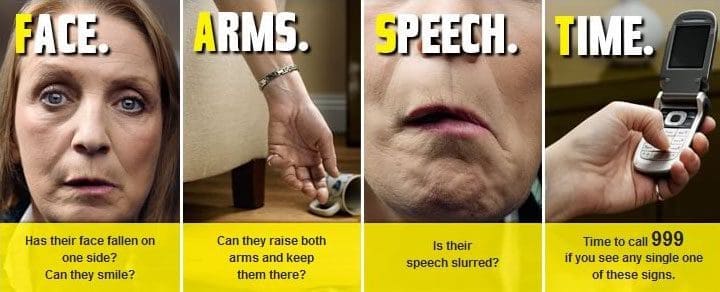
F – Face: Has one side of the face dropped? Can the person smile normally?
A – Arms: Can the person raise both arms and keep them raised?
S – Speech: Is their speech slurred, confused or unusually difficult?
T – Time: If any of these symptoms appear suddenly, call 999 immediately.
She emphasised that a person does not need to display all three symptoms. Just one sudden warning sign is sufficient reason to call an ambulance.
Many people hesitate because they do not want to waste the emergency services’ time. Others hope that the symptoms will disappear.
Unfortunately, that hesitation can have serious consequences.
Dr Abab explained that ambulance crews can assess the patient and alert the hospital stroke team before arrival, allowing investigations and treatment to begin more quickly.
She advised against driving the patient to hospital yourself, offering food or drink, or giving aspirin before the type of stroke has been established.
A stroke can affect swallowing, and aspirin may be dangerous if bleeding is involved.
Her message could hardly have been clearer: do not wait to see what happens.
Can We Reduce Our Risk?
One of the more encouraging aspects of the evening was learning how much can be done to reduce the likelihood of suffering a stroke.
Some factors, such as age and family history, are beyond our control. Others are not.
Dr Abab identified smoking, excess weight, physical inactivity, unhealthy diet and excessive alcohol consumption as important contributors.
She was particularly keen to encourage ordinary physical activity. Exercise does not necessarily mean joining a gym or taking up strenuous sport. Walking, gardening and housework can all be beneficial.
The general recommendation is around 150 minutes of moderate activity each week, but this can be divided into shorter periods. Three ten-minute walks may be easier to manage than one continuous half-hour session.
She also discussed the Mediterranean style of eating, with its emphasis on vegetables, fruit, whole grains, fish, nuts and healthier oils.
Alcohol deserves attention because it can increase blood pressure and contribute to an irregular heartbeat. She referred to the UK guideline of not regularly exceeding fourteen units a week, while pointing out how easily people underestimate the amount they drink.
The Silent Danger of High Blood Pressure
Of all the medical risk factors, high blood pressure received particular attention.
The difficulty is that it often produces no noticeable symptoms. A person can feel perfectly well while their blood pressure remains dangerously elevated.
This is why regular monitoring matters.
Doctors increasingly encourage patients to take readings at home, where the results may be more representative than those obtained during a potentially stressful surgery appointment.
Another important condition is atrial fibrillation, commonly known as AF. This causes an irregular heartbeat and can allow blood clots to form within the heart. A clot may then travel to the brain.
Appropriate blood-thinning medication can substantially reduce this risk in suitable patients.
Diabetes and high cholesterol are also significant because of their effects upon blood vessels.
What struck me was that stroke prevention is not simply a matter of telling people to live healthier lives. Identifying and properly managing existing medical conditions can be equally important.
The Mini-Stroke – A Warning Not to Ignore
Dr Abab also explained the significance of a transient ischaemic attack, or TIA, commonly called a mini-stroke.
The symptoms resemble those of a stroke but disappear, sometimes within minutes.
This can be misleading. Someone may feel perfectly normal afterwards and conclude that nothing serious has happened.
However, a TIA may be a warning of a more serious stroke to come.
The fact that symptoms disappear does not remove the need for urgent medical assessment.
This is another reason why the advice to call 999 applies even when someone appears to be recovering.
Remarkable Advances in Treatment
Dr Abab spoke enthusiastically about the progress made in stroke medicine during her career.
For certain patients with a clot-related stroke, doctors can administer medication to dissolve the clot. This treatment, known as thrombolysis, is generally considered within four and a half hours of the onset of symptoms.
Another development is thrombectomy, a procedure in which specialists physically remove a clot from a blocked artery.
In carefully selected cases, this may be possible up to twenty-four hours after the patient was last known to be well.
Neither treatment is suitable for everyone. The type of stroke, the location of the blockage and the patient’s circumstances all influence the decision.
For strokes caused by bleeding, treatment is different and may involve controlling blood pressure, reversing certain medications and occasionally surgery.
Dr Abab also described how ultrasound scans can identify narrowing of the carotid arteries in the neck. In some patients, surgery to remove a significant blockage can reduce the risk of another stroke.
The overall impression was of a branch of medicine that has made remarkable progress.
But there is an unavoidable condition attached to many of these advances: the patient must reach the right treatment in time.
Recovery Is Not Always the End of the Story
Surviving a stroke does not necessarily mean returning immediately to normal life.
Some patients experience weakness, problems with walking, difficulty speaking or swallowing, or changes in their ability to manage everyday activities.
Dr Abab described the work of rehabilitation teams, including physiotherapists, occupational therapists, speech and language therapists and dietitians.
Their aim is to help patients regain as much independence as possible.
Recovery may begin in hospital and continue at home or in a community rehabilitation unit.
She also discussed the restrictions on driving following a stroke or TIA. For ordinary car drivers, the usual minimum period without driving is one month, although returning to the road depends upon recovery and the relevant DVLA requirements.
For people living in rural areas, losing the ability to drive can be a considerable blow to their independence.
Questions That Brought the Subject to Life
The questions from the audience were particularly interesting because they moved the discussion away from medical theory and into people’s actual experiences.
One woman explained that she had suffered a stroke approximately three years earlier. Although she had recovered in many respects, her balance had never returned to normal, and she could no longer ride her bicycle.
She attended exercise classes and continued working on her balance, but the problem remained.
Dr Abab explained that strokes affecting particular areas towards the back of the brain can interfere with balance and coordination. The lasting effects depend upon which parts of the brain have been damaged.
Another participant described a relative who had experienced repeated episodes that were not initially recognised as possible mini-strokes.
This raised an important question: how does someone recognise a stroke if they are alone?
Dr Abab acknowledged the difficulty. A person may not notice that their face has dropped if they have not looked in a mirror. They may not realise that their speech is affected if they have not spoken to anyone.
It is therefore important to be alert to any sudden and unexplained change in normal abilities.
Are There Symptoms Beyond FAST?
Another question concerned symptoms not included in the FAST campaign.
Dr Abab explained that FAST is deliberately simple. It is designed to help the public remember the most recognisable warning signs, but it does not cover every possible stroke.
Sudden loss of vision in one eye, severe balance difficulties or sudden dizziness may also indicate a serious problem.
These symptoms can have other explanations, but they should not automatically be dismissed.
A further question concerned stress. Dr Abab agreed that stress can adversely affect health and may contribute to stroke risk. She also explained that conditions such as migraine can sometimes produce symptoms resembling a stroke.
Jenny Evans described another unexpected complication: her husband developed epilepsy several months after his stroke.
Dr Abab confirmed that seizures can occur following strokes, particularly more severe ones.
Finally, someone asked about the emotional consequences for families when a stroke proves fatal.
It was a reminder that the effects of a stroke extend well beyond the individual patient. Partners, relatives and carers may find their lives permanently changed.
Help for Patients and Carers
Towards the end of the evening, Sue, a care coordinator at Somer Valley Medical Group, explained how patients can obtain additional support.
Her role includes helping people who are experiencing practical or social difficulties and directing them towards organisations able to provide specialist assistance.
She had brought information about local and national services supporting stroke survivors and their families.
The Stroke Association was among the organisations mentioned.
Sue emphasised that people should not feel obliged to manage everything alone.
Sometimes a conversation with someone who understands the available services can make an enormous difference.
This applies particularly to carers, who may become so absorbed in looking after another person that their own needs receive very little attention.
My Reflections – Knowledge That Could Save a Life
I came away from the evening impressed not only by Dr Abab’s medical knowledge but also by the clarity and practicality of her presentation.
There is a natural tendency, particularly among older people, not to make a fuss. We may hope that an unusual symptom will disappear or persuade ourselves that it is probably nothing serious.
In the case of a stroke, that instinct can be dangerous.
I was also struck by how much modern medicine can now achieve. Treatments that would have been unavailable a generation ago can sometimes make an extraordinary difference to a patient’s prospects.
Yet even the most sophisticated treatment cannot recover time that has already been lost.
The questions from the audience were a valuable reminder that statistics and medical procedures tell only part of the story. Behind every stroke is an individual, and often a family, trying to come to terms with an unexpected change in circumstances.
Jenny Evans’s account of caring for her husband brought this home particularly powerfully.
The evening also demonstrated the value of the Friends of Somer Valley Medical Group. Such organisations do more than raise money for equipment. They bring professionals and patients together, encourage questions and help people become better informed about their own health.
It would be a great shame if the organisation’s future were threatened by a shortage of volunteers.
If I were to take away just one lesson from the evening, it would be this:
When a stroke is suspected, do not wait, do not hesitate and do not worry about making a fuss. Call 999.
A few minutes may change the course of someone’s life.
This article is an edited account of a public presentation, based on an automatic transcript rather than a verbatim record. Medical terminology has been clarified where necessary. It is intended for general information and should not replace professional medical advice.
