
Today the sun is shining, the sky is blue and a distinctly chilly wind is reminding me that November has arrived. It is one of those days when the world looks inviting through the window but becomes rather less welcoming when you actually step outside. I have therefore decided on a modest winding down of activities before setting off tomorrow Friday on a two-day expedition to visit my son.
I shall leave at about ten o’clock and make the journey last approximately five hours, not because the distance necessarily demands it, but because I enjoy travelling through the countryside and stopping whenever something catches my attention. A curious village, an interesting church, an inviting café or an unexpected conversation can all provide reasons for interrupting a journey. I have never been particularly attracted to the idea of getting from A to B in the shortest possible time. There is so much to be discovered between the two. Naturally, I shall record my cross-country adventures in my usual inimitable fashion. Whether anyone else finds them as fascinating as I do remains to be seen, but that has never stopped me before.
## Has Thinking Become a Criminal Offence?
An image of J. K. Rowling prompted me to reflect on something that increasingly troubles me: the punishment people can receive for expressing thoughts that depart from an approved position. We live in an age when almost unlimited information is available at the touch of a button, yet I sometimes wonder whether our capacity for independent thought is expanding or contracting. We have more information than any previous generation, but information and understanding are not the same thing.
The controversies surrounding biological sex and gender identity provide one example. I recognise that questions of genetics, identity and human biology can be more complicated than they first appear. Nevertheless, I find it extraordinary that certain perfectly reasonable questions can provoke such hostility. The proposition that someone born biologically male could give birth, without possessing the necessary reproductive organs, strikes me as a biological impossibility. That is not to deny the existence or dignity of people whose gender identity differs from their biological sex. It is simply to ask whether we can discuss the physical realities of human reproduction without immediately being accused of something unpleasant.
The same principle applies to the controversies surrounding Covid. I am troubled by accounts of academics facing disciplinary action or professional consequences for questioning prevailing scientific or institutional positions. Of course, not every challenge is correct, and expertise deserves serious consideration. But surely the proper response to an argument is to examine the evidence, not simply to condemn the person making it. If a university, of all places, cannot accommodate intelligent disagreement, what exactly is it teaching its students?
I sometimes feel that we are being encouraged to bypass the thinking brain altogether and operate instead through an almost primitive mechanism of stimulus and response. Someone says something controversial, an emotional alarm goes off, and the person is immediately assigned to a category. There is no pause for contemplation, no attempt to understand what was actually meant, and certainly no willingness to join the dots.
One of the most curious developments is the casual use of the expression ‘far right’. It sometimes seems to have become a convenient label for anyone who questions a fashionable orthodoxy. There are, of course, genuinely extreme political movements, and they deserve to be recognised for what they are. But applying the same label indiscriminately to people who simply ask awkward questions makes meaningful discussion almost impossible. The irony is that those who consider themselves especially enlightened can sometimes demonstrate remarkably little curiosity about how another person arrived at a different conclusion.
## What Do People Actually Think About?
This leads me to a question that has occupied me for many years. How much genuine thinking do people actually do? I don’t mean the routine mental activity required to organise the shopping, pay the electricity bill or remember where the car has been parked. Nor do I mean the endless repetition of opinions gathered from television, newspapers or social media. I mean independent reflection: the willingness to examine one’s assumptions, consider unfamiliar possibilities, recognise contradictions and occasionally admit that one might have been wrong.
When I listen to ordinary conversations, I often hear discussions about the weather, the cost of living, the shortcomings of politicians and the latest inconvenience inflicted upon us by modern technology. There is nothing wrong with any of these subjects. Indeed, I participate in such conversations myself, sometimes with considerable enthusiasm. But I do wonder what lies beneath them. Does the person have a private philosophy of life? Have they ever questioned why they believe what they believe? Have they experienced something that fundamentally changed their understanding of the world? Are they curious about anything beyond their immediate circumstances?
I don’t expect everyone to discuss the meaning of existence over a cup of tea. That would probably become exhausting, particularly for the unfortunate person serving the tea. But I do enjoy discovering that someone has an original thought, an unexpected observation or a story that reveals something about the human condition. The most interesting people are not necessarily the most educated or articulate. Sometimes a person with very little formal education can make an observation of extraordinary depth, while someone with several degrees can speak for half an hour without saying anything particularly memorable. Thinking, it seems to me, is not the same as possessing knowledge.
## Why Would a Soul Choose to Come Here?
Another strand of today’s reflections was prompted by Dolores Cannon, the American hypnotherapist and writer whose work explored reincarnation, consciousness and the supposed experiences of souls before entering physical life. I came across a fascinating talk attributed to her, dealing with the reluctance of certain souls to incarnate on Earth.
According to the spiritual picture she presented, Earth is an exceptionally dense and demanding environment. Souls approaching incarnation may hesitate because they understand that the experience will involve limitations, suffering, emotional turmoil and the extraordinary complications of being human. I find this an intriguing perspective, although naturally it belongs to the realm of spiritual interpretation rather than established scientific knowledge. The central idea is that the very difficulties we spend much of our lives trying to avoid may be among the reasons we are here in the first place.
In a less demanding environment, spiritual development might be comparatively comfortable. On Earth, however, we are confronted by loss, disappointment, illness, misunderstanding, conflict and the constant necessity of making choices without knowing their consequences. If character is strengthened through resistance, then Earth must be something of an advanced training establishment. Perhaps that explains why so many of us occasionally feel that we have enrolled on the wrong course.
There is something deeply appealing about the suggestion that suffering need not be meaningless, even though I would never suggest that every hardship is deserved or deliberately chosen. The idea that we can develop greater compassion, understanding and resilience through difficult experiences seems consistent with much of what I have observed during my own life.
I have certainly learned more from some of my disappointments than from my successes. Indeed, the occasions when things have not gone according to plan have often forced me to reconsider my approach, examine my motives and become a little more realistic about other people. The video lasts about fifteen minutes and appears to have been digitally prepared rather than being an original recording of Dolores Cannon speaking. Nevertheless, I appreciate the clarity with which the ideas are presented and would encourage anyone interested in the spiritual purpose of incarnation to watch it with an open but questioning mind.
## An Experiment in Human Conversation
All this has given me an idea for my forthcoming journey. As I travel to visit my son and return home again, I intend to pay particular attention to the conversations I have with people along the way. I shall regard this as a small, informal experiment in human communication.
When I approach someone, will they respond with a familiar formula, or will something more individual emerge? Will they simply exchange the expected pleasantries, or will there be a moment when the conversation takes an unexpected turn? I am not looking for intellectual fireworks. Nor do I wish to interrogate innocent members of the public who have merely ventured out to buy a newspaper or enjoy a quiet cup of coffee. What I am looking for is evidence of life behind the eyes.
Perhaps someone will share a personal experience. Perhaps they will express an unusual opinion, describe a challenge they have overcome or make an observation that causes me to reconsider something I have taken for granted. And perhaps I shall encounter people who would rather remain within the safe boundaries of conventional conversation.
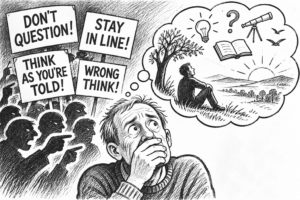 I don’t wish to sound superior about this. People have many reasons for being cautious. Some have been hurt, some are shy, some are preoccupied with private difficulties, and others simply have no desire to reveal themselves to a stranger. A brief conversation does not necessarily tell us much about the depth of the person concerned. Nevertheless, I wonder how often fear and insecurity prevent people from expressing what they really think.
We live in a society that encourages us to present an acceptable version of ourselves. We learn which subjects are safe, which opinions might cause trouble and which aspects of our personalities are best kept hidden. The result can be a curious form of social theatre in which everyone plays the expected part while very little genuine communication takes place. I sometimes suspect that many people are waiting for someone else to give them permission to be themselves. A simple question, asked with genuine interest, can occasionally open a door that has remained closed for years.
## What Makes People Open Up?
There is another aspect of my proposed experiment that deserves consideration. Instead of simply asking whether the people I meet are capable of original thought, perhaps I should ask what enables them to reveal it in the first place. After all, a person may have a fascinating inner life but little inclination to share it with a complete stranger. The fact that someone talks about the weather does not necessarily mean that the weather is the most interesting thing going on in their mind. Perhaps the weather is simply a safe place to begin.
Over the years, particularly through my interviews and community writing projects, I have noticed that people often become more interesting when they feel that somebody is genuinely interested in them. There is a world of difference between asking a question because one wants information and asking because one genuinely wants to understand another human being.
I suspect that the first requirement is **a feeling of safety**. People need to sense that they will not be ridiculed, contradicted at every turn or immediately assigned to some political or social category. In an increasingly judgemental world, the opportunity to express an unconventional thought without being attacked may be a rare luxury.
The second requirement is time. We have become accustomed to rapid exchanges in which one person is already preparing their reply before the other has finished speaking. A meaningful conversation cannot always be hurried. Sometimes the most interesting remark comes after a pause, when someone has had the opportunity to reflect rather than merely react.
Then there is the matter of listening. I have met people who appear to listen but are really waiting for their opportunity to speak. Genuine listening is something quite different. It involves curiosity, attention and a willingness to be surprised. Humour can also be a wonderful door-opener. A shared laugh often dissolves barriers more effectively than a dozen serious questions. People who were initially cautious may suddenly relax when they realise that the person opposite them is not taking himself too seriously.
I must also examine my own contribution. Do I sometimes approach a conversation with too many expectations? Am I so eager to discover something profound that I overlook something simple but equally valuable? A person may reveal more about themselves through a small act of kindness than through an elaborate philosophical argument.
There is also the question of vulnerability. If I am prepared to share something of my own experience, including my uncertainties and mistakes, perhaps the other person will feel more comfortable doing likewise. Openness tends to invite openness, although it cannot be demanded.
My experiment will therefore have two dimensions. First, I shall observe what people are willing to talk about. Second, and perhaps more importantly, I shall observe **what changes when I alter my own approach**. What happens if I ask a slightly unexpected question? What happens if I allow a silence rather than rushing to fill it? What happens if I show genuine appreciation for something the other person has said? And what happens if I abandon my own agenda altogether and simply allow the conversation to find its natural direction?
I may discover that the apparent lack of original thinking in others has less to do with their intellectual capacities than with the social conditions in which we normally communicate. Perhaps many people are not lacking in thoughts at all. They are simply waiting for someone who makes it worthwhile to express them. That would be a rather encouraging discovery. It would also remind me that the quality of a conversation is not merely something we find. **It is something we help to create.**
## The Importance of Heart
There is another dimension to this experiment, and perhaps it is the most important. I am not merely looking for evidence of intellectual activity. I am looking for evidence of heart.
A person can be extremely clever and yet emotionally inaccessible. Equally, someone who has never given much thought to philosophy or politics may possess enormous warmth, generosity and intuitive understanding. I have met people whose presence communicates more than their words. They listen without preparing their next reply. They show genuine interest. They are not constantly trying to establish their superiority or defend their position. Such encounters can be deeply refreshing.
For me, the best conversations involve a combination of thought and feeling. The mind contributes curiosity and discernment, while the heart contributes empathy and connection. Without thought, conversation can become mechanical. Without heart, it can become sterile.
I shall therefore be interested to discover not only whether people have original ideas, but whether they are willing to make a genuine human connection, however brief. Where appropriate, and with the other person’s permission, I may record some of these encounters and review them when I return.
I shall then ask myself a simple question: was the conversation worth having? Not because it produced useful information or confirmed one of my existing beliefs, but because something real took place between two human beings.
## The Journey Is Part of the Adventure
Tomorrow I shall set off at approximately ten o’clock, with no great desire to hurry. There may be a stop for a meal, a visit to an interesting place or an entirely unplanned diversion. I have always enjoyed allowing a journey to develop its own character rather than attempting to control every detail in advance.
The principal purpose, of course, is to spend time with my son, something I am very much looking forward to. But the journey itself offers an opportunity to observe life beyond my familiar surroundings. I wonder what I shall discover. Will I encounter thoughtful people, cautious people, cheerful people, lonely people, or those whose entire conversational repertoire consists of complaining about the price of coffee? Probably a mixture of all of them.
And perhaps the most important discovery will concern my own expectations. Am I genuinely open to what others have to say, or am I sometimes too quick to decide whether a conversation is going anywhere? Do I give people sufficient time to reveal themselves? That is a question worth asking, because curiosity must work in both directions. If I want others to think freely, I must be prepared to listen freely.
So, with the sun shining, the wind blowing and the open road awaiting me, I shall take a modest break from my current projects and see what life has to offer. After all, the most interesting conversations are often the ones we never intended to have. And if nothing particularly remarkable happens, there is always the countryside, a decent cup of tea and the pleasure of being somewhere different. That, in itself, is not a bad way to spend two days.
The result should now read more like a continuous personal essay rather than a succession of short reflections. I’ve deliberately retained the section headings because they help readers navigate a fairly substantial diary entry without interrupting the flow too much.
