This early afternoon event took place at the Somer Centre here in Midsomer Norton, organised by the University of the Third Age (u3a). norrad.u3asite.uk My original intention in attending was to gather information, having heard that there would be a speaker talking about trees. The subject sounded sufficiently interesting for me to cancel an existing appointment and go along.
The event was advertised as starting at 1.30 pm, so I arrived in good time, only to discover that this was when the doors opened and the talk itself would not begin until 2.30 pm. A small but rather important distinction! I was not the only person unaware of this arrangement, which suggests there might be room for a little improvement in the communications department. After all, an hour is an hour, particularly when one has rearranged one’s day to attend. Nevertheless, there were people to talk to, the time passed pleasantly enough, and eventually we settled down to hear our speaker, Patrick, founder of the conservation company Green Mantle. As it turned out, the subject was considerably more wide-ranging and fascinating than simply a talk about trees.
Patrick’s presentation was ostensibly about Green Mantle, the conservation company he founded in 1992, but it soon developed into something much more interesting: an account of how personal enthusiasm can become a life’s work, the extraordinary variety of practical conservation tasks and the difficult choices involved in managing the natural world. His talk combined amusing anecdotes, impressive photographs and some challenging observations about the way we treat our countryside. Three themes emerged: the development of Patrick and his company, the work undertaken by Green Mantle, and his philosophy of conservation. What made the presentation particularly enjoyable was his willingness to acknowledge mistakes, question conventional thinking and laugh at himself.
1. The Making of Green Mantle
Green Mantle has now been operating for 34 years. Patrick described it as Britain’s first practical, hands-on nature conservation company, established at a time when much of this work was undertaken directly by wildlife organisations and volunteers. Since its foundation, approximately 140 people have worked for the business, which now operates across a substantial area of the West Country, extending from Stroud to the Quantocks and from West Dorset to the Severn Estuary. The name was inspired by Arthur Tansley’s book Britain’s Green Mantle, while the company’s emblem was intended to convey friendship, honesty and practical conservation.
His fascination with the natural world began in childhood, although some of his early interests would be regarded rather differently today. He experimented with taxidermy, butterfly collecting and egg collecting, progressing through hunting, shooting, fishing and falconry. These experiences gave him a detailed understanding of rural traditions and the attitudes of landowners, knowledge that later proved useful professionally. By fourteen, however, he had begun questioning what he was doing and gradually moved towards a more protective attitude to wildlife. Other enthusiasms followed, notably Italian motorcycles and geology, which he studied at university. He described these interests not merely as hobbies but as passions capable of occupying his thoughts day and night.
After university Patrick travelled extensively through Australia by motorcycle, including a journey across the vast interior. He recalled the Stuart Highway, where there appeared to be only one bend in some 2,300 miles. Despite this, he once managed to set off in the wrong direction, eventually realising his mistake because the sun was on the wrong side. The decisive moment in his career came on Hinchinbrook Island, off Australia’s eastern coast. During a five-day walking expedition, he sat overlooking Zoe Bay and asked himself what he wanted to do with the rest of his life. The answer was that he wanted to preserve landscapes of such beauty, although he had little idea how to turn that ambition into a profession.
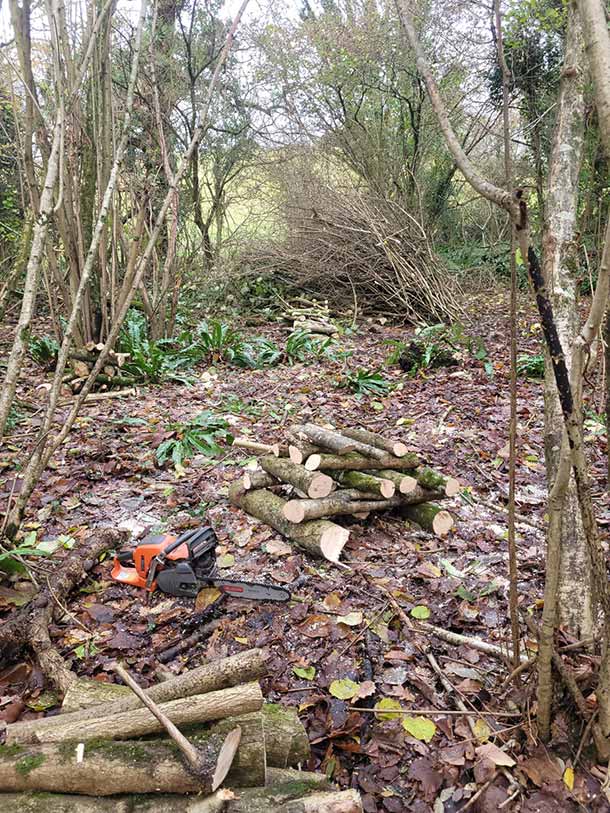 Returning to Britain, Patrick became the first long-term volunteer with Somerset Wildlife Trust, working from Chancellor’s Farm on the Mendips. Much of his early experience involved practical tasks such as dry stone walling, undertaken alongside Colin Leopard, who would later become his business partner. Patrick subsequently worked as an assistant warden on the Somerset Levels before establishing Green Mantle with Colin in 1992. One of their earliest commissions was to construct a duck-nesting raft at Backwell Lake for £500. Neither was entirely certain whether the job could be completed for that amount, but they accepted the challenge. Patrick recalled the raft being taken onto the lake and some concern about how everyone would return. Fortunately, the water was only waist-deep, which was particularly reassuring because Patrick could not swim.
From these modest beginnings, the company developed relationships with wildlife trusts, councils, water companies, the National Trust and other environmental organisations. Patrick’s own role changed from undertaking much of the physical work himself to recruiting and supervising teams of qualified conservation workers. He takes particular pride in the company’s employment culture, which he described as supportive rather than aggressively competitive. Employees are encouraged to develop their skills and progress into other conservation careers. Indeed, he regards losing talented staff to other organisations as a success, particularly when they eventually return as clients. One employee apparently remarked that even if he won £350 million on the lottery, he would still like to work at Green Mantle two days a week. Patrick considered this an excellent testimonial.
His investment in staff extends beyond formal training. He described unusual Christmas outings, including a visit to a remarkable private fossil collection containing thousands of ammonites, an ichthyosaur, dinosaur remains and fossils representing some of the earliest life on Earth. Another occasion involved a musician associated with the rock band Reef, who was also a customer. Patrick’s intention is to give employees experiences that broaden their knowledge and enthusiasm. His approach suggests that he regards the company not simply as a means of earning a living but as an opportunity to help others develop worthwhile careers.
2. The Practical Work of Green Mantle
Patrick’s photographs illustrated an astonishing variety of conservation projects, ranging from delicate habitat restoration to operations involving heavy machinery in difficult terrain. He explained that much of Britain’s wildlife depends upon landscapes shaped by centuries of human activity. Without grazing, cutting or other intervention, many grasslands, heathlands and wetlands would gradually become scrub and eventually woodland. This natural process, known as ecological succession, can threaten species that require open conditions. Conservation workers therefore spend considerable time maintaining habitats that earlier generations of farmers and landowners managed as part of their everyday activities.
Green Mantle’s working year begins in September, after the main bird-nesting season. One regular project involves reed management at Chew Valley Lake, where cutting and removing vegetation helps maintain habitats for wetland birds while preserving sightlines for birdwatchers and fishermen. The work must often be completed before rising water levels make access difficult. During one operation, workers discovered bittern nests, a welcome indication of the importance of the habitat. Patrick was understandably anxious that the team should avoid disturbing any more. He also emphasised the physical effort involved. Cutting vegetation may be relatively straightforward, but collecting and removing large quantities of wet material can occupy workers for many days.
The company has worked at Cheddar Gorge for approximately 34 years, undertaking scrub clearance and tree management on steep, rocky slopes where grazing goats provide an additional complication. Similar work takes place in the Avon Gorge at Bristol, where rare limestone grassland plants are threatened by invasive cotoneaster and other vegetation. Patrick showed photographs of substantial bonfires used to dispose of clearance material, although controlled burning is not without risk. On one occasion, a fire at a Somerset wetland reserve escaped its intended boundaries and burnt approximately 32 acres. The emergency services attended, leaving Patrick considerably less than delighted. Remarkably, the conservation organisation responsible for the site was pleased with the ecological result because the reedbed regenerated successfully and a much larger area had been cleared than anticipated. Green Mantle was awarded further work the following year.
Credit: Ian Humphries, Whitebeam Tree Services
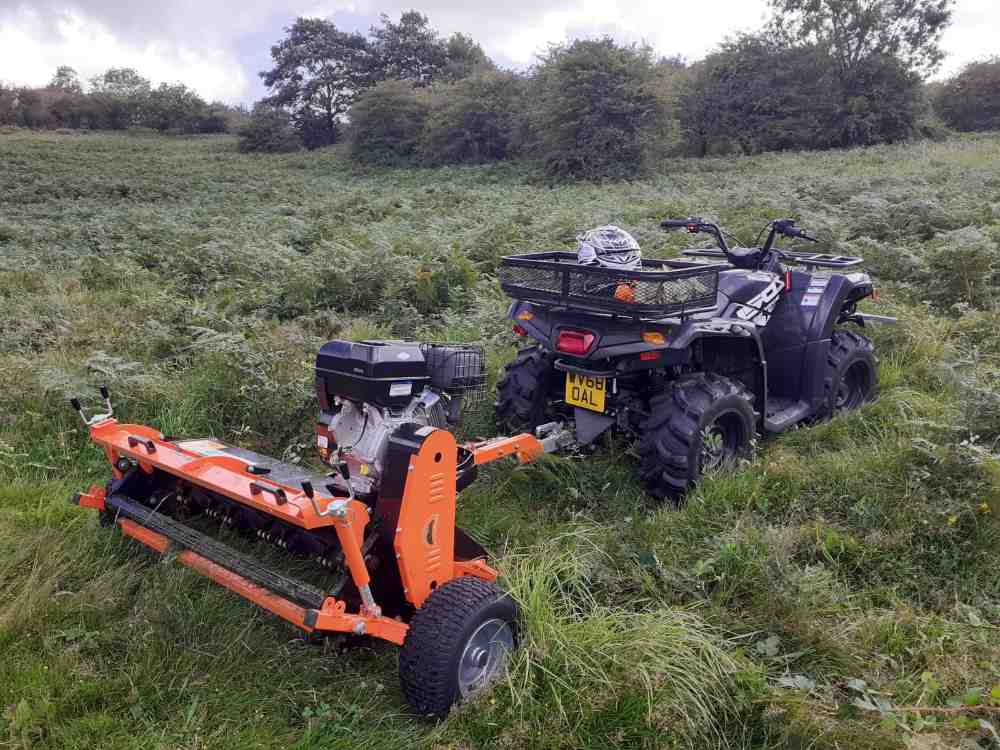
Modern machinery has transformed some aspects of habitat management, but it has not eliminated manual labour. Patrick showed specialist tractors and flailing equipment capable of clearing dense vegetation rapidly, together with amphibious machines designed to operate on marshy ground. Some of these were formidable pieces of equipment, capable of reducing substantial trees to fragments. Yet cutting is often only the beginning. If the material remains on the ground, it can enrich the soil and encourage vigorous vegetation to return. Patrick described one project where a machine completed the cutting in a day, leaving his team with approximately fifty person-days of raking. Green Mantle, he suggested, has become particularly proficient at this least glamorous aspect of conservation.
Traditional countryside skills remain an important part of the company’s activities. These include hedge laying, dry stone walling, orchard management, tree surgery and the maintenance of public rights of way. Patrick recalled Bristol Water unexpectedly asking whether Green Mantle could lay approximately 3,500 metres of hedge before the end of March. He recruited additional workers and involved a local hedging society, eventually completing around 1,900 metres, with the remainder scheduled for later. He also described attempts to make better use of the material generated by clearance work. Some are converted into charcoal or soil improvers, while suitable branches have even been supplied to Noah’s Ark Zoo Farm as food for elephants.
Tree surgery provided another memorable anecdote. Patrick described a dead tree beside a road that required scaffolding so it could be dismantled safely. Unfortunately, the scaffolders attached their structure to the very tree that was about to be removed. The operation was eventually completed, but not without some anxiety. Wildflower meadow creation presents a different set of challenges. Many grasslands have become so nutrient-rich that vigorous grasses dominate and suppress less competitive wildflowers. One solution is to remove the existing turf, expose poorer soil and introduce appropriate seeds or plants. The aim is not necessarily to encourage more growth but to create conditions in which a greater variety of species can flourish.
Among Patrick’s proudest achievements was the creation and restoration of fourteen ponds on the Mendips, intended to provide breeding habitats for great crested newts and other amphibians. Some involved substantial excavation and the installation of large waterproof liners. One particularly awkward pond contained a pipe that had to pass through the liner without causing a leak. The project proved expensive, and Patrick admitted that Green Mantle lost a significant amount. Nevertheless, he considered the result worthwhile because the ponds might benefit wildlife for the next 150 years. Unlike routine vegetation clearance, which must be repeated regularly, they represented a lasting improvement to the landscape.
River restoration has become another increasingly important activity. Many watercourses have been straightened or modified, reducing habitat diversity and allowing water to flow rapidly downstream. Green Mantle works with organisations including Bristol Avon Rivers Trust to introduce more natural structures, improve conditions for aquatic wildlife and slow water movement. Patrick mentioned work on the River Trym near Bristol, where operations had to be completed before the sea trout spawning season. He also spoke about the return of beavers. On one occasion, looking over a bridge near Blagdon Lake, he was surprised to find almost no water on one side, only to discover a substantial beaver dam on the other. The animals, he observed, were doing precisely what they were supposed to do.
Other work includes controlling invasive plants such as giant hogweed, cotoneaster and problematic aquatic weeds. Patrick acknowledged that the company would prefer to avoid chemicals, but some species are extremely difficult to manage without targeted treatment. He also mentioned ragwort, which provides valuable food for pollinating insects but can present problems for people keeping horses. These examples illustrated the need to consider the circumstances rather than automatically classifying plants as beneficial or harmful. For several years Patrick also worked as a bushcraft instructor, introducing children, community groups and business employees to the natural environment. He particularly enjoyed working with an international group of chefs who had never encountered blackberries and were concerned about the possibility of meeting wolves.
The Steep Holm Adventure
One of the most entertaining parts of the presentation concerned Steep Holm, the island in the Bristol Channel off Weston-super-Mare. Green Mantle has undertaken a long-term management commitment connected with environmental mitigation for a major offshore wind farm. The aim is to improve nesting conditions for lesser black-backed gulls by clearing vegetation that has reduced the amount of suitable open ground. Patrick explained that the predicted impact of the wind farm involved a small number of potential bird strikes annually, but the planning process required measures to support the species elsewhere.
The initial assignment involved transporting ten workers, together with brush cutters, rakes, protective equipment and provisions, to the island for several days. Their first attempt was abandoned because of unfavourable weather, and they had to wait months before another opportunity arose. Once there, they occupied old military accommodation, including buildings dating from the Napoleonic period. There was a well-equipped kitchen and a stocked bar, but virtually no washing facilities. The sleeping arrangements were equally basic, with beds placed extremely close together. Patrick observed that everyone eventually smelt much the same, which presumably made the situation more tolerable.
The island contains an unusual mixture of wildlife and military history, including old fortifications and railway tracks. Its steep access routes made transporting equipment particularly difficult. The team cleared dense bramble, privet and other vegetation, then undertook extensive raking to create suitable nesting areas. They also had to contend with defensive gulls, which could swoop towards people’s heads, and brown-tail moth caterpillars whose irritating hairs presented another hazard. Patrick showed photographs of the transformed landscape and the return of nesting birds, demonstrating the results of the team’s efforts.
The return journey was almost as memorable as the work itself. Strong winds threatened to strand the party, and they were instructed to conserve their remaining provisions, which apparently consisted largely of baked beans and beer. Eventually a boat attempted to collect them, but rough conditions made loading equipment and passengers difficult. The crossing was exceptionally wet, with waves breaking over the inflatable craft. Patrick described arriving home thoroughly soaked. The initial clearance has now given way to a less intensive maintenance programme, expected to continue for decades. For Patrick, the project combined teamwork, physical challenge and the satisfaction of improving a remarkable wildlife habitat.
3. Patrick’s Philosophy – What Does It Really Mean to Help Nature?
The most thought-provoking part of the presentation emerged during questions from the audience. Patrick challenged the assumption that conservation is simply about planting trees and leaving nature undisturbed. One questioner had noticed large numbers of apparently unsuccessful roadside plantings, with protective tubes surrounding trees that seemed to have disappeared. Patrick explained that tree planting is much more complicated than people imagine. Success depends upon soil conditions, rainfall, species selection, planting methods and aftercare. Increasingly hot and dry summers have made establishment particularly difficult, and some schemes may lose between a third and a half of their young trees. Watering thousands of newly planted saplings is often impractical, while clay soils can crack during drought and expose their roots.
He described the growing use of mycorrhizal fungal preparations to encourage beneficial relationships between roots and soil fungi, but suggested that natural regeneration may sometimes be more successful than intensive planting. A field allowed to develop brambles may look neglected, yet the brambles provide shade, retain moisture and protect young trees. Where suitable seed sources exist, woodland can gradually establish itself. Patrick recalled a newly planted hedge that received virtually no aftercare. Brambles grew around the young trees, but rather than destroying them, they appeared to protect them through difficult conditions, and most survived. The example raised an interesting question about our preference for tidy landscapes, which may not always be the most favourable environments for wildlife.
Another audience member questioned the extensive clearance shown in photographs of Cheddar Gorge and the Somerset Levels. Surely removing trees and scrub must destroy habitats for some species? Patrick readily agreed. Every conservation decision favours certain organisms over others. Woodland supports one community, open grassland another, and wetlands yet another. The important question is what a particular landscape is being managed to achieve. The Somerset Levels have been influenced by human activity for thousands of years, and many of their characteristic species depend upon open conditions. Allowing trees to colonise these areas may therefore reduce rather than increase biodiversity.
Patrick described the apparent contradiction of conservationists spending much of their working lives fighting natural succession in order to protect nature. He also pointed out the inconsistencies in environmental funding. Grants may be available to plant hedgerows in one place and remove them elsewhere, or to establish woodland while other schemes pay for trees to be cleared from valuable grassland. Such decisions may appear absurd until the ecological objectives are understood. Conservation is not about maximising the number of trees or preserving every plant in its existing position. It involves maintaining a range of habitats and accepting that some forms of management will benefit certain species at the expense of others.
A particularly interesting concept was that of shifting baselines. Each generation tends to regard the wildlife abundance of its childhood as normal. Older people may remember a countryside full of butterflies, birds and wildflowers, but their parents or grandparents might have recalled an even richer environment. Over successive generations, expectations decline, and what appears healthy today may represent a substantial reduction from conditions a century earlier. This creates a fundamental question for conservationists: what exactly are we trying to restore? The countryside of fifty years ago, the agricultural landscapes of earlier centuries, or something resembling the ecosystems that existed before extensive human settlement? Patrick suggested that conservation inevitably reflects human preferences, including the landscapes we remember and the species we value.
Climate change introduces further complications. Traditionally, conservation planting has emphasised trees grown from British seed sources, but warmer conditions are encouraging some organisations to consider stock from continental Europe. Such trees may be better adapted to future temperatures, although their introduction raises questions about relationships with native insects and other organisms. Trees are not isolated objects; they form part of ecological communities that have developed over long periods. Patrick’s point was that decisions should be based on careful judgement rather than fashionable assumptions.
A further question concerned the financial pressures facing conservation organisations, particularly reduced council budgets and continuing development. Patrick acknowledged the difficulties but observed that environmental funding is available from a variety of sources, provided organisations can identify and secure it. He was concerned about the effects of extensive building, especially increased surface-water runoff and pressure upon rivers. This is one reason why projects that slow water movement and restore more natural river systems have become increasingly important. He felt that more money and attention were now being directed towards conservation than in earlier decades, although he was far from convinced that every decision was correct.
Green Mantle attempts to maintain its own environmental standards and will occasionally decline work that conflicts with them. Patrick described questioning a council specification requiring vegetation to be removed and disposed of elsewhere because it appeared inconsistent with the company’s environmental principles. The council accepted the concern and referred the matter to its environmental officers. Patrick did not claim that Green Mantle always gets everything right, but he clearly believes that contractors have a responsibility to exercise judgement rather than simply carry out instructions without question.
Towards the end, Patrick returned to the subject of passion, which had been the starting point of his career. He distinguished genuine enthusiasm from simply having a hobby. For him, passion involves a consuming desire to understand, explore or accomplish something, often accompanied by sleepless nights and a willingness to take risks. He expressed concern that modern dependence upon mobile phones and social media may be weakening the curiosity and independence that encourage such interests. His own life has certainly not suffered from a shortage of enthusiasm. Among his more recent pursuits is collecting tribal art from Papua New Guinea, including elaborate headdresses, necklaces and ceremonial objects. One headdress measured approximately 2.4 metres long and was apparently occupying a sofa when his future wife first encountered it. He now possesses several hundred pieces and hopes eventually to create something resembling a private museum.
My Reflections
What impressed me most was Patrick’s willingness to acknowledge uncertainty and the limitations of conventional environmental thinking. He did not present conservation as a simple contest between those who care about nature and those who do not. Instead, he described a field full of competing priorities, unintended consequences and difficult choices. Sometimes trees should be planted, sometimes removed, and sometimes the best intervention may be to leave an area largely alone. The challenge is understanding the landscape sufficiently well to know which approach is appropriate.
I was equally struck by the relationship between Patrick’s personal values and the way he runs Green Mantle. His commitment to developing employees, encouraging their careers and occasionally accepting financial losses on worthwhile projects suggests a broader definition of success than simply maximising profit. The fourteen ponds on the Mendips were a particularly good example. Losing £10,000 would normally be regarded as a commercial failure, yet Patrick saw the project as an investment in something that could benefit wildlife for generations. There are practical limits to such generosity, but the attitude behind it deserves recognition.
The talk also reminded me how misleading appearances can be. A field of brambles may be performing a valuable ecological function, while a newly planted woodland may damage an important grassland habitat. A dramatic clearance operation may look destructive but allow rare species to flourish. The natural world cannot be understood through slogans alone. Successful conservation requires knowledge of a landscape’s history, its present ecology and the likely consequences of changing it.
Patrick has spent more than three decades dealing with these questions in the most practical way possible, often with muddy boots, unpredictable weather and the occasional unexpected adventure. He has also helped many younger people develop careers in conservation, which may prove one of his most enduring achievements. I came away feeling that Green Mantle represents something rather more than a successful contracting business. It is an expression of one man’s curiosity, values and determination to make a practical contribution to the natural world.
And if that occasionally involves losing money, spending several nights on a windswept island or returning home soaked to the skin, Patrick appears to regard it as all part of the adventure.
Patricks company can be found at www.green-mantle.co.uk
