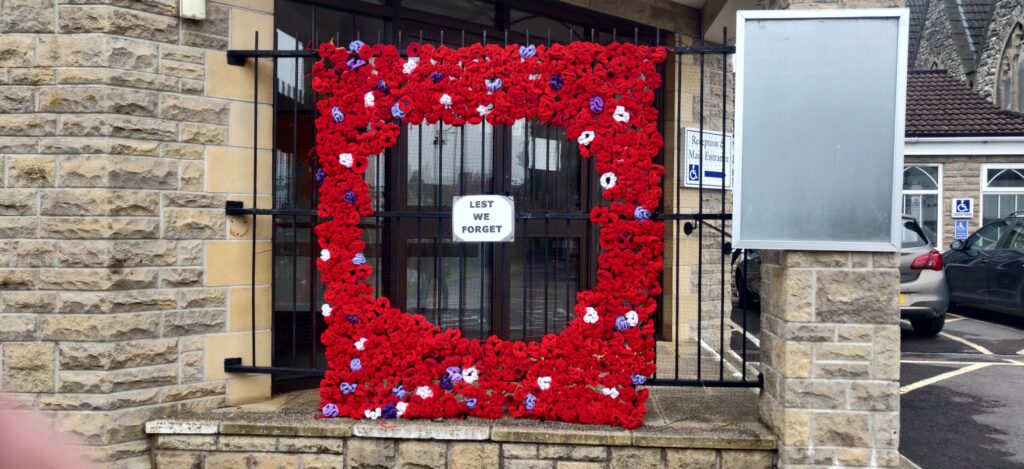
This morning I attended a Remembrance Sunday service, an occasion which always gives me cause to reflect not only on the enormous sacrifices made by previous generations, but also on the rather troubled world we have managed to create for ourselves. There is something about Remembrance Sunday that encourages us to stop and consider matters which, during the ordinary course of our busy lives, we tend to push into the background. We are constantly bombarded with information, opinions, arguments and demands upon our attention, yet how often do we give ourselves the time and space to consider what really matters?
The service began with a reflection on precisely this problem. We live in a world where communication is almost instantaneous, yet genuine understanding often seems in short supply. Power and money frequently speak more loudly than love and peace, and the constant pressure to react leaves little opportunity for thoughtful reflection. Against this background, the words of the prophet Micah seemed particularly appropriate: What does the Lord require of you but to do justice, to love kindness and to walk humbly with your God? It struck me that these few words contain a remarkably complete guide to human behaviour. If we actually practised them, rather than merely admired them, the world would be a very different place.
We were reminded that the purpose of Remembrance Sunday is not simply to honour those who died in the two world wars and subsequent conflicts, but also to renew our commitment to reconciliation between nations. Prayers were offered for those who continue to suffer the consequences of warfare, including the bereaved, the injured and those whose lives have been permanently disrupted by violence and terror. It is worth remembering that wars do not really end when the politicians sign their agreements or the soldiers return home. The effects continue in families, communities and sometimes entire nations for decades afterwards. The physical destruction may eventually be repaired, but the emotional and psychological consequences are not so easily dealt with.
We sang O God, Our Help in Ages Past, one of those traditional hymns which seem particularly appropriate on occasions such as this. I find that familiar hymns have a way of connecting us with earlier generations. The words have been sung by people who lived through circumstances we can scarcely imagine, and yet the underlying human concerns remain much the same. We still seek security, meaning, protection and some assurance that there is a greater purpose behind the apparent confusion of human affairs.
The Lord’s Prayer followed, together with the familiar words of remembrance, including We will remember them, and the Kohima Epitaph, which reminds us that the lives of the fallen were sacrificed for the benefit of those who came afterwards. A list of local men who had died during the First World War was also read aloud. I found myself thinking about how easy it is to regard these events as history, something safely contained within the pages of books or commemorated on stone memorials. Yet each person represented a life interrupted, a family affected and a future that never happened. Behind every name was a human being who probably had much the same hopes, fears and everyday concerns as ourselves.
The service included further singing, followed by a reading from St John’s Gospel, chapter 15, in which Jesus speaks about love, friendship and the importance of remaining faithful to his teachings. The passage includes the familiar declaration that no greater love can be shown than to lay down one’s life for one’s friends. These words are often associated with those who died in war, and understandably so, but I think their significance extends considerably further. They speak of the willingness to put the welfare of others before our own interests, something that is not necessarily fashionable in a society which places such emphasis on personal achievement, individual rights and material success.
What particularly interested me was the connection between love and action. It is easy enough to say that we love our fellow human beings, but what does that actually mean in practice? Are we prepared to inconvenience ourselves for somebody else? Will we listen to someone whose views differ from our own? Can we offer encouragement to a person who is struggling, without expecting anything in return? These are not dramatic acts of heroism, but perhaps they are the everyday expressions of the same principle. We cannot all be called upon to make the ultimate sacrifice, but we can certainly make smaller sacrifices in the interests of others.
This thought was reinforced by the Act of Commitment, during which we were invited to dedicate ourselves afresh to the service of God and our fellow men and women. The words referred to helping, encouraging and comforting others, supporting those working to relieve suffering, and contributing to the peace and welfare of the nation. The accompanying prayer asked for wisdom, courage, hope and faithfulness. I was particularly struck by the inclusion of courage. We tend to associate courage with dramatic situations, but it can take considerable courage simply to stand up for what is right, to speak honestly when silence would be more convenient, or to offer friendship to someone who has become isolated.
The congregation then sang God Save the King, and the service concluded with a blessing asking for peace, unity and concord among the Church, the King, the Commonwealth and all people. There was something reassuring about the familiar structure of the service, with its mixture of scripture, prayer, music and remembrance. At a time when so much of society seems to be changing at an extraordinary rate, these occasions provide a welcome sense of continuity.
As I reflected on the service, I found myself returning to the question of what remembrance actually achieves. We rightly honour those who died, and I would not wish to diminish the importance of the ceremonies, wreaths, memorials and traditions associated with the occasion. But I wonder whether we sometimes find it easier to commemorate the sacrifices of the past than to confront the responsibilities of the present. We can stand respectfully for two minutes in silence, yet still return almost immediately to the arguments, divisions and prejudices that contribute to conflict in the first place.
There is also a danger of regarding war as something inevitable, an unfortunate but permanent feature of human existence. Certainly, history provides plenty of evidence to support such a gloomy conclusion. Yet I cannot help feeling that accepting conflict as inevitable risks becoming a self-fulfilling prophecy. If we genuinely believe in peace, reconciliation and justice, surely we have an obligation to examine the attitudes and assumptions that make peaceful relationships so difficult, whether between nations, communities or individuals.
I was also conscious of the contrast between the simplicity of the Christian message and the complexity of the world in which we attempt to apply it. Love your neighbour, practise kindness, seek justice and walk humbly. None of these instructions requires an advanced degree in theology, yet humanity has spent centuries finding reasons why they cannot always be followed. Perhaps the problem is not that we fail to understand the message, but that we find it inconvenient.
For me, the most valuable aspect of Remembrance Sunday is that it invites us to move beyond ourselves. We are reminded that our present freedoms and opportunities did not simply appear by accident, and that many people paid a terrible price for the world we inherited. But gratitude should surely involve more than respectful words. It should influence how we behave towards others and how seriously we take our responsibility for the society we are helping to create.
I came away feeling that the service had provided something more than an opportunity to remember the dead. It had also offered a quiet challenge to the living. We cannot undo the suffering of previous generations, nor can we individually resolve the conflicts currently taking place around the world. What we can do is examine our own conduct, practise a little more understanding and make some contribution, however modest, towards the wellbeing of those around us.
Perhaps that is where peace really begins. Not in grand declarations or international conferences, important though these may be, but in the everyday decisions we make about how we treat one another. It is not a particularly spectacular conclusion, but it may be one of the most practical.
After all, if we cannot manage to live peacefully with our neighbours, what hope is there that entire nations will manage it?
