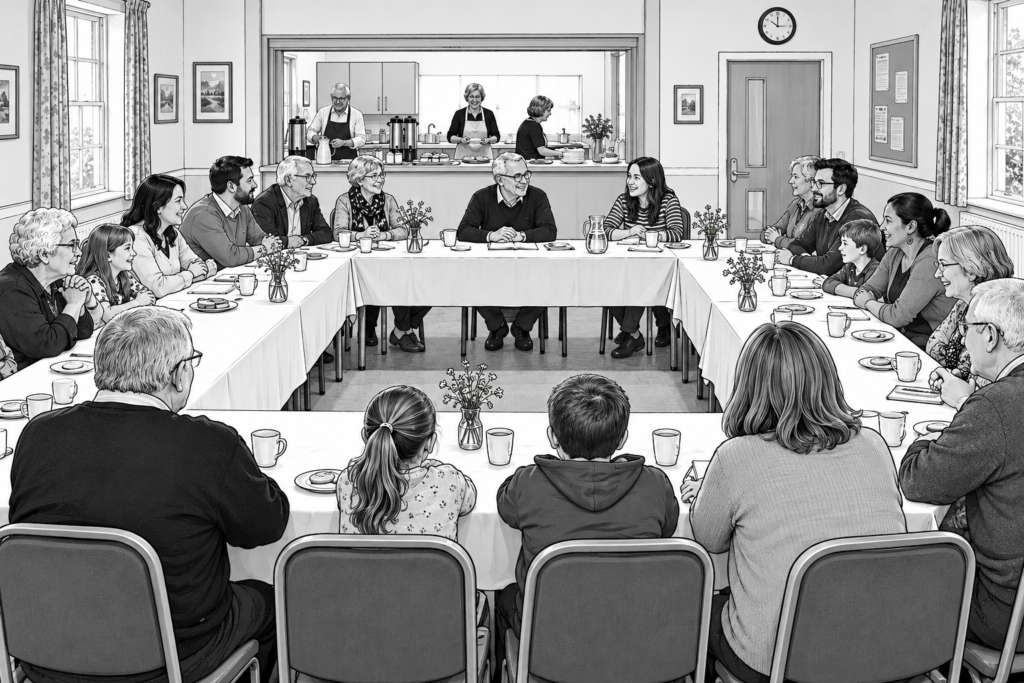
Artist impression only 🙂
Bath Community Kitchen – More Than Just a Meal
Part One – An Evening of Unexpected Encounters
Yesterday evening I visited Bath Community Kitchen in Writhlington, Radstock, following a recommendation from Diane at Radstock Library. I am always willing to follow up such suggestions because I never know what interesting people or situations I might encounter. On this occasion I was certainly not disappointed.
The meal was vegetarian, freshly prepared and substantial, beginning with an excellent homemade soup. The food was delicious, but I had come primarily to discover what sort of people attended and what brought them together. I soon realised that this was far more than a place where people could obtain a meal for little or no money. It was a social occasion in the best sense of the term, where people could sit down together without ceremony and enjoy one another’s company.
I met Rob Lewis, the founder of Bath Community Kitchen, whose enthusiasm for the venture was evident. I was impressed by the volunteers who prepared and served the food and by the relaxed atmosphere they had created. One regular attendee explained why they kept coming back. The food was good, the building was welcoming and the cooks were excellent. What more could one ask? I could not disagree.

Rob Lewis – Founder of Bath Community Kitchen….. Could this by any chance be a role model for husbands to take more interest in cooking?
There were people who had been attending for many months, and I could see that these weekly gatherings had become an important part of their lives. Some faces were familiar to one another, but there was no sense of a closed circle. I particularly liked hearing that some volunteers deliberately chose not to sit with their own family members, preferring to mix with others. What a simple and effective way of encouraging conversation.
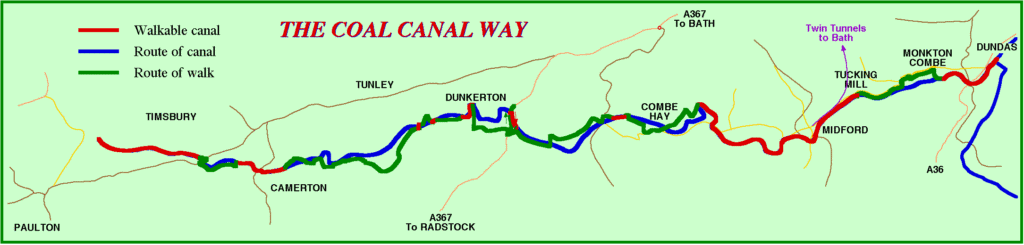
I had several interesting exchanges about local community activities. There was discussion about children’s reading and storytelling sessions at Radstock Library, gardening and wellbeing projects, and the future of local community facilities. I also heard about a forthcoming talk concerning the Somerset Coal Canal and the area’s mining history, possibly at Paulton Village Hall. This was precisely the sort of information I had hoped to discover, although I shall need to check the details.
The subject of libraries came up more than once. I have long felt that a good library should be much more than a place where books are borrowed. It can be a meeting place, an information centre and a source of encouragement to people who might otherwise remain isolated. After all, it was a conversation in Radstock Library that had brought me here in the first place.
Naturally, I mentioned my developing Somer Valley Diary website and the accompanying guide to local organisations. I explained that I was attempting to bring together information about the extraordinary variety of activities already taking place in our district. Much of this work is being done by dedicated volunteers, but the public often has little idea of its existence.
We also discussed the difficulty of attracting younger people into established organisations. Many groups depend heavily on volunteers in their sixties, seventies and beyond. Unless another generation becomes involved, some of these valuable activities may eventually disappear. The way we communicate is changing, and a young person looking for something to do on a mobile phone is unlikely to search for information in the same way as an older resident.
One aspect of the evening I particularly appreciated was the willingness of some people to challenge my opinions. I have never understood why disagreement should automatically be regarded as unpleasant. A thoughtful objection can be far more valuable than half a dozen people nodding politely. It forces us to examine our assumptions and perhaps discover that we have overlooked something important.
By the time I left, I had gained useful contacts, learned about several activities previously unknown to me and enjoyed some stimulating conversations. I had gone along to investigate a community meal and came away with a much wider appreciation of what can happen when people are given a welcoming place in which to meet.
Part Two – The Invisible Barrier Facing Newcomers and the Lonely
One conversation during the evening particularly affected me. I heard about a woman who wanted to attend a community activity but could not summon up the courage to enter the building. She walked past the entrance three times. Eventually, someone opened the door and invited her inside. That small gesture made all the difference.
I have been thinking about this ever since, because it goes to the heart of a problem that is very easily overlooked.
Those of us who are reasonably confident about approaching strangers tend to assume that everyone else can do the same. We see an advertisement for a meeting, a club or a social activity, and if it interests us we simply turn up. But for many people the process is nothing like so straightforward.
Imagine someone who has recently moved into the district. They may have left behind their friends, neighbours and familiar surroundings. Perhaps they have come here to be closer to family members who are themselves busy with work and children. They may know practically nobody outside their immediate household.
Then there are those who have been bereaved, divorced or separated. Their social lives may have revolved around a partner who is no longer there. The invitations stop coming, familiar routines disappear and the prospect of starting again can be daunting.
Loneliness does not necessarily mean having nobody around you. It can mean living among hundreds of people but feeling that you have no meaningful place in their lives.
A person in this position might see a notice advertising a coffee morning, a walking group or a local society. They may be interested, but immediately a series of questions arises. Will everyone already know one another? Will I be the odd one out? What if nobody speaks to me? What if I arrive and find that I have nothing in common with the others?
To an outsider these fears may seem exaggerated, but to the person experiencing them they can be quite sufficient to prevent any action at all.
This is why I believe that simply publishing lists of organisations, however comprehensive, is not enough. Information is essential, but information by itself does not create confidence.
I want my Somer Valley Diary and accompanying printed guide to do something more. I want them to communicate a sense of welcome. Wherever possible, I would like each organisation to have a named contact or telephone number so that a hesitant newcomer can speak to a real person before attending.
Imagine the difference between reading a bare notice saying that a group meets on Thursday evenings and speaking to someone who says, ‘Of course you can come. Ask for me when you arrive, and I’ll introduce you to a few people.’
Those few words could transform the situation.
I also think organisers need to consider what happens when a stranger first enters the room. It is all very well to say that everyone is welcome, but does anyone actually take responsibility for welcoming them? Is there somebody prepared to notice the person standing uncertainly near the door, perhaps wondering whether they have made a mistake?
There is a world of difference between an organisation being technically open to newcomers and making newcomers feel that they belong.
Another difficulty is that people who are not comfortable using smartphones or computers may have little idea what activities are available. Local information is scattered across websites, Facebook pages, noticeboards and occasional leaflets. Some organisations are excellent at publicity; others are almost invisible. This is one reason why I am producing a printed guide as well as a website.
I do not imagine that a directory, however well constructed, will solve the problem of loneliness. Human relationships cannot be manufactured by technology or created by putting names into a database. But we can make it easier for people to discover opportunities, and we can encourage the organisations themselves to think more carefully about the experience of arriving for the first time.
The community meal at Writhlington demonstrated how effective this can be. There was no elaborate programme, no pressure to perform and no requirement to explain why one had come. People simply sat down, shared food and talked. The informality was one of its greatest strengths.
I suspect that many people who are lonely do not necessarily need another service or another formal intervention. They need somewhere ordinary to go, something worthwhile to do and somebody who is genuinely pleased to see them.
Perhaps the greatest contribution any community organisation can make is not the activity it provides but the relationships that develop around it.
I returned home thinking about the woman who walked past the door three times. How many others are doing the same, literally or metaphorically, every day? How many would like to join something but are waiting for a little encouragement?
We cannot force people to become sociable, nor should we try. But we can remove unnecessary obstacles and make the first encounter as easy as possible.
It is one thing to tell people that the door is open. It is quite another to make them feel confident enough to walk through it.
If my Somer Valley project achieves nothing more than helping a few people take that first step, I shall consider the effort worthwhile.

Editor : Just to show you the sort of valuable information that can be picked up informally
- A forthcoming talk about the local mining and canal history was mentioned at Paulton Village Hall. The recording suggests Friday evening, but the exact time and subject should be confirmed, but I think it was about coal mining in Colford.
- A local wellbeing group was described as undertaking gardening activities on Wednesdays at an estate, although the estate’s name was not reliably transcribed.
- Volunteers discussed children’s reading and storytelling activities at Radstock Library and possible changes to the library’s premises.
- One participant suggested that people without smartphones can find it particularly difficult to discover local activities, reinforcing the value of your printed directory.
