During our stay on Hayling Island, I did a Google search asking what cultural centres there were within reasonable travelling distance. The Spring Arts and Heritage Centre in Havant jumped out of the page at me, as these things tend to do, and I knew intuitively that this was somewhere I had to visit. I am very glad that I followed my intuition because what I discovered was an excellent example of how a community can bring together its various talents, interests and resources under one roof.
The building was not particularly clearly identified from the outside, although the presence of some sculptures gave me a clue that this was no ordinary establishment. We parked the car with some difficulty, our long Volvo not being particularly suited to confined spaces, and made our way inside. I entered expecting to find a conventional museum but instead discovered something altogether more interesting.
There were a couple of rooms containing memorabilia from earlier in the twentieth century, together with a fascinating delineated map illustrating the development of Havant from a village into a town. However, I might equally well have walked into a coffee lounge. There were numerous people sitting around chatting over coffee, and there was a distinct atmosphere of ease and familiarity. This was obviously the place to be. People appeared comfortable in their surroundings and, more importantly, comfortable with one another.
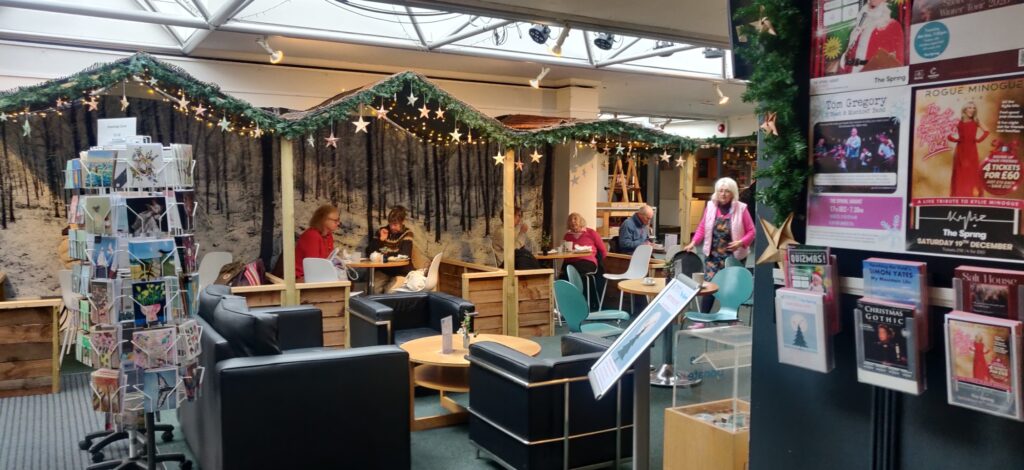
As I explored further, I discovered various rooms suitable for meetings and group activities. To the left of the booking office was a theatre, with a programme of performances that would not have put any town of reasonable size to shame. There was a mixture of comedy, music, opera broadcasts, films and theatrical productions – all the indications of a vibrant cultural life. The whole establishment reminded me somewhat of the TARDIS in Doctor Who, being apparently considerably larger on the inside than its external appearance would suggest.
I spoke to the chap at the front desk, who readily admitted that he did not know a great deal about the history of the establishment but suggested that I return on a Tuesday or Friday when there would be people available who could enlighten me further.
How it all began
The origins of The Spring go back to Victorian times. In 1868, a group of local businessmen established the Havant Town Hall Company, resulting in the construction of a new Town Hall in 1870. Four years later, an adjoining property known as Moorlands was built for a lady called Mary Charge, who wanted a house incorporating a hall large enough to accommodate a choir or orchestra. There is something rather delightful about the fact that her enthusiasm for music and communal activity still finds expression in the building some 150 years later.
The local authority acquired Moorlands in 1946. Following the relocation of the council’s offices, the former Town Hall was given a new lease of life, opening as Havant Arts Centre in June 1978. The following year, a local history museum opened in the adjoining building. In 2009, the two organisations merged to become what is now known as The Spring Arts and Heritage Centre.
Today, The Spring operates as an independent charity, supported by professional staff and approximately 100 volunteers. It incorporates a theatre seating around 145 people, a museum, exhibition spaces, a historical research facility, meeting rooms, a café and a shop. Its activities extend to creative workshops, painting, dancing and sessions designed to encourage companionship and reduce social isolation. Its annual income in 2024–25 was in excess of £700,000, which gives some indication of the scale of the operation.
More than a collection of activities
If I were a resident of Havant, I would certainly make this one of my regular places to visit. What appealed to me was not any particular activity but the combination of activities and the atmosphere that resulted from their proximity to one another. You could go there with no particular intention other than having a cup of coffee and come away having booked a theatre ticket, discovered something about the history of your town or made the acquaintance of someone with whom you shared an interest.
There is an important distinction between providing entertainment for people and providing an environment in which people can become involved. Entertainment is essentially something we consume, whereas involvement gives us an opportunity to contribute, develop relationships and discover aspects of ourselves that might otherwise remain dormant. A successful community establishment should surely provide opportunities for both.
I was also impressed by the apparent absence of formality. You did not have to belong to a particular organisation, possess an artistic talent or have a specialist interest in local history to justify your presence. You could simply be there. We should not underestimate the importance of having somewhere to go where our presence does not require an explanation, particularly for those who live alone or whose circumstances have changed through bereavement, divorce or retirement.
Lessons for the Somer Valley
Naturally, my thoughts turned to my own community project in the Somer Valley. We have an abundance of talented people, voluntary organisations, meeting places and activities, but they tend to operate independently of one another. Unless you already know what is going on, discovering the full range of opportunities can be quite a challenge.
What The Spring has achieved physically, I would like to achieve to some extent through the medium of a website and a printed community guide. We do not necessarily need another building. We need a greater awareness of what we already have, more communication between organisations and a willingness to regard ourselves as part of something larger than our own particular sphere of interest.
One of the great advantages of bringing things together is the element of serendipity. We go somewhere for one reason and discover something entirely unexpected. Indeed, my own visit to The Spring was an example of precisely that phenomenon. I went looking for a cultural centre and came away with some valuable thoughts about the nature of community itself.
A thriving community cannot be manufactured simply by providing buildings, spending money or drawing up an impressive programme of events. These things are important, but they are the means rather than the end. The real measure of success is the extent to which people feel encouraged to participate, to contribute, to make new acquaintances and to develop a sense of belonging.
The Spring in Havant struck me as a particularly good example of what can happen when these ingredients are brought together.
It is, indeed, considerably more than bricks and mortar.
Further information: www.thespring.co.uk
59 East Street, Havant PO9 1BS
023 9247 2700
info@thespring.co.uk
