Bishop Ruth Bushyager – Christians in Media 2026
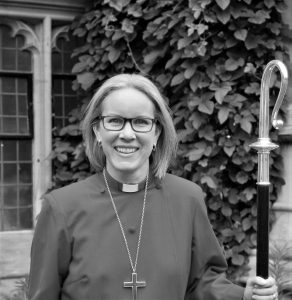 Good morning, everyone. It’s a real joy to be here. I ought to begin with a confession. I’m not in the media industry at all. I’ve decided to stay in my lane. I’m a Bible teacher, so I’m going to teach the Bible and hopefully apply it to your world. I hope that’s all right!
But first, I want to say thank you. I look around this room and see broadcasters, journalists, producers, filmmakers and people doing extraordinary things. I know it isn’t easy being a Christian in the media. You’re working in an environment where your words and actions are constantly scrutinised, where criticism comes from every direction, and where some of the harshest attacks can come from fellow Christians.
I know something about that. Recently, somebody posted a photograph of me baptising a new Christian. The first comment underneath said, “I would rather shoot myself at the altar than be baptized by that woman.” Wow! Ouch! Good morning, brother. Be blessed. Have a great day!
I’m also rather conscious that I’m speaking to people who know far more about media than I do. After a conference this summer, a queue of young people wanted to know my Instagram details. They were absolutely appalled when I told them I didn’t have any. I don’t think they’d ever met anyone without social media profiles before!
And while we’re here, can we deal with imposter syndrome? I imagine there’s plenty of that in your industry. Somebody else has a bigger book deal, more followers, a better commission or a longer contact list. But whether you’re running GB News or managing your church’s social media account, you’re here for a reason. God has brought us together. So let’s stop wondering whether we’re important enough to be in the room.
Our theme is One Voice in a Divided World, and I want to suggest something very simple: you cannot have one voice without one God.
I believe the divisions we see in society are rooted in something deeper. We’ve divided our loyalties between all sorts of gods, and when our hearts are divided, our voices become divided too.
Let me take you back to Elijah and the prophets of Baal in 1 Kings 18. Israel had suffered three years of drought, but the real problem wasn’t the weather. The people had lost their spiritual bearings. They hadn’t stopped believing in God; they’d simply started believing in lots of other gods as well.
It’s a bit like going into a casino and spreading your chips around the roulette table. Perhaps this one will come good, or that one. Better hedge your bets! I’ve been to Las Vegas twice, incidentally. I don’t know anything about gambling. Both times I went for the all-you-can-eat buffet. Absolutely amazing!
But before we feel superior to those ancient people worshipping statues, perhaps we ought to examine ourselves. We have plenty of gods today. We just don’t call them gods. Money, beauty, success, pleasure, recognition, popularity and, perhaps most dangerously in the media, the need for approval and the need to be right.
Your industry has turned approval into something measurable. How many followers? How many likes? How many downloads? What are the viewing figures? Has your article been shared? Have you secured the next commission?
There’s nothing wrong with wanting your work to succeed. But when our sense of worth depends upon those numbers, we’re in trouble. There’s always another target, another audience, another opportunity to prove ourselves. When do we finally reach the point where we can say, “That’s enough. I’m content”?
And then there’s appearance. I’m 49 now, and Facebook has obviously worked that out because my feed is suddenly full of women in their fifties having facelifts. Here’s Maureen six weeks ago, and here’s Maureen now. I look at Maureen and think, goodness me, that’s a very good surgeon! Then I wonder how much it cost, and before I know it, I’m standing in front of the mirror doing strange things with my neck.
It’s ridiculous, isn’t it? But we’re constantly being told we’re not attractive enough, successful enough or important enough. And in the media, where appearance and public approval are so closely connected, those pressures can be relentless.
Now, whenever I prepare a sermon, I have to preach it to myself first. So I’ve been asking what the false gods are in my own life. Suppose someone placed a microphone in my house and recorded everything I said during an ordinary week. What would they conclude was the deepest object of my love and affection? Would it be Jesus Christ?
Well, I’m not entirely sure. Because this morning that microphone would have heard me saying, “Good morning, my love. You’re wonderful. My heart is yours. Whatever you want, darling.”
And who was I talking to? My cockapoo. Yes, my dog!
We have a shop near our house selling doggy pick-and-mix treats. I get a little brown paper bag and tell her she can have whatever she wants. We reach the till, and the man says, “That’ll be £9.99.” And I think, this is completely ridiculous. But never mind. She’s an absolute princess.
So if you’re struggling to identify the false gods in your life, I’ve already found one of mine. We’ll deal with repentance later!
The serious point is that we can take something perfectly good and give it a place in our hearts it was never intended to occupy. And in the media, even good things such as creativity, influence and the desire to communicate truth can become idols if our identity depends upon them.
That’s what Elijah was confronting. He challenged the people to decide whom they would follow. The prophets of Baal shouted, danced, pleaded and even injured themselves in their desperation to get their god’s attention. But nothing happened.
False gods demand more and more without ever satisfying us. And isn’t that rather like the endless pursuit of recognition? Another programme, another article, another award, another thousand followers. The demands never stop.
Then Elijah stepped forward. He didn’t try to outshout the others. He rebuilt the altar, prepared the sacrifice and poured water over everything until it was completely soaked. He made the situation humanly impossible, and then he prayed.
What interests me is what he didn’t pray. If I’d been Elijah, I suspect my prayer would have been something like, “Lord, everybody’s watching. Please don’t embarrass me! Show them I’m right and they’re wrong!”
But Elijah didn’t pray that. He asked God to turn the hearts of the people back to himself.
And here is something I particularly want those of you working in the media to hear. Our purpose is not to win arguments, increase our numbers or prove that we’re right. Our responsibility is to tell the truth with integrity and to create opportunities for hearts to change. The outcome belongs to God.
That matters enormously in an industry where confrontation attracts attention, controversy generates audiences and the temptation to demolish an opponent can be almost irresistible.
Let me give you a lovely example. A journalist called Nigel wrote an article in The Spectator criticising the decline of the Church of England. He was particularly unimpressed by what he saw as the loss of genuine Christian belief among the clergy.
My friend Edward, who leads Chichester Cathedral, read the article. He could have written a furious response, challenged Nigel publicly or launched a social media campaign against him. But he didn’t. He wrote to him personally and said, in effect, “Nigel, that really isn’t my experience of Christianity. Would you like to come for coffee?”
And they met. Just two people having coffee.
Three months later, Nigel wrote another article, this time describing his own unexpected journey into Christian faith. He had begun to pray and had discovered something he hadn’t expected to find. A few weeks later, he was baptised in the ancient font at Chichester Cathedral.
Isn’t that beautiful? Nobody had won an argument. A heart had been turned. And now this man, who had previously criticised the Church, was speaking publicly about his own faith.
I love that story because it demonstrates something we desperately need to recover in public communication. You don’t have to humiliate somebody to change their mind. Sometimes a genuine conversation achieves more than a thousand angry words.
There’s another example I want to share. You may have seen John Lennox, the Oxford mathematician and Christian thinker, being interviewed by Steven Bartlett on The Diary of a CEO. They spent two hours discussing Christianity, faith and the great questions of life.
But at the end, Bartlett said something extraordinary. What impressed him most wasn’t necessarily anything John had written or argued. It was John himself. There was a peace about him, a contentment, a sense of being anchored in something deeper.
John explained that when he looked at another human being, he saw someone of infinite value because that person was made in the image of God.
Isn’t that wonderful? Here was a brilliant intellectual who didn’t need to demonstrate his superiority. He was simply at peace. And that was what his interviewer noticed.
For those of you with microphones, cameras, audiences and editorial influence, I think that’s an important lesson. People don’t only hear what we say. They notice how we say it, how we treat those who disagree with us, and whether our lives reflect the convictions we profess.
We can become so preoccupied with defending our positions and winning debates that we forget what we’re actually here for.
Jesus showed us a different way. When his disciples encountered people who rejected him, they wanted to call down fire from heaven and destroy them. You can almost hear their indignation. How dare these people treat Jesus like that!
But Jesus rebuked them. He hadn’t come to destroy people. He had come to give himself for them.
And that is the extraordinary difference between Jesus and all the false gods we construct for ourselves. Those gods demand more and more. Work harder. Look better. Achieve more. Get more approval. And still it isn’t enough.
Jesus offers something entirely different. We don’t have to earn our worth or spend our lives desperately seeking validation. We are already loved.
When we understand that, something changes. We no longer need to win every argument or measure ourselves against somebody else’s success. We can speak honestly without hostility, disagree without contempt and exercise influence without making ourselves the centre of attention.
And that brings me back to our theme: One Voice in a Divided World.
At Pentecost, people from many different backgrounds heard the message of God in their own languages. There were many voices, but one message. Unity didn’t mean everybody becoming identical. It meant people with different gifts and personalities finding their common purpose in Christ.
That’s what I long to see among Christians working in the media. Not everybody repeating the same slogans or holding identical opinions, but journalists, broadcasters, producers and communicators who know whom they belong to.
People who tell the truth even when it’s costly. Who resist the temptation to manufacture outrage. Who treat opponents as human beings rather than targets. Who don’t measure their worth by audience figures, popularity or professional success.
And perhaps, through the way we work, speak and live, others will recognise something of the peace that Steven Bartlett saw in John Lennox.
Many voices. One God. One purpose. One message of hope.
Thank you. Can I pray for us before we go to lunch?
