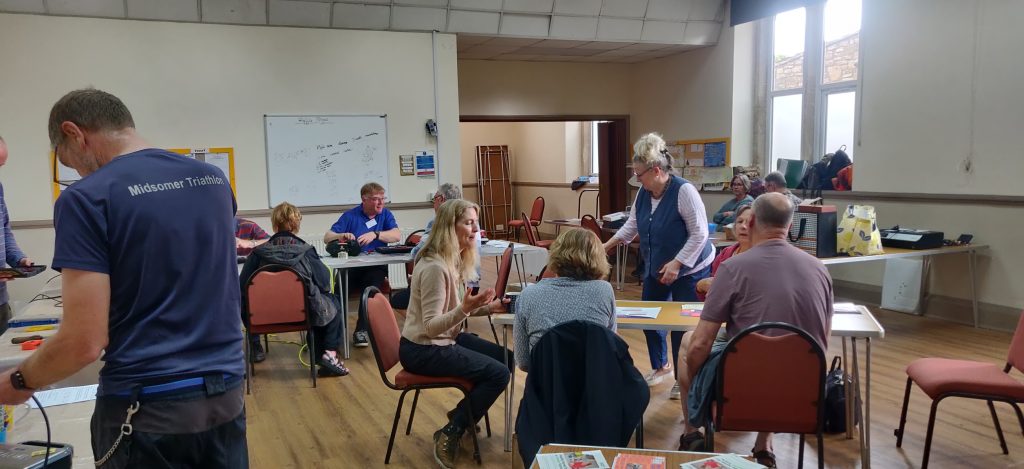
We attended the monthly Share and Repair session at the local Scout Centre in High Littleton, held on a Saturday from 10.00 am until 12.30 pm.
Françoise had brought along an ageing hi-fi unit, complete with CD and cassette player, which she hoped could somehow be rejuvenated and given a new lease of life.
The system is delightfully simple. You bring along your malfunctioning object, whatever its form, book it in and wait your turn in the queue. We arrived at about 11.15 and were seen roughly an hour later.
I found the whole atmosphere rather moving. It reminded me of days gone by, when people simply got together and helped one another, without money being the main consideration. Volunteers were giving their time and skills, tea and biscuits were being served, and people were sitting around chatting and catching up with the local news while they waited.
There was something wonderfully human about it. Instead of throwing away an object because it had stopped working, you brought it to someone who was prepared to sit down, examine it and see whether anything could be done. Even if a repair proved impossible, there was value in the attempt.
I spoke to a lady who offers sewing repairs. She told me that they had had relatively few visitors that morning, whereas the previous session had been much busier.
I suggested that perhaps they should put more emphasis in their publicity on repairing clothes and other fabric items. When people hear the words “Share and Repair”, they may instinctively think of electrical appliances, tools and mechanical objects. They don’t necessarily think, “I can take my damaged jacket, trousers or curtains there, and someone may be able to mend them.”
In an age when we are encouraged to replace rather than repair, there is something very refreshing about the whole enterprise. But for me it wasn’t really about broken hi-fi systems or torn clothing. It was about people sharing their skills with other people and expecting nothing in return.
We could do with rather more of that.
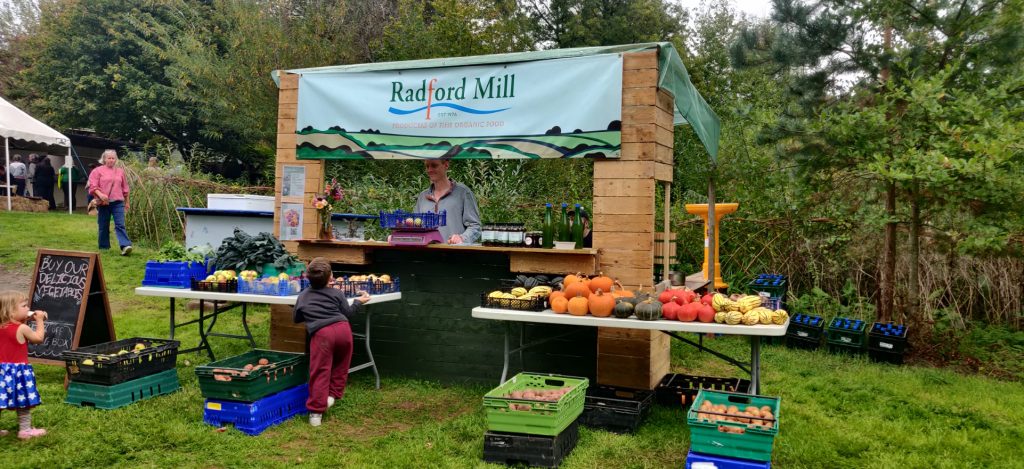
As we drove away from the scout hut, I remembered the annual Harvest Festival at the nearby Radford Mill, so we swung by to see what was going on.
.
Certainly. I would bring the ancient history in quite early, because it gives a nice sense that today’s alternative community is only the latest chapter in a place that has continually reinvented itself. I have also corrected the anniversary point: 2026 is specifically Radford Mill Farm’s 50th year as an organic farm, dating from 1976. [Radford Mill Farm](https://www.radfordmillfarm.com/history
Radford Mill Farm – The Alternative Spirit Lives On
This is about as near to the spirit of the 1960s as you are likely to get in Somerset today.
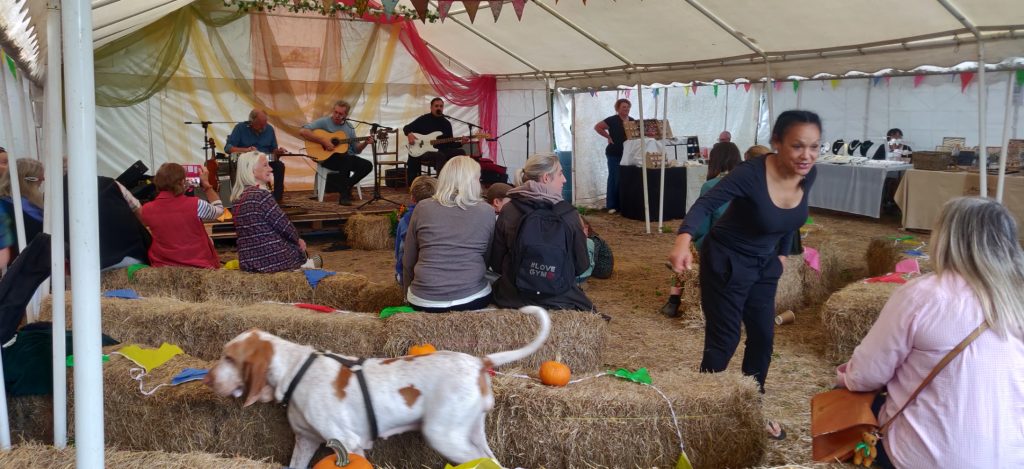
We visited Radford Mill Farm, near Timsbury, for its Harvest Festival. Entry was free, although there was a £4 charge to park the car. There was a small bar serving cider and soft drinks, a large refreshment area serving vegetarian food, and perhaps 30 stalls displaying art, pottery, crafts and all manner of handmade objects.
But what was special was not so much what was being sold as **the atmosphere**. There was a wonderfully relaxed attitude and a striking degree of acceptance that people seemed to have for one another. Nobody appeared particularly concerned about how anyone else dressed, looked or chose to live. People simply got on with being themselves.
It reminded me strongly of the alternative movement of the 1960s and 1970s, although perhaps what we were seeing was a new generation expressing the same instincts in its own way.
A place with a very long memory
Radford Mill is not some recently invented alternative retreat. People have been working at this spot for centuries.
The mill is believed to be the one recorded in the Domesday Book, which takes its story back towards the time of the Norman Conquest. The present mill building dates from the mid-17th century, while the stone mill house was built or rebuilt in 1706.
By the late 18th century the Collins family had become closely associated with Radford Mill. In 1788 James Collins acquired the mill, beginning a long period in which the site developed into something of a small industrial community. By the 19th century the activities here included a brewery, a tannery and candle making. Candles produced here were used by miners working in the surrounding Somerset coalfield.
There is another reminder of that industrial past running straight through the farm: the remains of the Somerset Coal Canal, built to carry coal from the Somerset coalfield towards Bath.
So today’s peaceful collection of fields, workshops, animals and artists sits on land which has seen an extraordinary variety of human activity.
1976 – another beginning
The modern Radford Mill story began exactly 50 years ago, in 1976
Two couples were looking for somewhere where they could establish a home and two rural businesses — bespoke hand-weaving and vegetable growing. They found a completely derelict property alongside a run-down farm. The buildings were in such poor condition that the Ordnance Survey map simply described them as “derelict”.
Young, inexperienced and ambitious, they pooled their money, took out a substantial mortgage and bought the properties which became Radford Mill Farm.
That decision was made at a fascinating moment. The ideals associated with the 1960s — communal living, environmental awareness, crafts, self-sufficiency and questioning conventional ways of doing things — were finding practical expression during the 1970s.
Radford Mill fitted naturally into that world.
The farm has been managed to certified organic standards since 1976, long before “organic” became the familiar supermarket term it is today. During the 1980s and 1990s it found itself at the forefront of Britain’s growing organic food movement. It produced vegetables, Jersey yoghurt, organic meat and Norfolk black and bronze turkeys, and developed a home-delivery vegetable service before the expression “box scheme” had even become commonplace.
But Radford Mill gradually became much more than a farm.
Hundreds of broadleaf trees were planted. People with physical and mental challenges were welcomed. Workshops and festivals were organised. In 2001 Jenny’s Path opened, which the farm says was then the first rural footpath in the district accessible to wheelchairs.
Artists and craftspeople moved into workshops in the old mill — stone carvers, silversmiths, woodworkers, jewellery makers and textile artists among them. Music, weddings, workshops, camping and community gatherings became part of the life of the place.
And that brings us neatly back to today.
Fifty years on
2026 marks Radford Mill’s 50th year as an organic farm, and a series of festivals has been held to celebrate the anniversary.
Perhaps that explains why I felt something particularly strong about the place when we arrived.
The people have changed. The clothes have changed. The causes and vocabulary have changed. But something of that earlier alternative spirit seems to have survived.
What struck me most was the absence of judgement. There seemed to be an unspoken agreement that people could simply turn up as themselves. Money did not dominate the proceedings. There was no great attempt to impress anybody. Children wandered around, people chatted, musicians played, craftspeople displayed what they had made, and everyone seemed remarkably comfortable in everyone else’s company.
Maybe this is the new breed of alternative person
They are not necessarily trying to recreate the 1960s. Most were not even alive then. But they seem to have inherited something from that period — a suspicion of excessive commercialism, an interest in the environment and handmade things, and above all a belief that there ought to be room in society for people who choose to live a little differently.
Radford Mill has survived for 50 years in its present incarnation and for many centuries in one form or another before that.
Mills, breweries, tanning, candle making, coal, farming, organic vegetables, craftspeople and festivals have all left their mark here.
Perhaps the common thread is simply people making things and getting on with one another.
At a time when so much of life seems regulated, commercialised and divided into opposing camps, it was refreshing to spend a few hours somewhere where people appeared simply to give one another permission to be themselves.
