A quick word before you start reading. I had some difficulty identifying who was speaking, and the transcription software occasionally struggled with Caribbean accents. I’ve done my best to capture the spirit of the meeting, but a few errors may have crept in. If you were there and spot anything that needs correcting, please let me know. I’ll be more than happy to put it right straight away. – Ed. brian@pobox.com
Overview
The Bristol gathering focused on hearing community experiences of the Windrush scandal and improving justice, support, and recognition.
Commissioner Priorities
- Clive identified justice and healing, prevention of future harm, and recognition of Windrush contributions as priorities.
- He reported that claim processing has become faster, but 56% of claims receive no award; his office is reviewing why and advocating for free, independent legal support.
- He said the minimum compensation award is £10,000, there is no ceiling, and compensation is distinct from reparations.
Community Concerns
- A speaker described a rejected grant application and criticised the process as insensitive and disconnected from Bristol’s community organisations.
- Attendees raised concerns about the term “Windrush”, which some elders feel does not describe them, and asked whether compensation is taxable. Clive said compensation is tax-free and eligibility extends to affected Commonwealth citizens, not only people who arrived on the ship.
- Local access to application assistance remains a concern; Bristol Law Clinic and Bristol North India were mentioned as sources of support.
Open Questions
- How can Bristol contribute to cultural change and ensure local pioneers’ histories are documented?
- How can the scheme improve decision consistency and support people who struggle to apply?
Action Items
- Return to Bristol for a longer follow-up visit and spend additional time engaging with the community.
- Connect with Bristol institutions before the follow-up visit, including the local authority, community organisations, churches, faith organisations, and universities.
- Prepare and send attendees and registered participants a written summary of the meeting’s learnings, concerns, and outcomes.
- Report back to the city in the coming months on efforts to incorporate the Bristol bus boycott into the national school curriculum.
Outline
Welcome and Purpose
- Bristol councillors and the Windrush Commissioner welcomed attendees and framed the gathering as a listening event about the scandal and its effects.
- The Home Office engagement team described its outreach on the compensation scheme and sought local stakeholder connections.
Windrush History and Community
- Speakers recognised the contributions and resilience of the Windrush generation and Bristol pioneers, including the Bristol bus boycott.
- Community members discussed the need to preserve local histories and sustain elders’ activities.
Scheme Experience and Commissioner Response
- A speaker criticised the handling of a local grant application and noted limited support for applicants.
- The Commissioner outlined priorities of justice and healing, prevention, and legacy; he discussed compensation eligibility, awards, claim timelines, and the ongoing review of unfavourable decisions.
- Questions addressed terminology, tax treatment, overseas eligibility, legal assistance, and possible links to reparations.
Bristol’s Role and Local Support
- Attendees asked how Bristol could support cultural change and document its history; discussion included civic and educational participation.
- Participants identified Bristol-based support options and requested that the meeting’s learnings be shared.
An account of a public listening event at Bristol City Hall, Saturday 17 October 2026
1. The Gathering of 60 concerned souls
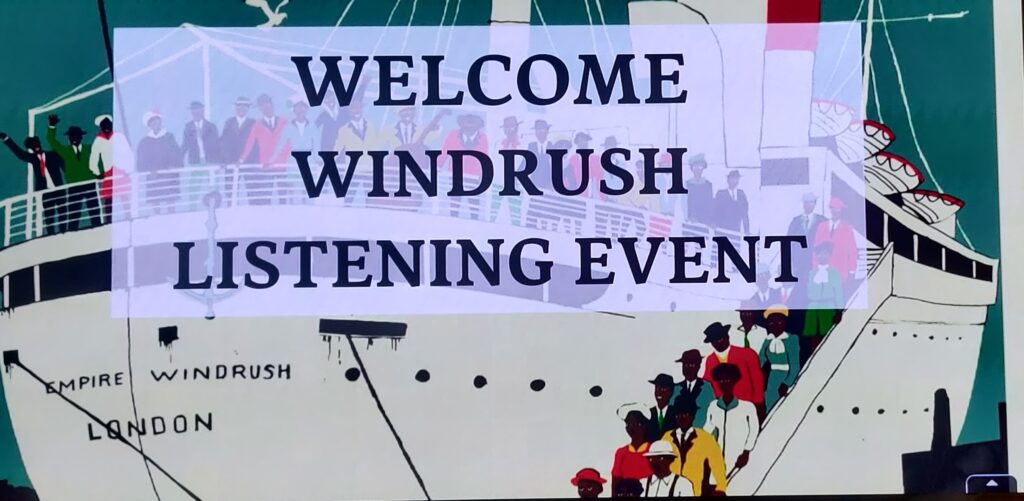
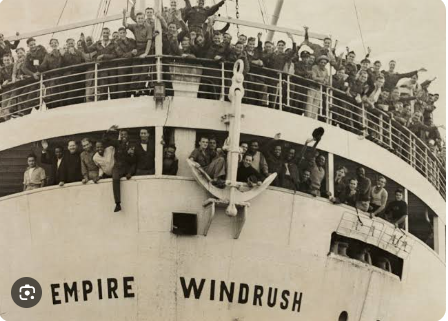
There is something remarkable about attending a meeting in 2026 to discuss the consequences of events which began in 1948, when the Empire Windrush arrived at Tilbury carrying passengers from the Caribbean. Seventy-eight years have passed, and yet here we were, gathered in Bristol City Hall, still discussing questions of belonging, citizenship, compensation and justice. The Windrush scandal itself is considerably more recent, having come to public attention in 2018 when it emerged that people who had lived lawfully in Britain for decades were being required to prove their immigration status, sometimes with devastating consequences. Some lost their employment, others were denied services, and some were detained or removed from the country they regarded as home. The purpose of this meeting was to give those affected and those working on their behalf an opportunity to speak directly to Reverend Clive Foster MBE, the Independent Windrush Commissioner.
I had come partly out of curiosity and partly because I have always been interested in the relationship between ordinary people and the institutions which govern their lives. When an injustice has been acknowledged, what actually happens next? Who takes responsibility? How does an individual obtain redress from a large government department? And what happens when those seeking justice are growing old? The meeting was hosted by Councillor Lorraine Francis, who welcomed those present and introduced representatives from the Home Office, Bristol City Council and the local community. The emphasis was firmly upon participation rather than ceremony. We were not simply there to listen to speeches; the Commissioner had come to hear what people were experiencing and to take those concerns back into his discussions with ministers and Home Office officials.
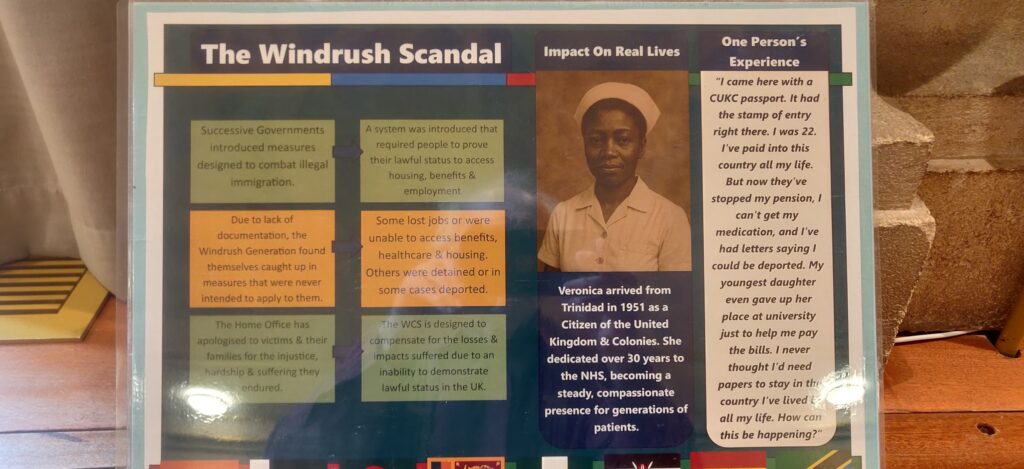
A Home Office representative who introduced himself as Abby explained that his engagement team travelled around the country raising awareness of the Windrush compensation scheme. Information leaflets were available, and members of the team were prepared to speak individually to anyone seeking advice. He also appealed for local contacts, recognising that there might be people in Bristol entitled to assistance who had not yet come forward. This struck me as an important point. A compensation scheme can exist on paper, but it is of little use to someone who does not know about it, doubts that it applies to them, or is apprehensive about dealing with officialdom. Councillor Tony Dyer, Leader of Bristol City Council, then offered a brief welcome, acknowledging the enormous contribution of the Windrush generation and the injustice of people who had helped build modern Britain subsequently being treated as though they did not belong.
One of the most moving contributions came from Councillor Carole Johnson, who invited us to think about the Windrush generation in a rather different way. When we hear that expression today, it is easy to imagine elderly people whose experiences belong to a distant chapter of British history. But they were not elderly when they arrived. Many were eighteen, nineteen, twenty or twenty-one years old, leaving behind parents, brothers, sisters, friends and familiar surroundings. Carole spoke about her own parents, who had made that journey when they were still very young. Imagine being eighteen years old, travelling thousands of miles to a country you have never seen, with little certainty about what awaits you. There must have been excitement, apprehension, hope and a considerable degree of courage. Many had grown up within the British Empire and understood themselves to have a legitimate place within the wider British world, yet the reception they encountered was not always welcoming.
Carole reminded us of the hostility, discrimination and obstacles faced by many arrivals. Housing could be difficult to obtain, employment opportunities were restricted, and people encountered prejudice in everyday situations which others took for granted. Nevertheless, they persevered, working in hospitals, factories, transport, public services and numerous other occupations. They established families, supported one another and contributed to the reconstruction and development of post-war Britain. Carole suggested that the word ‘immigrants’ did not adequately describe what these people had accomplished. She preferred to think of them as pioneers, adventurers and founders. I thought that was a particularly interesting distinction. A pioneer is someone who enters unfamiliar territory and establishes something which did not previously exist, implying courage, initiative and a willingness to face uncertainty. That description seemed to capture something important about the generation being discussed.
2. The Power of Community Action
Carole then moved from historical reflection to her own experience of working as a Windrush ambassador. She explained that she had been one of 41 people appointed to help connect affected communities with government information and support. Initially, the assignment had been presented as a relatively short commitment of eight weeks, during which the ambassadors organised events, spoke to community groups, participated in interviews and helped people understand the available schemes. But something happened which transformed their work. According to her account, they learnt that 50 people were facing deportation, causing considerable alarm among the ambassadors, who felt that the circumstances demanded urgent collective action. Rather than responding separately, they joined forces and prepared a joint letter to the Home Office containing three recommendations.
Carole described how, following their intervention, 37 of the 50 people were removed from the proposed deportation list. She presented this as an example of what could be achieved when people organised themselves and approached an injustice collectively. The ambassadors had also pressed for changes to compensation arrangements, and she recalled the increase in the minimum award for the impact on a person’s life from the original £250 to £10,000. Her message was not that every problem had been solved, but that determined advocacy could influence decisions which might otherwise appear beyond the reach of ordinary citizens. I found myself reflecting upon the difference between individual complaint and organised representation. A person acting alone may feel powerless when confronted by a government department, whereas a group bringing together experience, knowledge, persistence and a clear set of demands can sometimes achieve considerably more.
The next substantial contribution came from Roger Griffith, whose work as a writer, historian and community advocate has been closely associated with Bristol’s African-Caribbean population. He reminded us that the Windrush story is not merely a national story but one woven into the history of particular towns, cities, neighbourhoods and families. Bristol has a distinctive place in that history, and Roger spoke about people who had arrived from the Caribbean and subsequently made important contributions to the city’s development. He referred to the difficulties they encountered, but also to the organisations, friendships and cultural activities which helped them establish a sense of community. St Paul’s featured prominently in his account, having become a place where Caribbean families could meet others with similar backgrounds, share food, enjoy music, exchange news and offer practical assistance.
Roger described the importance of informal gatherings, sometimes moving from one household to another. These occasions were about much more than entertainment, providing companionship and a sense of belonging in surroundings which could otherwise be isolating. He also reminded us of the discriminatory notices which had once been displayed in Britain, excluding Black people and others from accommodation. It is difficult, looking back from the present day, to appreciate how openly such prejudice could be expressed. The people who encountered these barriers did not simply disappear or abandon their aspirations. They developed organisations, challenged discrimination and gradually helped change the society around them. Their achievements were not confined to overcoming obstacles; they also created cultural institutions and community networks which have enriched Bristol ever since.
Roger devoted particular attention to the Bristol Bus Boycott of 1963, when campaigners challenged the Bristol Omnibus Company’s discriminatory employment policy, which prevented Black and Asian people from being employed as bus crews. He referred to the contributions of local campaigners, including Roy Hackett, Paul Stephenson and Guy Bailey, whose experiences and determination helped bring the issue into public view. Eventually the colour bar was lifted, and the campaign became one of the significant episodes in Britain’s civil rights history. What interested me was the way Roger connected these achievements with the challenges facing people today. The struggle against discrimination did not consist of a single event followed by permanent resolution; it involved continuing efforts by people prepared to organise, speak publicly and challenge established practices. The Bristol Bus Boycott remains a particularly striking example because it concerned something so ordinary: the right to apply for a job.
3. Preserving a Living History
Roger’s contribution was not confined to the past. He spoke about the importance of recording the experiences of older Caribbean residents, many of whom had lived through the formative years of their communities in Britain. These people possess memories which cannot simply be recovered from official archives. They remember the houses in which people gathered, the organisations which were established, the difficulties encountered in employment and housing, and the friendships which made life possible. Some are now elderly, and Roger was concerned that their experiences should not disappear without being recorded. He also spoke about the practical needs of community groups supporting older residents. Weekly gatherings, cultural activities and opportunities for social contact can make a substantial difference to people who might otherwise become isolated, but such activities require money, premises, volunteers and organisation.
There is something rather sad about waiting until individuals have died before deciding that their stories deserve attention. The people who participated in the early years of Caribbean settlement in Bristol are themselves living archives. They can tell us what the streets were like, how communities organised themselves, which individuals provided leadership and how discrimination was encountered and overcome. Such testimony adds a human dimension to official records. It is one thing to read that a colour bar existed in employment; it is another to hear from somebody who personally experienced it. Roger’s appeal for the experiences of older Caribbean residents to be preserved was therefore more than a request for historical material. It was an appeal to recognise the value of people whose lives have helped shape the city. Towards the end of his contribution, he read a poem honouring the Windrush generation, an appropriate conclusion to a presentation which had moved between history, personal experience and community responsibility.
Before the Commissioner delivered his main address, the chair invited someone from the audience to describe their experience of the Windrush schemes. A representative associated with the Bristol West Indian Phoenix Cricket Club spoke about an unsuccessful application for funding. The speaker explained that the club had applied for a grant of £25,000 towards refurbishment work, but that the application had taken approximately a year to be rejected. There was particular frustration about the distribution of funding, with the speaker believing that organisations with strong historical connections to Bristol’s Caribbean community had not received appropriate recognition. The process was described as impersonal and insensitive. This introduced a theme which would recur throughout the afternoon: the difference between the intentions of a scheme and the experience of those attempting to use it.
Government programmes are often described in terms of eligibility, procedures, allocations and outcomes. Those applying for assistance may experience the same arrangements as confusing, slow or detached from the realities of their lives. The speaker also suggested that visiting officials should be encouraged to see St Paul’s and its public artwork rather than confining their understanding of Bristol to a meeting room. I thought this a reasonable suggestion, because there is a difference between hearing about a community and actually visiting the places in which its history has unfolded. A visitor who walks through the neighbourhood, sees the murals and speaks to residents may acquire an understanding which cannot be obtained from a briefing paper alone. This is particularly relevant when institutions are attempting to repair relationships damaged by years of mistrust.
4. The Commissioner’s Priorities
Reverend Clive Foster then delivered his principal address, beginning by acknowledging Bristol’s history of community action and resistance to discrimination. He had clearly been interested in Roger Griffith’s contribution and expressed a willingness to learn more about the city’s Black history. He referred to the Bristol Bus Boycott as an example of people organising themselves strategically to challenge injustice. Anger alone had not been sufficient; those involved had planned their campaign, worked together and identified ways of bringing pressure to bear upon the institutions concerned. Clive believed that the same spirit of organisation and determination remained important in addressing the consequences of the Windrush scandal. He also spoke about his own family background. His parents had come from Jamaica, his father had worked in factories and mines, and a family member had worked in nursing. He described the contribution of Caribbean people to the National Health Service and other essential industries.
The scandal had been particularly painful because many of those affected regarded themselves as British. They had lived in Britain for decades, raised families, paid taxes and contributed to society, only to find their right to remain questioned. The Commissioner made clear that the consequences had extended beyond the United Kingdom. Some people had travelled or returned to Caribbean countries and subsequently found themselves unable to re-enter Britain. Others remained overseas while attempting to resolve their status or obtain compensation. This was not, therefore, a problem confined to people currently living within Britain’s borders. Clive explained that his office was concentrating upon three principal areas: justice and healing for those harmed, prevention of similar injustices in the future, and recognition of the Windrush generation’s contribution to Britain.
Justice and healing involved more than financial compensation. People had suffered a range of losses, including employment, housing, benefits and access to services, while others had been wrongly detained or removed. But there was also a less easily measured form of harm. People who had spent much of their lives in Britain had been made to feel that they did not belong, damaging their dignity, reputation and sense of security. Financial compensation could address some of the consequences, but it could not necessarily restore everything that had been lost. Prevention required attention to government policy, administrative procedures, safeguards and the culture within the Home Office. Legacy meant ensuring that the achievements of the Windrush generation were recognised as a permanent part of Britain’s national story. These priorities seemed closely connected: justice concerns what has happened, prevention concerns what must not happen again, and legacy concerns what future generations should remember.
Perhaps the most urgent part of the Commissioner’s address concerned the age of those still seeking redress. Many members of the Windrush generation are now in their seventies, eighties or nineties, and some have already died. For those who remain, time is not an abstract consideration. A compensation payment received after years of uncertainty may be welcome, but it cannot restore the years during which someone was deprived of financial security or peace of mind. The Commissioner emphasised that justice needed to arrive within people’s lifetimes. This struck me as one of the central messages of the afternoon. We often hear of inquiries, reviews, consultations, recommendations and reforms, each of which may have a legitimate purpose, but the passage of time has a different meaning for an elderly claimant than it does for an institution. A government department may measure progress in financial years; an eighty-five-year-old person waiting for compensation measures it against the years they may have left.
Clive acknowledged that the compensation arrangements were not satisfactory in every respect and that many applicants had encountered considerable difficulties. Nevertheless, he reported improvements, including faster processing times, arrangements to accelerate consideration of claims from people aged over seventy-five, changes concerning pension losses and the possibility of receiving a substantial proportion of an award while challenging the amount offered. These examples were presented as evidence that concerns raised by affected communities could influence government decisions. But he was equally clear that problems remained, particularly the proportion of applications which resulted in no compensation. He referred to approximately 56% of claims not receiving a favourable outcome and explained that his office was examining the reasons. Were applications being assessed consistently? Were decision-makers sufficiently aware of the historical and cultural circumstances of those applying? Were the requirements for evidence realistic? These questions went to the heart of whether the scheme was capable of delivering the justice it had been established to provide.
5. Questions That Needed Answers
The formal presentation was followed by a question-and-answer session, which was, to my mind, one of the most interesting parts of the meeting. Prepared speeches have their place, but questions from an audience often reveal what people are actually thinking. One contributor spoke about Bristol’s history of civil rights campaigning and asked how the city could support the Commissioner’s work, particularly in bringing about wider changes in institutional culture. Clive welcomed the suggestion and spoke about the forthcoming eightieth anniversary of the arrival of the Empire Windrush in 2028. He encouraged Bristol to involve its civic institutions, schools, universities, health organisations and community groups. There was also discussion about recording the experiences of older residents and securing greater recognition of the Bristol Bus Boycott within the school curriculum. This seemed particularly worthwhile, since the events of 1963 formed part of the wider development of civil rights in Britain, yet I suspect many younger people know little about them.
Another question concerned the terminology used to describe the scandal. The word Windrush is familiar, but does it accurately communicate who may be eligible for assistance? The original ship carried passengers from the Caribbean, and the expression has become closely associated with Caribbean migration. However, the consequences of immigration policy and failures of documentation affected people from other Commonwealth countries as well. One audience member suggested that some older people did not identify with the term because they had not travelled on the Empire Windrush, or because their country of origin was elsewhere. Could the name itself be discouraging eligible people from seeking help? The Commissioner acknowledged the difficulty and explained that eligibility was not confined to passengers on the original ship. The relevant issues concerned lawful residence, immigration status and the harm arising from the failures which had occurred. It was an interesting illustration of how terminology which becomes widely recognised in the media may nevertheless fail to communicate clearly with some of the very people it is intended to help.
A further question returned to the practical operation of the compensation scheme. Had applications become easier to complete, and were they now being handled more quickly and consistently? There had been accounts of people submitting claims repeatedly, receiving unfavourable decisions and subsequently obtaining awards. The Commissioner said that processing times had reduced considerably, contrasting earlier experiences of claims taking around twelve months, sometimes much longer, with more recent figures indicating that approximately 62% were being completed within three months. These were encouraging figures, but they did not resolve every concern. A quick decision is not necessarily a correct decision. If a person receives no compensation because an application has been misunderstood, inadequately supported or incorrectly assessed, the speed of the process offers little consolation. Clive acknowledged this difficulty and returned to the question of legal assistance, explaining that applicants who received expert help were often better able to present their circumstances and provide the evidence required.
His office was therefore pressing for independent, free legal support. This seemed to me an important admission. If a scheme has been established to compensate people for failures of government administration, it should not be so complicated that those affected struggle to use it without professional assistance. Yet that was clearly one of the concerns being expressed. Another audience member asked whether organisations in Bristol were available to help people complete compensation applications, explaining that suitable assistance could be difficult to find locally. The Commissioner referred to the work of a local law clinic and invited those present to identify other sources of support. There was some discussion of community groups and information available from representatives at the meeting, but the exchange suggested that accessible assistance was not as straightforward as it might have been. A government may establish a website and publish guidance, but somebody who is elderly, unfamiliar with computers or uncertain about the requirements may need another human being to sit beside them and explain what is being asked.
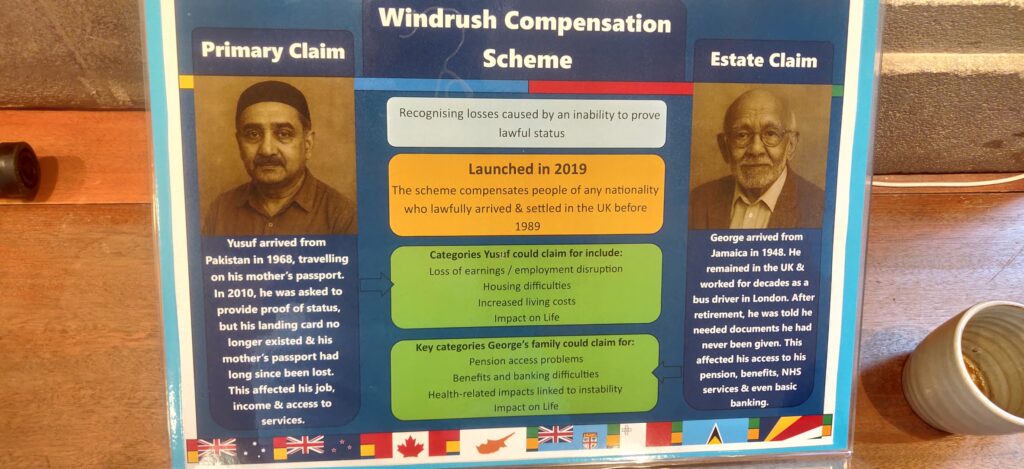
Another question concerned the amount of compensation individuals could receive. How did the scheme deal with people who had lost almost everything? Was there a maximum award, or were people restricted to relatively modest sums regardless of the scale of their losses? The Commissioner explained that there was no overall ceiling on compensation and distinguished between the minimum amount payable under the relevant impact-on-life arrangements and additional compensation which might be awarded for particular losses. He recalled the earlier minimum figure of £250 and the successful pressure to increase it to £10,000, explaining that some people had received six-figure awards. During the meeting he referred to approximately £132 million having been paid to more than 4,000 people. These were figures given during the discussion and would need checking against the latest published statistics before being treated as definitive. Nevertheless, they demonstrated that substantial payments had been made, while leaving open the question whether the money was reaching all those entitled to it.
A particularly interesting question raised the relationship between the Windrush compensation scheme and the wider debate about reparations for slavery and colonialism. The questioner referred to discussions among Caribbean governments and asked whether the two subjects were being considered together within the British Government. Were they part of the same financial arrangements, and did they involve the same departments and decision-makers? The Commissioner drew a distinction between them. The Windrush compensation scheme was intended to address specific harm arising from the treatment of people whose lawful status in Britain had been questioned or mishandled, whereas the wider debate about reparations concerned historical injustices and relationships between countries. Although the subjects could be connected within broader discussions of history and discrimination, they were not the same scheme and did not operate from the same financial arrangements.
Clive was particularly concerned that this distinction should not obscure the position of people currently living overseas who might be eligible for Windrush compensation. He explained that some people in Caribbean countries had been directly affected by the scandal and that efforts were being made to reach them. He referred to contacts with Jamaica and the importance of working with the relevant authorities to identify those who might be entitled to assistance. He also reminded the audience that claims were not necessarily restricted to the person directly affected; in some circumstances, close family members or representatives of deceased individuals could also have grounds for applying. The discussion was a reminder that the consequences of the scandal extended across families and international boundaries. It also showed how easily a scheme intended to provide redress can become difficult to understand when its eligibility rules, administrative arrangements and relationship to wider political questions are not clearly explained.
6. What Happens Next?
Towards the end of the question-and-answer session, the discussion turned to what would happen after the meeting. One contributor asked whether the Commissioner intended to produce a written account of what had been learned in Bristol. Would the questions and concerns raised during the afternoon be recorded and shared, or would those present have to wait a year or two before discovering whether anything had happened? Clive indicated that he wanted to return to Bristol and develop relationships with local institutions, including councils, community organisations, churches, faith groups and universities. But the questioner pressed him on the immediate issue of reporting back. It was all very well to promise further engagement, but how would the people in the room know what had been done with their contributions? The Commissioner responded that members of his team were collecting information and that a summary could be shared with those who had registered for the event.
I thought this exchange captured an essential feature of public consultation. People are frequently invited to give their views, attend meetings, complete questionnaires, submit evidence and explain their experiences. But unless there is some visible response, the process can begin to feel one-sided. A genuine conversation requires more than one party speaking and the other listening. There needs to be an acknowledgement of what has been heard, an explanation of what can be done and, where possible, a report on what has actually changed. The Commissioner appeared to recognise this, and his willingness to return to Bristol was encouraging. The value of that commitment will ultimately be measured by what follows. At one point during the discussion, I also made a brief contribution, explaining that I had recorded the proceedings and intended to make an account available through my website, so that people could read it afterwards and offer corrections or additional information.
I have spent many years writing about meetings, conversations and community activities, and I am increasingly conscious of how much useful material disappears because nobody takes the trouble to preserve it. When people attend a gathering of this kind, they may hear a considerable amount of unfamiliar information, and it is difficult to remember every detail, particularly when several speakers are addressing complicated historical and administrative subjects. Of course, a recording is not a perfect record. Voices overlap, names are misheard and transcription software makes mistakes, so any published account needs to be treated with appropriate care. Nevertheless, I believe there is value in making the substance of an important public discussion available to those who could not attend. I hope this account will serve that purpose, while also providing an opportunity for participants to clarify or expand upon what was said.
As the afternoon progressed, Councillor Lorraine Francis reminded everyone that refreshments and food were available. There was particular consideration for the older members of the audience, who were encouraged to make their way to the food before the formal discussion had completely finished. This provided a rather human contrast to the serious subjects being discussed. After all, the gathering was not simply an administrative exercise; it was also a social occasion, bringing together people who knew one another, shared memories and had common interests. There were opportunities to speak individually to the Commissioner, Home Office representatives and local community organisers. A person reluctant to ask a question in front of an audience might feel more comfortable approaching a representative privately, while someone seeking help with an application might make a useful contact. These informal connections are difficult to measure, but they can be among the most valuable outcomes of a community gathering.
It would be easy to judge the meeting entirely by whether the Commissioner announced some dramatic new measure. He did not. There was no sudden resolution of the compensation difficulties, no announcement that every outstanding claim would be settled, and no guarantee that the problems described by the audience would disappear. But that was not really the purpose of the occasion. It was a listening event intended to bring the experiences and concerns of local people directly to the attention of someone with a responsibility to influence government policy. The Commissioner acknowledged the seriousness of the remaining problems and described changes which had already been made. The audience, in turn, raised practical questions about eligibility, communication, legal assistance, processing times, compensation amounts and the need for proper follow-up. There was also an important historical dimension, reminding us that the Windrush generation should not be remembered solely through the scandal which eventually bore its name.
I was struck by the importance of Bristol’s particular contribution to the discussion. The city has a history of campaigning against discrimination, and the Bristol Bus Boycott remains an example of local action producing wider consequences. But history does not preserve itself. It survives because people record it, discuss it, pass it on and make it accessible to those who come afterwards. Equally, recognition is not a substitute for justice. A society cannot adequately honour a generation through speeches, plaques and commemorations while leaving members of that same generation struggling to obtain compensation. Both things matter. The arrival of the Empire Windrush in 1948 is now part of history, but the scandal which came to public attention in 2018 belongs very much to our own times. For those still seeking redress, the consequences are not historical; they are present-day problems involving money, security, dignity and peace of mind.
Another theme running through the afternoon was trust. The Windrush scandal involved people who believed they had a secure and lawful place in Britain, only to discover that the authorities were questioning their entitlement. It is hardly surprising that such experiences can damage confidence in government institutions. A compensation scheme is intended to put matters right, but if the process itself is experienced as difficult, impersonal or inconsistent, it may reinforce the very mistrust it was designed to overcome. This presents a considerable challenge for the Home Office. It is not enough to establish rules and invite people to apply. Those administering the scheme must demonstrate patience, understanding and a willingness to recognise circumstances which may not fit neatly into standard forms. The Commissioner’s support for independent legal assistance and his concern about the high proportion of unsuccessful applications suggested that he recognised the need to look beyond headline statistics.
I came away from Bristol City Hall feeling that I had witnessed something worthwhile, even though the issues discussed were far from resolved. There was a sense of community, a willingness to speak openly and a determination that the experiences of the Windrush generation should neither be forgotten nor dismissed. I appreciated the fact that the Commissioner was prepared to take questions and acknowledge shortcomings in the system, rather than simply deliver a prepared speech and depart. That does not mean every answer was satisfactory, or that the audience’s concerns have been resolved, but it provided a basis for further engagement. I was particularly impressed by the repeated emphasis upon ordinary people taking responsibility for one another. The history of the Bristol Bus Boycott, the work of the Windrush ambassadors, the activities of local community groups and the efforts to preserve the memories of older residents all illustrate the importance of people acting together.
Perhaps the most important question arising from the afternoon is what happens next. Will the concerns raised in Bristol influence the Commissioner’s recommendations? Will applicants receive better assistance? Will compensation decisions become more consistent? Will the Home Office improve its communication with communities? And will those who attended receive the promised account of the meeting’s outcomes? These are matters which can be followed up and measured, and I hope they will be. For me, the lasting message of the afternoon was that recognition without action is incomplete, and justice which arrives too late may cease to be justice at all. Seventy-eight years after the arrival of the Empire Windrush, Britain has had ample time to acknowledge the contribution of those who came to help build its future. The remaining challenge is to ensure that those who suffered injustice in the country they helped to build receive fair treatment while they are still here to benefit from it.
Editorial note: This account has been prepared from an audio recording of the public meeting, with some assistance from automatic transcription and AI editing. It is intended as a narrative account rather than a verbatim record. Some passages have been paraphrased for clarity. Corrections, clarifications and additional information from speakers or attendees are welcome and will be considered promptly.
