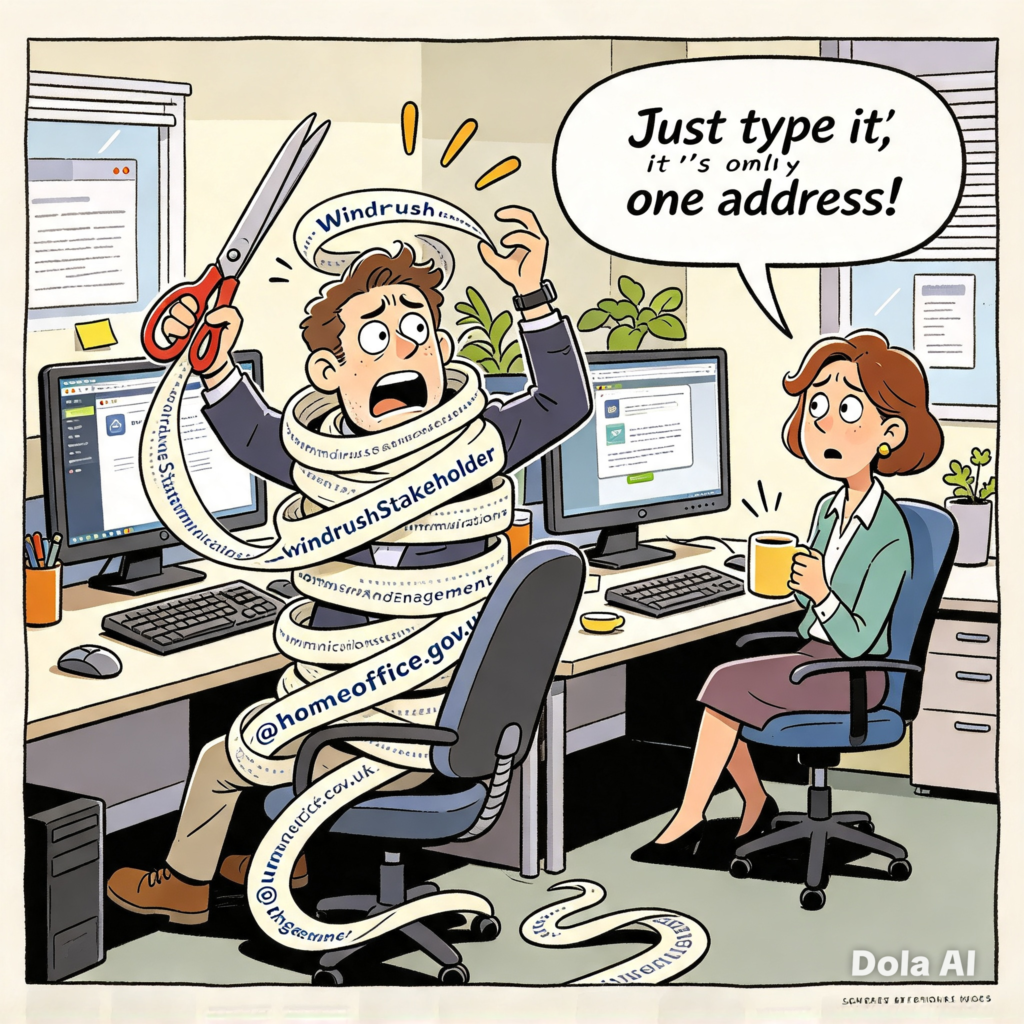
# The Most User-Unfriendly Email Address I Have Ever Encountered
I spend far more time than I probably should sitting in front of my computer, exploring websites, corresponding with people and generally poking my nose into matters which may or may not concern me. After all these years, I thought I had encountered most of the peculiarities of the internet. However, yesterday, while attending the excellent Windrush event in Bristol, about which I have written in my previous diary entry, I was handed a business card from the relevant government department, which stopped me in my tracks.
Printed on the card was an email address. Nothing unusual about that, you might think. But wait for it. Roll of drums, please…
mailto:WindrushStakeholderCommunicationsAndEngagement@homeoffice.gov.uk
This brings me to the wider subject of website and email addresses, which I find surprisingly interesting. The problem is that when you are familiar with a particular subject, the meaning of an address seems perfectly obvious. You know where one word ends and another begins, even when there are no spaces. But someone encountering it for the first time may read it quite differently.
A famous example is [**www.penisland.net**], intended to suggest *Pen Island*, a business associated with pens. Unfortunately, the same collection of letters can also be read as *Penis Land*, suggesting an entirely different sort of establishment. I leave the reader to imagine the possibilities. What seems perfectly innocent to the person inventing an address may look quite extraordinary to somebody seeing it for the first time.
There is actually a linguistic explanation for this. When we read ordinary English, the spaces between words tell us where one ends and another begins. Remove those spaces, as happens with website addresses, and the brain has to work out the boundaries for itself. Usually this happens almost instantaneously, but occasionally the result is unintentionally hilarious. It is a reminder that communication is not simply about what the writer intends to say; it is about what the reader understands. This is a distinction which some organisations, particularly large ones, might profitably bear in mind.
As far as email addresses are concerned, my guiding principle has always been **the shorter and simpler, the better**. Years ago I signed up for a service called Pobox.com, which allows me to use short email addresses that forward messages to my regular mailbox. Among my addresses are
brian@pobox.com
artist@pobox.com
consultant@pobox.com
They are straightforward and relatively easy to remember. If I meet someone unexpectedly and they have neither pen nor paper, there is at least a reasonable chance that they will remember one of these addresses when they get home. I cannot imagine anyone remembering the Home Office’s 64-character masterpiece after hearing it once, unless they possess the memory of an elephant and the patience of a saint.
Another problem arises when people are asked to write their email addresses on a form, perhaps when attending a conference or community meeting. I have organised and attended enough gatherings to know what happens. Someone hands round a sheet of paper, and everybody dutifully scribbles their name and email address, often while simultaneously listening to a speaker or chatting to the person beside them.
The result can resemble a collection of medical prescriptions written by doctors in a considerable hurry. Later, some unfortunate organiser has to decipher the handwriting and enter the addresses into a computer. All it takes is one incorrect character for an email to bounce back, leaving both parties wondering what went wrong.
Spoken email addresses can be just as troublesome. Take a surname such as MacGibbon. Is it MacGibbon, McGibbon or Mackgibbon? Unless the person spells it out carefully, there is no way of knowing. Even apparently simple letters can cause confusion. Was that an M or an N? A B or a D? And was the number fifteen or fifty? Add a few hyphens, underscores and full stops, and the whole business becomes a test of endurance. This is why I believe simplicity is not merely a matter of convenience but an essential part of good communication.
Which brings me to one of my favourite little hobbyhorses: the humble business card. I wish more people would adopt the simple expedient of carrying one. It need not be elaborate or expensive. All that is required is a name, an easily remembered email address, a mobile telephone number and perhaps a few words explaining what the person actually does. In my case, the word *Writer* would be quite sufficient. There is no need to list every qualification, achievement, committee membership or honorary title accumulated since leaving school. The purpose of a business card is to help somebody remember you and contact you, not to provide a condensed autobiography.
I know that we live in an age of smartphones, QR codes, electronic contacts and all manner of ingenious devices for exchanging information. These certainly have their uses, but I remain fond of the ordinary printed card. It requires no battery, no internet connection, no special application and no explanation. You simply hand it to somebody. They put it in their pocket, and the next day, when they come across it, they remember the conversation. There is something reassuringly civilised about that.
I sometimes wonder whether the people responsible for designing complicated systems ever test them on ordinary members of the public. Not colleagues from the same department, who already understand the terminology, but people encountering the system for the first time. Ask someone to remember an email address, complete a form or find a particular piece of information without assistance. You might be surprised by the results. What appears perfectly logical to the person who designed it can be bewildering to everybody else.
The underlying principle is very simple: **make it as easy as possible for people to communicate with you**. That means short addresses, clear instructions, straightforward language and a minimum of unnecessary complication. We have enough difficulties in life without turning the simple act of sending an email into an examination in spelling, memory and perseverance.
Meanwhile, I shall keep the Home Office business card as a splendid example of how not to do it. I have nothing against the department or the people working there, but I cannot help feeling that somewhere in Whitehall there must be a committee whose members are paid to invent the longest possible names for things.
Perhaps their next project could be to shorten this one. They might even finish before the next Windrush anniversary.

0 Comments