 Religion was not so much an optional extra as a permanent feature of the household. I sang alto in the choir and can still remember the mild discomfort of the ruff, that elaborate piece of white material worn around the neck. It was hardly an instrument of torture, but neither was it designed with the comfort of small boys in mind.The choir master was a Mr Southgate.
By the age of eighteen, I had begun to rebel against organised religion, perhaps not surprisingly after such an intensive upbringing. I wanted to discover things for myself rather than simply accept what had been handed down to me. Over the years, however, I gradually returned to Christianity, developing an understanding of faith that felt more authentic and personally satisfying. My relationship with the person of Jesus Christ has remained remarkably continuous throughout my life, even when my relationship with the institutions claiming to represent him has been rather less straightforward.
More recently, I have become interested in gnostic Christianity, which seems to contain something of the direct spiritual experience for which I have always yearned. I find myself drawn towards the earlier, more mystical dimensions of Christianity, before the theological and political struggles associated with the Council of Nicaea and the subsequent development of church orthodoxy. Whether or not my historical interpretation would satisfy an academic theologian is another matter, but the attraction is very real to me.
As regular readers may have noticed, I have been on something of a writing roll in this last week, and today, Sunday 18 October, it continues accompanied by bright sunshine streaming through the windows, I felt inclined to continue yesterday’s explorations by attending a local church. I have no regular church affiliation these days and tend to visit different places as the spirit moves me. I knew that the Reverend Matthew Street was vicar of St John’s Church in Peasedown St John, and at about 9.30 this morning I suddenly decided that this was where I wanted to go. Once again, that curious mechanism of inspiration which strategically takes charge of my activities clicked into action. Having hastily demolished a croissant and some scrambled egg, I set off.
On arrival, I was warmly greeted at the entrance, which is always a promising beginning. But what delighted me almost immediately was the discovery that the church had no pews. I have encountered this transformation elsewhere, including Wells Cathedral and All Saints’ Church in Paulton, and I am increasingly convinced that removing fixed seating can make an enormous difference to the atmosphere of a building.
Traditional pews have their place in history, but they can also give a church a rather rigid and formal character, with everyone arranged in orderly rows facing the front. Here, by contrast, the space felt open, welcoming and adaptable. The pews were removed 5 years ago. There was something almost democratic about it, as though the building belonged to the people gathered there rather than to a particular arrangement of furniture. I felt comfortable from the moment I walked in.
At one side of the church stood a large sofa, on which someone was sitting quite happily, while on the right there was a play area for children. These may sound like small details, but to me they spoke volumes. They suggested that the church was prepared to accommodate people as they actually are, rather than expecting everyone to conform to a particular idea of how a congregation ought to behave. Meanwhile, two musicians were rehearsing, one playing the trumpet and the other the piano.
The sound of live music drifting through the building added to the relaxed atmosphere, and I found myself feeling increasingly at home. There was no sense of having entered a solemn institution where one must immediately lower one’s voice and watch one’s step. Instead, I had the impression of entering a living community.
It was a striking contrast with the church of my childhood, where the structure of worship was firmly established and the congregation was expected to fit into it. I do not wish to dismiss that tradition, which gave me a grounding in music, liturgy and the Christian story that has stayed with me all my life. But I cannot help wondering whether this more flexible, welcoming and human approach might point towards something important for the future of the Church of England. After all, a church should surely be a place where people feel able to enter, settle down and discover something for themselves, rather than feeling that they must first learn an elaborate set of rules.
My visit had only just begun, but already I was asking myself a question: might the future of the Church of England depend less upon preserving the familiar furniture and formalities of the past and more upon creating places where people genuinely feel they belong?
One of the things that struck me almost immediately was the manner in which the service was introduced. The Reverend Matthew Street welcomed everyone, making a particular point of acknowledging visitors and inviting them to stay for coffee afterwards. This may seem a small courtesy, but it makes a considerable difference when entering an unfamiliar church. There was no assumption that everybody knew the ropes, understood the liturgy or had attended every Sunday since childhood. Everything we needed was in the printed service sheet, although Matthew cheerfully admitted that the date was wrong. It said 11 October rather than the 18th. I rather liked that. Here was a church prepared to acknowledge a mistake without treating it as a national emergency.
The notices were equally informal and revealing. There was to be a special service on 1 November for remembering loved ones, with an invitation to submit names of people whom the congregation wished to remember. We were also told about a monthly gathering called Limitless, which takes place without a predetermined agenda, allowing time and space for whatever might emerge. That particularly interested me because I have long felt that the spiritual life cannot always be organised into a timetable. Sometimes the most worthwhile things happen when people are given the freedom to be still, listen and respond.
There was also an announcement about the former vicar’s vestry, which had been converted into a storeroom, together with warm thanks to the people who had undertaken the work. The old room was now approached through what was being called the lounge. I found these details rather endearing. Here was a church which appeared to regard its building as a practical resource for a living community rather than a museum whose contents must remain untouched for eternity.
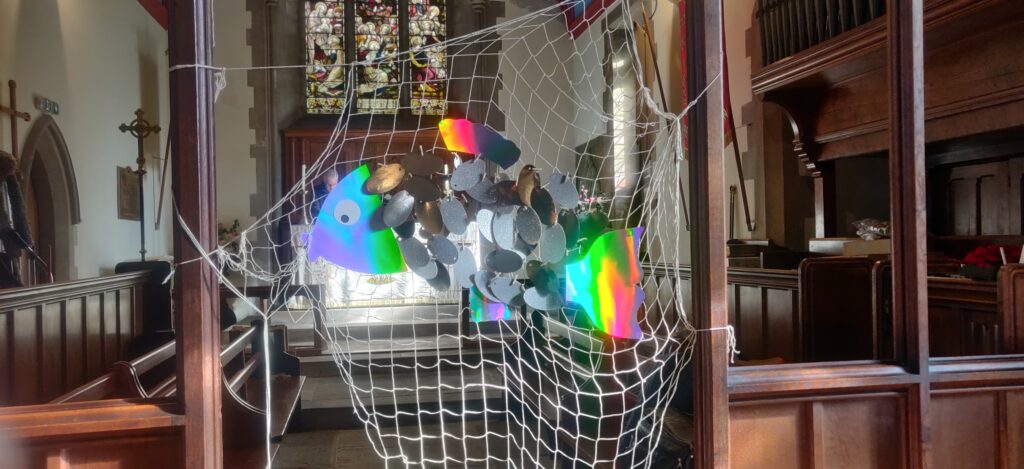
Matthew then explained the theme of the service. The church was following a sermon series based on animals and what they might teach us about Christian life. This month’s subject was fish. A large fish displayed in the church was not, therefore, an unexplained piece of ecclesiastical decoration. The previous week’s service had explored the miraculous catch of fish and the calling of Simon Peter. Today’s theme was the parable of the fishing net from Matthew’s Gospel, in which the kingdom of heaven is compared to a net gathering fish of every kind. It was an imaginative way of connecting successive services and giving the congregation something tangible to remember.
 What particularly appealed to me was that Matthew did not simply announce the first hymn and expect everybody to get on with it. He drew attention to its meaning, asking us to consider three propositions: that God created us, that God loves us and that God wants the best for us. He invited us to think about whether we really believed these things. The hymn was All People That on Earth Do Dwell, which was certainly familiar to me from my childhood. But the difference was that we were being encouraged to reflect upon what we were singing rather than merely producing the correct notes at the appropriate moment.
The same approach continued with the confession. Instead of launching immediately into the familiar words, Matthew asked us to consider the things we had said, done or thought which we regretted, as well as the things we ought to have done but had neglected. He observed that familiar religious words can become automatic and encouraged us to pause and give them some personal meaning. This was an important distinction. I have attended enough Anglican services to know how easily a congregation can recite a confession without necessarily engaging with its significance. Here we were being invited to make the words our own.
The celebration of Holy Communion was similarly explained in practical, reassuring terms. Nobody was obliged to come forward. Those wishing to receive bread could do so, while anyone preferring a prayer could indicate this by the position of their hands. There was a choice of alcoholic and non-alcoholic wine, served from different cups, and Matthew carefully described where people should stand and how they should return to their seats. Such explanations might seem unnecessary to regular worshippers, but to a newcomer they remove a great deal of uncertainty. Nobody wants to feel conspicuous because they have stood in the wrong place or misunderstood an unfamiliar custom.
What impressed me was that the informality did not come at the expense of spiritual substance. The familiar language of confession, forgiveness, thanksgiving and Communion remained. There was a clear acknowledgement of the significance of Jesus’ death and the meaning of the bread and wine. The traditional elements were still present, but they were being interpreted and made accessible. I began to see that the real innovation was not necessarily changing the content of worship but changing the relationship between the service and the people taking part in it.
A Sermon Involving Fish, Sweets and the Danger of Judging Others
The sermon was delivered by a woman introduced as Sarah Bubyar, who began by apologising for having a cold and reassuring us that she did not intend to speak for too long. She also promised that there would be sweet treats, which was certainly one way of securing the congregation’s attention. I have heard many sermons in my time, but comparatively few in which the preacher arrived equipped with bags of sweets and an apparent intention to distribute them.
The biblical reading was Matthew 13:47–51, the parable of the net. Jesus compares the kingdom of heaven to a fishing net gathering fish of every kind. At the end of the age, the catch is sorted, with the righteous separated from the wicked. It is not an entirely comfortable passage, since it deals directly with divine judgement and the consequences of evil. Sarah did not attempt to disguise this, but her central question was a remarkably simple one: Who gets to do the sorting?
She began with a memory from when she was eighteen, shortly after completing her A-levels. She had been attending a church in Bath where a course for young Christians included Bible teaching in the mornings and evangelism in the afternoons. On one occasion, the group went into Southgate with a large stepladder and a fishing rod. One person climbed to the top and sat there holding the rod, while the others waited for curious passers-by to ask what on earth was going on. The answer, of course, was that they were fishing for people, following Jesus’ invitation to his disciples to become fishers of men.
I could imagine the scene rather vividly. A young person perched on a stepladder with a fishing rod in the middle of Bath would certainly attract attention, although perhaps not all of it favourable. Sarah admitted that the exercise had been somewhat embarrassing, particularly for a teenager in her own city, but it had also led to genuine conversations. Some people simply walked away, while others stopped to talk. The important thing was the willingness to engage with people outside the familiar boundaries of church life.
She then turned to the sweets. Instead of sorting actual fish, which she described as slippery and horrible, she had brought a selection of confectionery and two bowls. One was labelled Love It and the other Not My Favourite. Members of the congregation were invited to express their opinions about marshmallows, liquorice, fudge, sherbet lemons, milk bottles, mint humbugs, fruit pastilles, Dolly Mixtures and various other childhood favourites. There was a good deal of participation and amusement, particularly as people’s preferences differed. Sarah confessed to disliking liquorice and recalled an unfortunate occasion when her sister had given her liquorice allsorts for her birthday, only to discover that the present was not entirely appreciated.
At first sight, this might have appeared to be little more than an entertaining diversion, but it was actually a carefully chosen illustration. We all have preferences. What one person loves, another cannot stand. But our personal opinion does not determine the intrinsic worth of the thing being judged. Sarah used this simple demonstration to return to the parable. We are constantly sorting people, often without even realising it. We decide whom we like, whom we trust, whom we invite into our homes, whom we sit beside and whom we would rather avoid. Even within churches, people can quietly decide who belongs and who does not.
Her point was that the fishing net gathers all kinds of fish. It does not select only those which happen to be attractive, agreeable or familiar. The kingdom of God, she suggested, is bigger than our personal categories. We see only part of another person’s story, while God sees the whole picture. She referred to Jesus’ warning in Matthew 7 against judging others hypocritically, and to the account in 1 Samuel 16 in which God looks upon the heart rather than outward appearances.
Sarah was careful not to dismiss the seriousness of judgement. The parable does speak of a final separation between good and evil, and she acknowledged the traditional Christian understanding of heaven and hell. But she insisted that human beings are not qualified to make those ultimate decisions. We may recognise wrongdoing without claiming to know the final spiritual destiny of another person. This distinction seemed to me particularly important in an age when people are so ready to classify others according to their beliefs, appearance, behaviour or social identity.
She then brought the subject into her own working life. Sarah works with teenagers, some of whom come from very difficult home circumstances and can be challenging to teach. She described going into school while feeling unwell and being asked by one pupil why she had bothered to come in at all. It was hardly the sympathetic response she might have hoped for. Yet she explained that, because she knew something of these young people’s backgrounds, she understood that their behaviour could not be judged solely by what happened in the classroom. Sometimes she might be the only person who spoke kindly to a particular child that day.
I thought this was one of the strongest parts of the sermon. It is easy to talk about Christian love in general terms, but considerably harder to practise it with somebody who is rude, difficult or apparently ungrateful. Sarah was describing not an abstract theological principle but a daily exercise in patience and compassion. Her experience illustrated the difference between judging someone’s immediate behaviour and attempting to understand the human being behind it.
Another example came from her university days, when she became friends with a gay student. She described how her Christian beliefs initially made her uncertain about accepting an invitation to attend an event organised by an LGB society. After reflecting and praying about it, she decided to go. Her reasoning was that if she wanted her friend to feel comfortable entering her church, she ought first to be willing to enter his world and meet his friends. She attended, enjoyed the evening and met some lovely people. Later, when she invited him to church, he accepted, and she believed that her earlier willingness to meet him on his own ground had helped make that possible.
Whatever one’s views on the theological questions surrounding sexuality, the practical lesson was clear. Relationships cannot flourish if we insist that everybody must first come to us on our own terms. Sometimes we have to cross a boundary ourselves, listen to people and discover that they are rather more interesting and complicated than the labels we have attached to them. Sarah was not suggesting that convictions should simply be abandoned, but that genuine human contact should come before premature judgement.
The sermon then turned its attention back upon the congregation. It is easy to listen to a passage about the separation of good and evil and immediately begin thinking about everybody else. But perhaps the more useful question is what needs changing within ourselves. Are there people we have written off? Is there someone we ought to forgive? Are we secretly rather pleased with our own spiritual standing? Sarah suggested that Jesus’ question to the disciples, asking whether they had understood his teaching, was not merely a test of comprehension. It was a challenge to do something with what they had heard.
She also spoke movingly about the importance of friendship and mutual support within a Christian community. At one point she had been struggling with a personal matter but had hesitated to confide in anyone. Then a fellow Christian contacted her, wanting to discuss a difficulty of their own. Suddenly the opportunity arose for both people to speak honestly and support one another. It was a reminder that church should not be a gathering of people pretending to have everything sorted out, but a community in which individuals can acknowledge their difficulties without fear of being diminished.
The sermon drew upon several biblical passages, including James 1:19 on the importance of listening, Ephesians 2:8–10 on salvation by grace and the life of good works, and Romans 12 on living peaceably with others. These references were not presented as an academic exercise but as practical encouragement. The overall message was that Christians are called to share their faith and demonstrate God’s love, while leaving ultimate judgement to God.
Sarah concluded by returning to her bag of sweets. Members of the congregation were invited to take one away as a reminder of the message. It might not be their favourite, but that was precisely the point. Just as our preferences about sweets differ, our immediate reactions to other people may tell us more about ourselves than about them. She encouraged everyone to think of somebody they might make a special effort to speak to during the coming week, particularly someone they would ordinarily find difficult.
I found this a particularly effective way of concluding a sermon. Instead of allowing the message to evaporate as soon as the congregation left the building, she had provided a small physical reminder of its meaning. A sweet discovered later in a pocket might prompt someone to remember the question: Who am I judging, and what might I be missing about that person?
My Impressions
What interested me most about the whole experience was the combination of accessibility and seriousness. The service was relaxed, the explanations were clear, the congregation was invited to participate and the sermon contained humour, personal stories and even confectionery. Yet none of this prevented difficult theological subjects from being addressed. Judgement, grace, forgiveness, hypocrisy, salvation and the responsibility to love people who challenge us were all present.
Coming from my background of traditional Anglican worship, I could not help noticing the contrast. In the church of my childhood, the emphasis was very much upon the correct performance of the service. Here, the emphasis seemed to be upon helping people understand and apply what was being said. The difference is subtle but potentially profound. One approach risks leaving the congregation as spectators of a familiar ceremony; the other encourages them to become active participants in their own spiritual development.
I particularly appreciated the fact that the preacher did not present herself as someone who had mastered all the answers. She spoke openly about her uncertainties, her mistakes, her difficult days at work and the occasions when she herself had been challenged to reconsider her attitudes. To me, that kind of honesty carries far more weight than a sermon delivered from an imaginary position of spiritual perfection.
It would be foolish to suggest that removing pews, introducing informal language or distributing sweets will somehow solve all the problems facing the Church of England. The difficulties are much deeper than that. But I came away feeling that I had witnessed something worth taking seriously: a church making a conscious effort to welcome people, explain its practices, encourage participation and connect Christian teaching with the ordinary complications of everyday life.
Perhaps that is where renewal begins. Not with another committee, a new policy document or an elaborate programme of institutional reform, but with people walking into a church and discovering that they are welcome, that their questions are legitimate and that the Christian message has something to say about the lives they are actually living.
If that is the direction in which the Church of England is moving, I would regard it as a very encouraging development
Young children in an adult service.
There is, however, one aspect of church attendance with which I have been wrestling for some time, and I appreciate that my views may not be universally popular. A young couple arrived with a toddler who, being at that delightful but demanding age when everything is an invitation to exploration, naturally wanted to wander around, investigate unfamiliar objects and make occasional noises. The parents did their best to maintain some semblance of order, offering smiles and gentle reminders to be quiet, but anyone familiar with children of that age will know that such appeals generally have little effect. A toddler is not being deliberately disruptive; he or she is simply behaving like a toddler.
Nevertheless, I do question the wisdom of bringing very young children into a service where people are hoping to listen, reflect and perhaps experience a little spiritual stillness. My reservations are threefold. First, although I accept that a child may benefit in some intangible way from being in a church environment, much of what is being said and done will inevitably be beyond their comprehension. Secondly, the parents themselves are placed at a considerable disadvantage. Instead of being able to concentrate upon the prayers, readings or sermon, they must constantly keep one eye on their offspring, anticipating the next expedition or unexpected outburst. Thirdly, and perhaps most controversially, the resulting noise and movement can be distracting to other members of the congregation who have come specifically for an opportunity to listen and reflect.
I fully appreciate that churches wish to welcome families and that children are part of any healthy community. I am certainly not suggesting that young children should be made to feel unwelcome, nor that parents should be criticised for perfectly normal childhood behaviour. But surely there is a distinction between welcoming families and expecting toddlers to sit quietly through a service designed principally for adults. A supervised children’s activity, a crèche or a family service might offer a more satisfactory arrangement for everyone concerned. The children could explore and enjoy themselves, the parents could participate without constant anxiety, and the rest of the congregation could follow the proceedings without interruption. It seems to me that a little practical consideration on this subject would benefit all concerned.

0 Comments