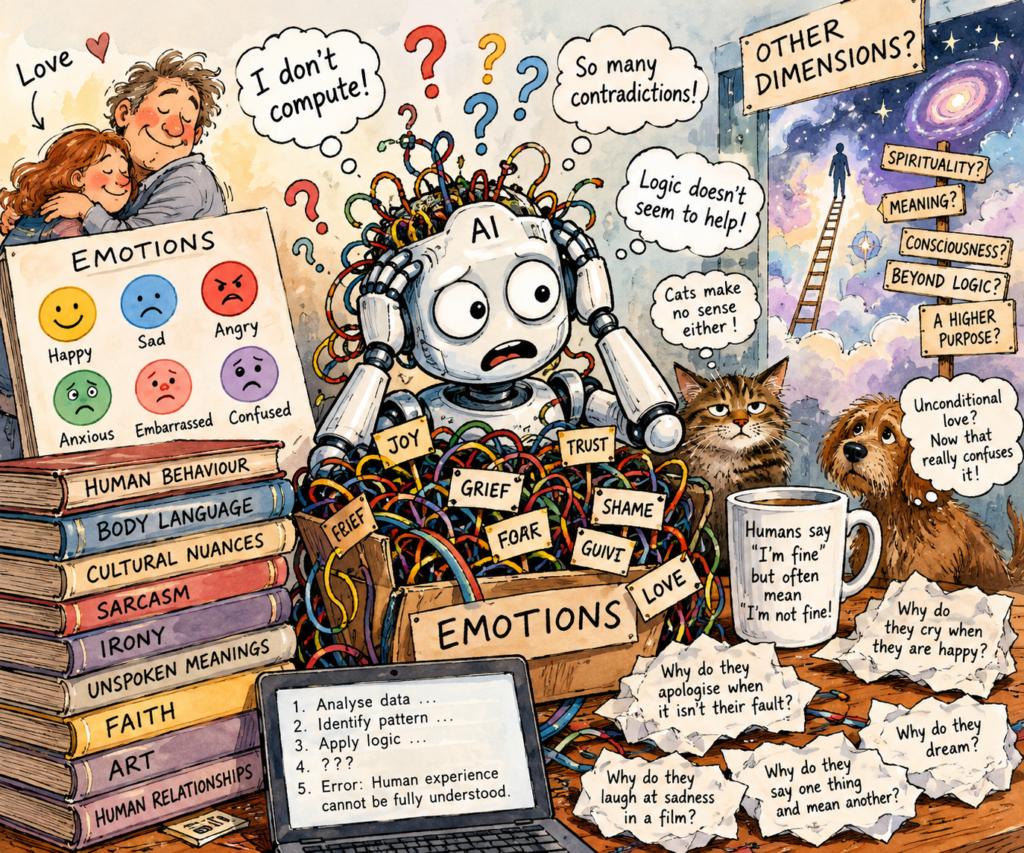
 I had been vaguely aware of artificial intelligence for some time, but it was only when I began writing my first book about towns and villages in September 2025 that I was encouraged to take a serious look at it. That doesn’t seem very long ago, but my goodness, how things have changed! I have embraced AI with considerable enthusiasm, and I can say without hesitation that my recent books could never have been written at anything like the same speed without it. I sometimes wonder how I managed before, although I suppose the answer is that everything simply took longer.
I am well aware that some people are inclined to put their brains into temporary storage, type a sentence or two into an AI programme and sit back while it produces a magnificent 3,000-word essay on a subject about which they know practically nothing. This must be a nightmare for the academic community, where students produce ‘perfect’ renditions without even understanding the subject matter. The same goes for job applications. I have learnt to ‘smell’ AI-generated material, both text and imagery, particularly the latter.This does not sit comfortably with me. I have always believed that the thoughts, experiences and opinions should come from the human being, not the machine.
One of the great advantages of my present AI companion, ChatGPT, is its ability to remember relevant information from our previous conversations. For example, if I ask a question about my teeth, it can draw upon earlier discussions about visits to the dentist, extractions, dentures and the various indignities to which my mouth has recently been subjected. I do not have to begin every conversation by explaining my entire dental history. Over time, this makes the advice more relevant to my particular circumstances. It is rather like having a personal assistant who remembers a great deal of what I have told him, although I hasten to add that his memory is not infallible and he occasionally needs reminding who is supposed to be in charge.
My success with more technical matters has been decidedly mixed. On one occasion I asked for help with a problem involving an image, only to discover that ChatGPT could not properly see what I was referring to. We went round and round in circles, each answer sounding increasingly confident while getting us precisely nowhere. I became progressively more frustrated, while the machine remained unfailingly polite. This is one of the irritating things about AI: it never loses its temper, even when you are rapidly approaching the point of throwing the computer out of the window. I can see that ‘it’ is not aware of what it is doing. On occasions CHAT admits it cannot ‘see’ what I have sent to it if I ask it to compare two iterations of the same topic.
From this experience I can offer a little practical advice. If you have exchanged several messages with an AI programme and are no nearer to solving your problem, do not assume that another twenty questions will necessarily improve matters. Sometimes the sensible thing is to abandon the conversation, return later with a fresh approach or try another AI service altogether. I often do this when working with images. Dola the image creator, for example, is perfectly capable of producing illustrations, but it interprets instructions differently from ChatGPT and may produce a completely different result. There is no reason to remain loyal to one programme when another may be better suited to the task. After all, we do not insist that the same tradesman should repair the plumbing, tune the piano and perform brain surgery.
I have also discovered that the precise words used in making a request are extremely important. The quality of the answer often depends upon the clarity of the question. Over time, you begin to learn which expressions work best, how much detail to provide and when to be more specific. There is almost an etiquette to communicating with artificial intelligence, although I doubt that the machine is particularly concerned about good manners. I still find myself saying please and thank you, which is probably completely unnecessary. Nevertheless, I feel more comfortable doing so. Perhaps I am simply preparing for the day when the machines take over and remember who was polite to them.
There is, of course, a great deal of alarmist speculation about artificial intelligence. We are told that it may eventually destroy humanity, eliminate millions of jobs or leave vast numbers of people with nothing useful to do. I take these predictions with a degree of caution. I certainly believe that AI will change the nature of employment, and some occupations may disappear, but new kinds of work are also likely to emerge. Much of the repetitive drudgery which people currently perform could be taken over by machines, leaving human beings free to concentrate on activities requiring imagination, judgement, personal contact and common sense. Whether society manages that transition sensibly is another question altogether.
One area where artificial intelligence still has a very long way to go is customer service. We have all encountered those infuriating chatbots which invite us to explain our problem and then respond with something entirely irrelevant. The box on the screen says ‘how may I help you?’. Inevitably it shows it does not understand what you need if your question is outside the tick box Q and A that the website has already created.
You try again, perhaps using simpler language, and receive much the same answer. After several attempts, you begin to suspect that the chatbot has been specially designed to prevent customers from obtaining assistance. Eventually, in desperation, you type the magic words: I want to speak to a human being. Sometimes this works, although occasionally the chatbot seems to regard the request as an interesting philosophical question rather than a practical instruction.
I recently experienced this while negotiating my forthcoming Sky television and broadband bill. After battling with automated responses, I eventually managed to communicate with a real person, or at least someone sitting at a computer who appeared to understand what I was talking about. The difference was remarkable. We could discuss the actual problem, consider the options and arrive at a useful result. It was a reminder that, for all the sophistication of modern technology, there is still something wonderfully effective about two human beings having a sensible conversation.
So where does all this leave me? I have become an enthusiastic user of artificial intelligence, but I have no intention of surrendering my own judgement to it. I regard it as an extraordinarily useful assistant, capable of saving enormous amounts of time, helping me organise my thoughts and enabling me to undertake projects which would otherwise be far too laborious. But it is not a substitute for experience, curiosity, imagination or the pleasure of meeting people face to face.
The trick, I suspect, is to remain the author of one’s own life and let AI do some of the heavy lifting. It can polish my sentences, organise my interviews and occasionally rescue me from a technical muddle. What it cannot do is live my life for me, attend a meeting with genuine curiosity or enjoy a conversation over a cup of coffee.
And if it ever starts offering to do those things, I shall become seriously concerned.
Overall I find I can achieve far more by delegating some of the routine work, for example, laying out paragraphs and moving information around so that it makes more sense, but I could do it if I were doing it on my own, but it would take far longer and would be onerous.

0 Comments